ChatGPT reached 100 million monthly active users about two months after launch, according to Reuters. That growth triggered a flood of AI stock picks generated by prompts, but a fast list is not the same as a sound portfolio. This chatgpt investment portfolio review gives you a practical test you can run on any AI-themed basket: check real AI-linked revenue, check valuation, check concentration risk, then compare performance against a plain benchmark like the S&P 500.
You will learn how to verify each company claim with its own SEC filings, how to flag position sizes that break basic diversification rules, and how to judge whether returns beat a low-cost baseline such as the Vanguard S&P 500 ETF (VOO). By the end, you can separate “AI hype picks” from holdings that can survive weak earnings, rate pressure, and normal market drawdowns. Start with the core question every review should answer: what does each pick actually add to risk-adjusted performance?
What should you check before trusting a ChatGPT investment portfolio review?
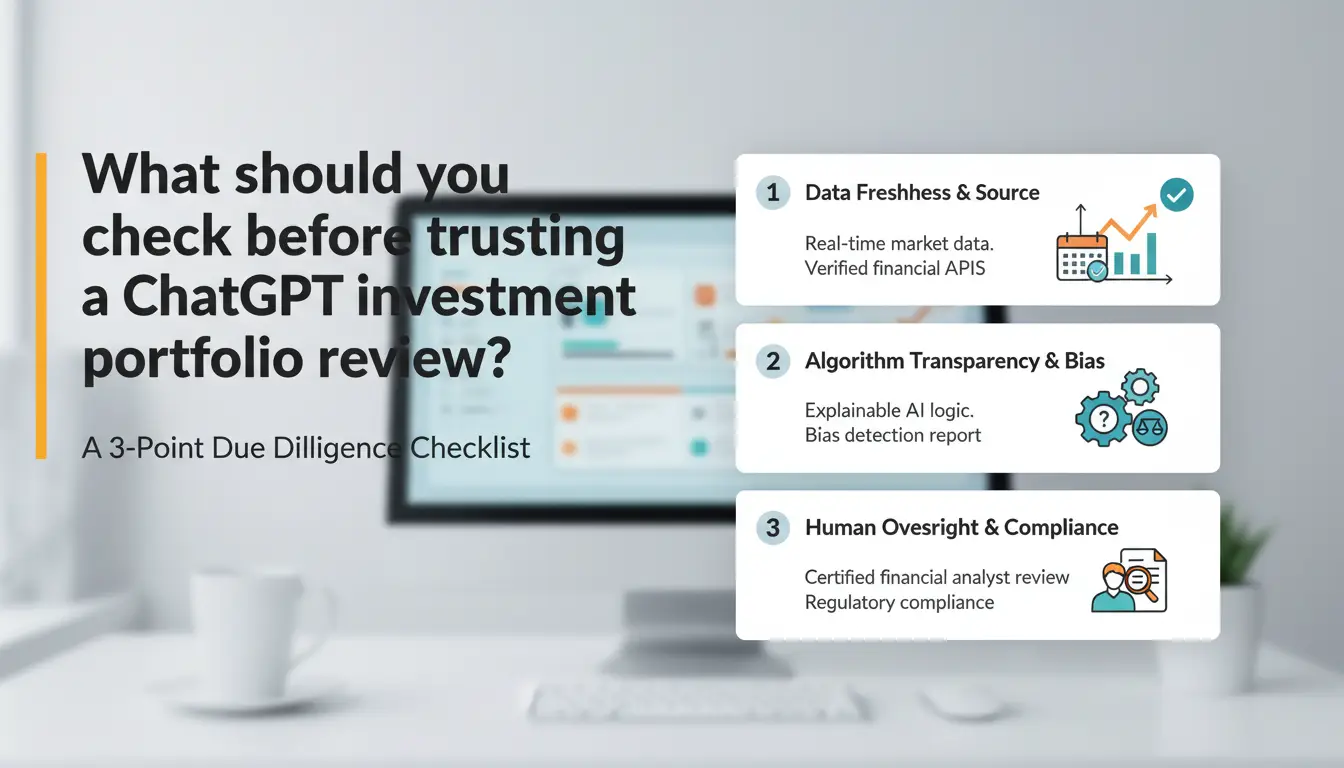
A solid chatgpt investment portfolio review should read like an audit trail, not a highlight reel. If you cannot reproduce the holdings, dates, and assumptions, treat performance claims as marketing copy.
Is the review using a real, testable portfolio or cherry-picked examples?
Ask for full holdings, exact weights, rebalance dates, and clear holding rules. If a review shows only winning picks, you cannot judge risk. You need losers, turnover, and cash handling too.
Use this quick screen:
| Check |
What credible evidence looks like |
Red flag |
| Holdings list |
100% of positions with weights totaling 100% |
Only top picks shown |
| Rebalance rules |
Dates and trigger logic stated |
“Adjusted as needed” |
| Loss reporting |
Drawdowns and closed losers included |
Winners only |
| Verification |
Tickers match SEC filings where relevant |
No source trail |
Are return claims based on the right timeframe and market regime?
A one-year run in a strong market proves little. Check results across up, down, and flat periods. Compare the same dates against a plain baseline like the S&P 500 or VOO.
Also check start and end dates. If the window begins right after a selloff and ends at a peak, returns can look inflated without better stock selection.
Does the review disclose assumptions, data source, and prompt method?
You should see the exact inputs: price source, fundamental metrics, macro filters, and update schedule. Prompt transparency matters too. If the author cannot show the prompt and version used, you cannot replicate results.
For portfolio safety checks, confirm position sizing follows basic diversification rules. A chatgpt investment portfolio review is useful only when another person can rerun it and get close to the same outcome.
How do you judge whether ChatGPT portfolio picks are actually high quality?
A solid chatgpt investment portfolio review should test process, not stories. You want clear rules, stable position sizing, and updates tied to evidence from SEC filings or reported results.
Do the picks follow a clear strategy (value, momentum, quality, or mixed)?
Start by tagging each stock with one primary factor using plain definitions from MSCI factor indexes.
- Value: lower valuation vs peers
- Momentum: strong recent price trend
- Quality: stable earnings, strong balance sheet
- Mixed: a stated blend with fixed weights
If you cannot label each holding with one factor, treat the list as noise. You should also log strategy drift. If last month’s picks favored value and this month shifts to momentum, the model should state what changed (earnings trend, rates, or guidance), not just rotate names.
Are position sizes sensible for risk, not just return potential?
High-volatility names need smaller caps. A practical rule for retail reviews: set a max single-name weight and a max sector weight, then check every update against those limits and diversification basics.
| Check |
Good sign |
Red flag |
| Single-stock weight |
Stays under your cap each rebalance |
One stock grows far above cap without rule |
| Sector exposure |
Sector totals stay within limits |
Portfolio clusters in one theme |
| Volatility control |
Riskier names get smaller weights |
Same size for stable and unstable stocks |
Does the portfolio thesis stay coherent after new market data arrives?
Track each thesis in one line: “Why own it, what breaks it, what metric confirms it.” In your next chatgpt investment portfolio review, compare revisions against earnings, guidance, and valuation changes. If the thesis changes after every price move but ignores business data, you are seeing reactive guesswork. If updates follow preset triggers and still beat a plain baseline like VOO, quality is likely real.
How can you review risk in a ChatGPT portfolio like a professional investor?
A solid chatgpt investment portfolio review starts with one rule: rank downside risk before return. A portfolio that drops less in bad markets gives you better odds of staying invested and compounding.
Which risk metrics matter most for an AI portfolio review?
Use this checklist before you trust any headline gain:
| Metric |
What to check |
Red flag |
| Max drawdown |
Largest peak-to-trough loss |
Deeper drop than S&P 500 |
| Volatility |
How widely returns swing |
Large swings with no extra return |
| Sharpe / Sortino |
Return per unit of risk |
Low Sharpe ratio, weak downside-adjusted return |
| Downside capture |
Loss behavior in down markets |
Above 100 means it falls more than benchmark |
| Turnover |
How often holdings change |
Near or above 100% yearly |
| Liquidity |
Can you enter/exit without big slippage? |
Thin trading volume for position size |
What hidden risks are often missed in ChatGPT investment portfolios?
Check sector crowding. If top weights all sit in the same AI or mega-cap theme, one earnings miss can hit the full portfolio. Then check style drift. A portfolio sold as “balanced AI exposure” may quietly become a growth-only bet. Run a rolling correlation check and compare stress periods, such as spikes in the VIX Index. If correlations jump toward 1.0 during stress, diversification can fail when you need it.
How do stress tests reveal weak portfolio construction?
Run three scenario tests: rate shock, recession, and earnings miss cluster. Use past periods from Federal Reserve rate history and NBER recession dates. Track two outputs: peak loss and time to recover. If recovery takes too long after each shock, trim crowded names and rebalance position sizes. That turns a chatgpt investment portfolio review into a repeatable risk process.
How to run your own ChatGPT investment portfolio review step by step
Use this workflow every time you test AI stock ideas. The goal is simple: check if a pick improves return for the risk you take, compared with a plain index like the S&P 500 or VOO. A repeatable process keeps your chatgpt investment portfolio review consistent across market cycles.
Step 1: Define your review rules before generating any AI picks
Write your rules in one page before you open ChatGPT. Set your stock universe (for example, US large cap only), max position size (such as 5%), sector cap (such as 25%), rebalance timing (monthly or quarterly), and benchmark.
Add pass/fail checks. Example: reject any portfolio with fewer than 15 holdings, or with one stock above your max weight. This aligns with basic diversification guidance.
If rules change after you see picks, your test is biased.
Step 2: Prompt ChatGPT with structured inputs and constraints
Use a fixed prompt template so each run is comparable. Ask for: ticker, thesis in one sentence, risk score (1-5), confidence score (1-5), expected holding period, and top downside trigger.
Require output in CSV or JSON so you can backtest cleanly. Also require one evidence link per pick, then verify facts in SEC EDGAR filings for earnings, debt, and guidance language. If a claim cannot be verified, mark that pick “unproven” and exclude it from the test set.
Step 3: Backtest, paper trade, and compare out-of-sample results
Run two phases: historical backtest (in-sample) and paper trade (out-of-sample). Keep fees, slippage, and taxes on in both phases.
| Test phase |
Time window |
Purpose |
Pass signal |
| In-sample backtest |
Past data |
Check rule logic |
Beats benchmark after fees |
| Out-of-sample paper trade |
Forward period |
Check real behavior |
Similar risk/return profile |
If out-of-sample results break from backtest results, treat it as model drift, not bad luck. That single check makes your chatgpt investment portfolio review hard to fool.
Why do many ChatGPT portfolio reviews look good on paper but fail in practice?
A chatgpt investment portfolio review can look strong if the test setup is weak. Paper tests fail in live markets when they use future data, skip failed stocks, or ignore trading frictions. If a model can “know” tomorrow’s earnings, or if it keeps only survivors, returns get inflated before the first trade. Always compare results to a plain benchmark like the S&P 500.
Data leakage, hindsight prompts, and survivorship bias
Leakage starts when prompts include facts not available at the decision date. A common mistake is using full-year numbers before they appear in SEC filings. Hindsight prompts do the same thing in plain language. Survivorship bias adds another error: tests that include only currently listed firms drop delisted and bankrupt names. Use timestamped inputs and a survivorship-free dataset.
Ignoring implementation costs and execution limits
Backtests often assume perfect order fills. Live trading pays spread, fees, and slippage. Small-cap names can move while your order is still filling, so your actual entry price is worse.
| Model setting |
Paper test |
Live-safe assumption |
| Commission |
$0 |
Broker fee schedule |
| Spread |
0 bps |
Recent bid-ask spread |
| Fill price |
Midpoint |
Worse side of spread |
| Order size |
Unlimited |
% of average daily volume |
Overtrading from frequent prompt updates
Daily prompt rewrites create churn. Churn raises costs and can erase edge. Set rebalance bands, like trading only when a position drifts 5% from target, then review weekly or monthly. In a chatgpt investment portfolio review, stable rules usually hold up better than constant rewrites, and they are easier to audit against a low-cost baseline like VOO.
How should you compare a ChatGPT portfolio against index funds or human advisors?
Use this chatgpt investment portfolio review process to compare AI picks, index funds, and advisors on equal terms. Judge net outcome after risk, fees, and trading costs, not just top-line return.
What is the right benchmark for your strategy type?
Match style before you claim outperformance. If a portfolio holds large US stocks, compare it to the S&P 500 or VOO, not a bond index. If the portfolio mixes factors, use a blended benchmark that mirrors its stock, sector, and cash mix.
| Portfolio type |
Fair benchmark |
What to check |
| US large-cap growth |
S&P 500 / VOO |
Return gap after fees |
| Multi-factor equity |
Blended equity index mix |
Style drift and turnover |
| Advisor-led balanced |
Equity + bond blend |
Drawdown control |
How to compare risk-adjusted returns instead of raw gains
Raw gain can hide weak risk control. Track max drawdown, time to recover, and rolling 12-month results. A simple check: if returns beat VOO only during one short window, treat that as noise. In a chatgpt investment portfolio review, consistency across market drops is the harder test.
When does AI-assisted research outperform a fully automated AI portfolio?
Use ChatGPT for idea generation, earnings-question checklists, and scenario stress tests. Verify claims in SEC filings and run position-size checks against diversification rules. Keep final allocations under a written policy: target weights, rebalance bands, and sell rules. This keeps AI output useful without handing it full control.
How can teams review portfolios with one ChatGPT account without creating access or security risks?
What risks appear when multiple analysts share one ChatGPT login?
In a team setting, one shared login can break fast. Two people can overwrite each other’s prompts, lose context, or trigger unusual sign-in behavior that leads to a lockout. Shared passwords create blind spots: no one can prove who exported data, changed a prompt, or approved a risky output. For a clean chatgpt investment portfolio review, you need stable sessions, clear ownership, and traceable actions. This also helps you stay aligned with OpenAI Terms of Use and internal audit rules.
How DICloak reduces team access risk during portfolio review workflows
You can use DICloak to route team access through controlled browser profiles instead of passing raw credentials in chat. Set profile-level permissions, bind each profile to a fixed proxy, and keep operation logs for review. That setup reduces random login jumps, lowers accidental sign-outs, and gives managers a clear action trail by person and time.
How to set up a clean team process for prompt versioning and review history
Use this role split for chatgpt investment portfolio review:
| Role |
Access |
Task |
| Researcher |
Prompt only |
Draft analysis |
| Reviewer |
Prompt + comment |
Check assumptions |
| Approver |
Final send/export |
Sign off decision |
Store prompt templates and keep logs tied to each role. Reviewers can then reproduce outputs and spot drift before decisions go live.
When is a ChatGPT investment portfolio review useful, and when should you avoid it?
A chatgpt investment portfolio review works as a fast analyst, not a final decision-maker. Use it to speed reading, compare assumptions, and stress-test ideas against a baseline like VOO. Then verify company claims in SEC EDGAR.
Best use cases: research acceleration, screening, and scenario planning
Use AI to scan filings, summarize earnings calls, and flag outlier position sizes. It works well for hypothesis tests like rate shocks or margin drops. It is weak for automatic trade execution.
| Good fit |
Bad fit |
| Faster research, broader screening, scenario planning |
Prompt-to-trade automation without human approval |
Weak use cases: blind trust, opaque logic, and no governance
Avoid trades from unverified prompts or undocumented assumptions. If logic is not traceable, risk is not traceable. Regulated teams should check FINRA suitability guidance.
Shared credentials can also break audit trails. Tools like DICloak let you map team roles to isolated browser profiles, apply permission control, and keep operation logs for prompt and assumption changes.
A practical decision checklist before allocating real capital
For any chatgpt investment portfolio review, confirm reproducible prompts, position limits, benchmark context, and implementation costs. You can use DICloak with dedicated proxy configuration per profile so researcher and reviewer activity stays separated and auditable. Start with paper trading, then stage real capital.
Frequently Asked Questions
Is a chatgpt investment portfolio review reliable enough for real-money decisions?
A chatgpt investment portfolio review is useful only when the process is testable. Use clear rules for inputs, position sizing, stop-loss limits, and rebalancing. Then check results on out-of-sample periods, not the same data used to design prompts. Treat AI output as a draft. Final trades need human approval and risk checks.
How often should I update a chatgpt investment portfolio review?
Update a chatgpt investment portfolio review on a schedule, not every market headline. For long-term index or ETF portfolios, a quarterly review is usually enough. For factor or tactical strategies, use monthly reviews. Add event-based checks for major life changes, cash needs, or policy shifts. Scheduled cycles reduce emotional, prompt-driven overtrading.
Can a chatgpt investment portfolio review be used for long-term investing?
Yes. A chatgpt investment portfolio review can support long-term investing by summarizing earnings trends, valuation changes, and portfolio drift before rebalancing. Keep the core plan anchored to target asset allocation, contribution rate, and tax location rules. Review annually or semiannually with a human advisor or accountable decision-maker to keep behavior and risk aligned.
What tools should I pair with a chatgpt investment portfolio review for better accuracy?
Pair ChatGPT with trusted price and fundamentals feeds, a backtesting platform, and a risk dashboard. For example, test suggested allocations across bull and bear periods, then check drawdown, volatility, and correlation by holding. This workflow turns a chatgpt investment portfolio review from a text opinion into a measurable process with repeatable checks.
Is there any compliance risk when sharing access during a chatgpt investment portfolio review process?
Yes. Compliance risk rises when teams share models, prompts, and account links during a chatgpt investment portfolio review. Protect client and trading data with encrypted storage, role-based permissions, and least-privilege access. Keep audit logs of prompt history, model outputs, and final approvals. Set review policies so only authorized staff can move from analysis to trade execution.
A ChatGPT investment portfolio review works best as a decision-support tool, helping you spot allocation gaps, risk concentration, and rebalancing opportunities faster. The strongest results come from combining AI-generated insights with your own goals, time horizon, and a final check from reliable market data or a qualified advisor.
Try DICloak For Free
 Web Proxy Tools
 Free Tools
 Cookie Plugin
 UA Generator
 MAC Address Generator
 IP Generator
 IP Address List
 2FA Code Generator
 World Clock
 Anonymous Check
 WebRTC Leak Test
 UUID Generator
 Free Web Proxy Site
 Proxy Checker
 FB Ad Checker
 AI Web Scraping
 Free SMM Tools
 Twitter Shadowban Checker
 Instagram Name Checker
 UTM Generator
 Username Generator
 AI Hashtag Generator
 LinkedIn Headline Generator
 Social Media Image Resizer