Maintaining a resilient digital infrastructure on Amazon is a high-stakes requirement for modern sellers and dropshippers. When the "Amazon Fraud Detector", a black-box AI heuristic engine, triggers an account freeze, the resulting downtime can lead to catastrophic brand erosion and financial stagnation. This guide provides a technical breakdown of risk vectors and a roadmap for systematic account restoration.
Understanding the Mechanism: Why the Amazon Account Locked Trigger Occurs
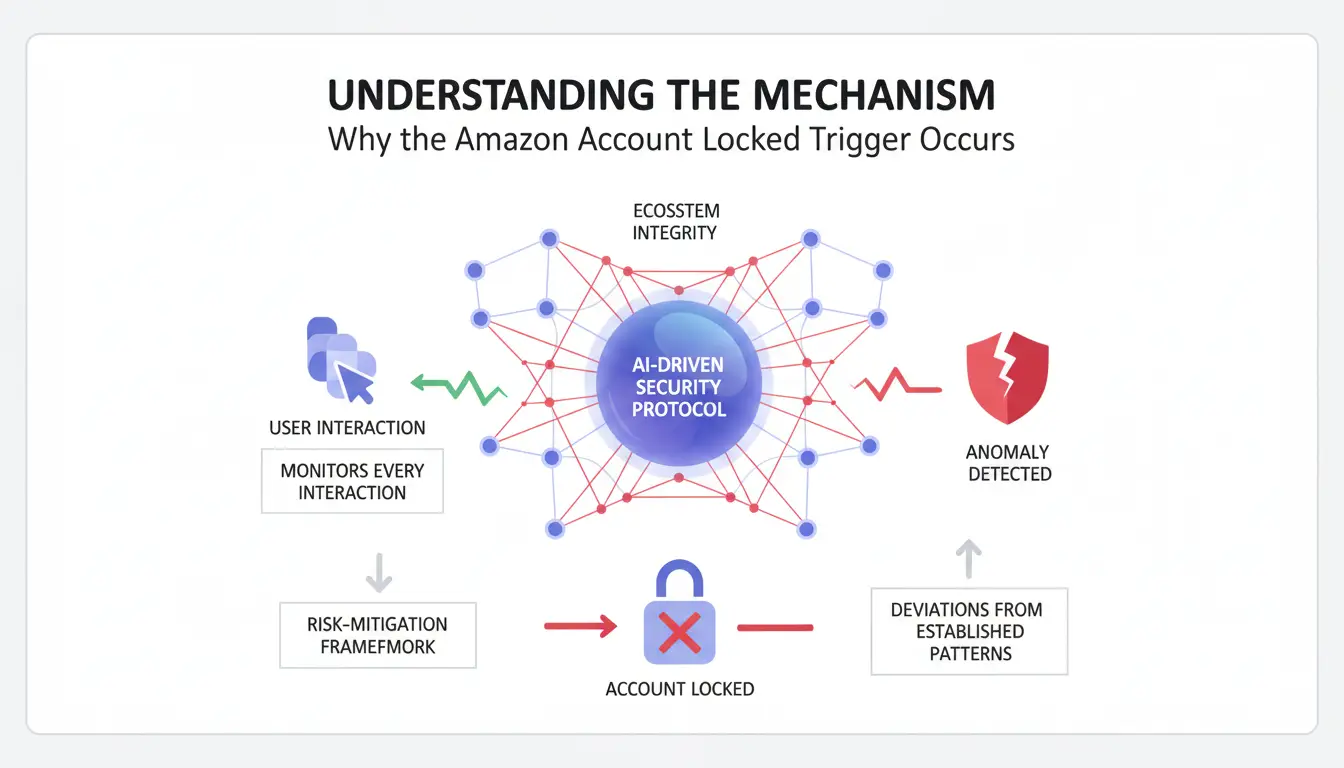
Amazon’s security architecture functions through an automated, AI-driven protocol designed to prioritize ecosystem integrity over individual user convenience. This "magical weapon" is essentially a risk-mitigation framework that monitors every interaction for anomalies that deviate from established behavioral baselines.
The core objective is the prevention of unauthorized transactions and the detection of sophisticated financial crimes, such as money laundering. From a cybersecurity perspective, Amazon treats any account deviation as a potential compromise. When the system detects a high-risk signature, it immediately initiates a lockout to protect its financial liabilities, requiring the user to clear "Know Your Customer" (KYC) hurdles to prove legitimacy.
Primary Behavioral Triggers Leading to an Amazon Account Locked Status
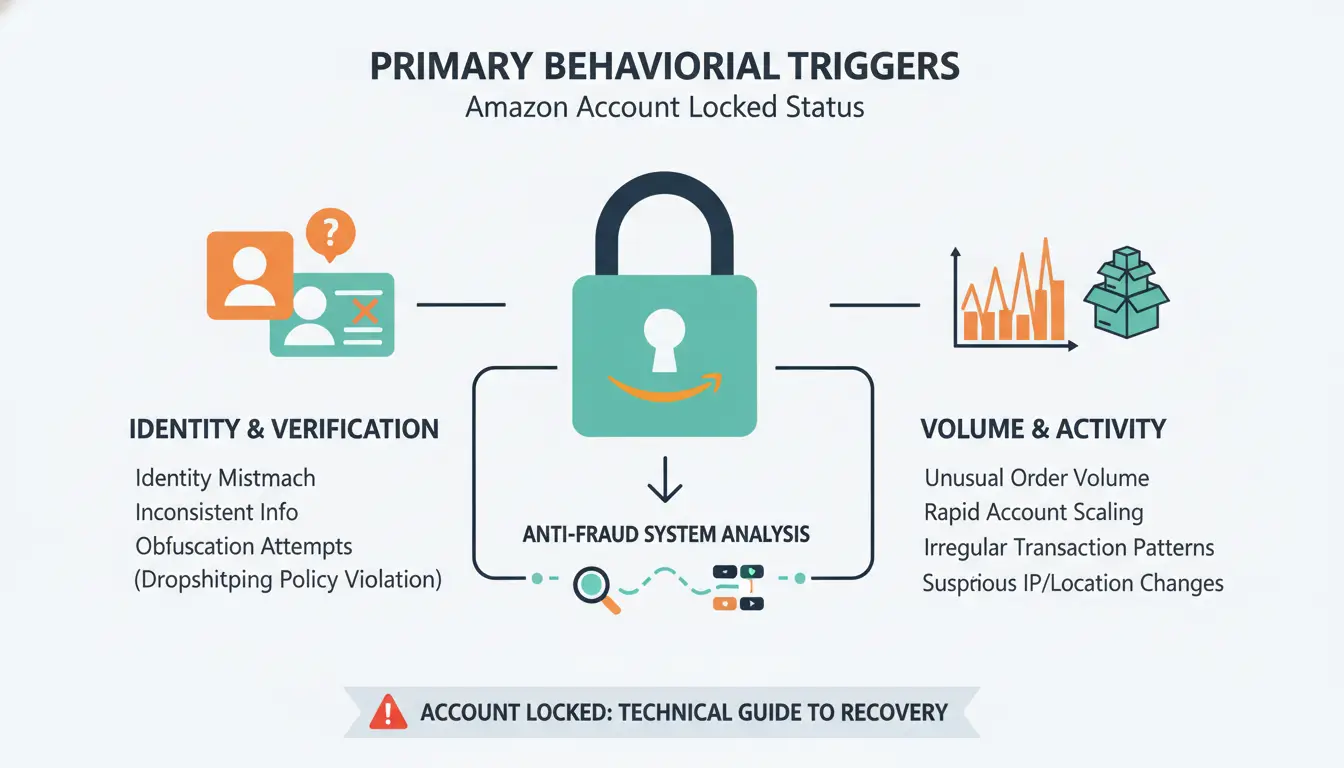
The anti-fraud system analyzes account data through various filters, specifically looking for inconsistencies in identity and volume.
Verification Protocols and Identity Mismatch
Amazon permits dropshipping within strict policy boundaries, yet many practitioners attempt to obfuscate their identity using placeholder data. Any discrepancy between the provided account details and the financial records attached to the payment method creates an immediate KYC flag.
For instance, a seller registers a new account using the name "Premium Goods Logistics" for the shipping profile but provides a personal credit card under the name "Robert Smith." This mismatch triggers a verification protocol because the digital identity does not align with the financial instrument.
Return Rate Heuristics and Financial Integrity
Amazon meticulously tracks the ratio of successful transactions against returns. High return rates represent a direct financial loss to Amazon in shipping overhead and signal a "bad actor" profile or a low-quality operation that threatens platform stability.
For example, a user returns 4 out of their first 10 orders within 30 days. This 40% return rate significantly exceeds the industry baseline of 1–2%, marking the account as a high-risk consumer profile and triggering an automated lockout for manual review.
Order Velocity Triggers for New Account Profiles
Order volume scaling must be handled with extreme care during the "seasoning" phase of a new account. Rapid spikes in volume are interpreted as "velocity triggers" typical of fraudulent bot activity or compromised accounts.
For instance, a newbie account attempts to place 55 orders on its second day of operation. This aggressive scaling signals the anti-fraud system to lock the account. A safe infrastructure deployment would limit volume to 5–10 orders daily, gradually scaling to 25–30 orders only after a baseline of trust is established.
Financial Risk Factors: Gift Cards and Transactional Flags in an Amazon Account Locked Context
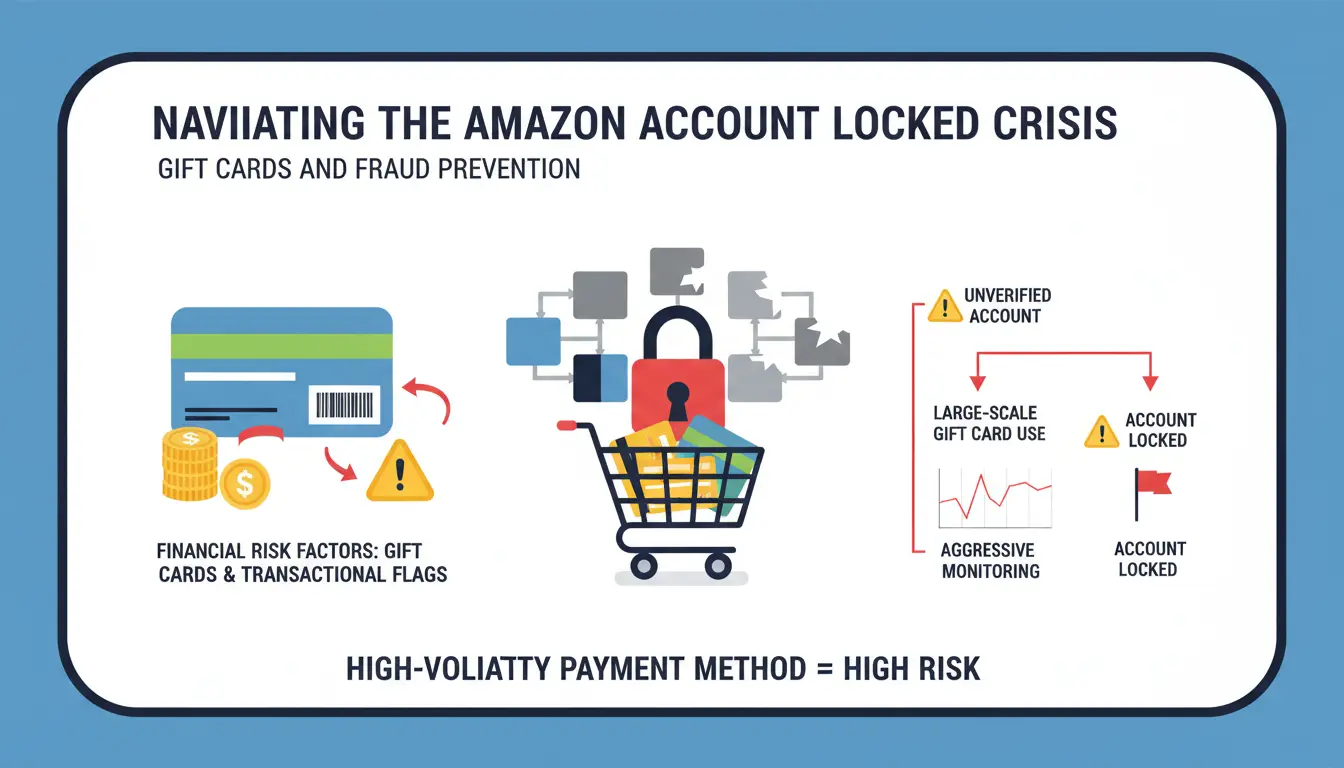
Gift cards are a high-volatility payment method frequently used in money laundering schemes. Consequently, Amazon’s security system applies aggressive monitoring to any account heavily reliant on them.
Immediate, large-scale Gift Card utilization on unverified accounts is a primary risk vector. Because the platform has no established trust history for the user, high-value Gift Card transactions suggest potential fraud.
Pro-Tip: To build account longevity and minimize risk, limit Gift Card transactions to under $200 per day. Maintain this threshold until the account has a proven track record of successful, non-contested deliveries.
How Amazon Account Locked Triggers Link to Network Identity
Amazon’s detection capabilities extend beyond simple user data into the realm of network forensics and device fingerprinting.
Network Isolation and the Logic of Proxy Management
Signing in from multiple locations or inconsistent IP addresses provides an immediate alert to the Fraud Detector. The system assumes a session hijacking or account theft has occurred.
Technical Distinction: Practitioners must distinguish between general network connection tools and Proxy Management. General network connection tools often utilize "datacenter IPs" which are shared and easily blacklisted. High-quality Proxy Management utilizes "residential IPs" to mimic authentic user behavior from a consistent, geolocated source, ensuring network isolation.
Device Fingerprinting and Digital Parameter Analysis
Amazon employs advanced device fingerprinting to identify users attempting to bypass previous bans or link multiple accounts. This involves analyzing digital parameters such as browser headers, WebGL settings, canvas fingerprinting, and hardware IDs. If these parameters shift unexpectedly, or if they match a previously banned profile, the account is flagged for review.
Immediate Solutions for an Amazon Account Locked Situation
Recovery requires a clinical approach to documentation and a persistent communication strategy. The standard review window is 24 to 48 hours following submission.
KYC Verification and Required Documentation
Upon lockout, check the registered email for a message from an account specialist. You will be required to submit high-integrity documentation to verify your identity.
- Account Serial Number: Provide the unique account identifier (found in your account settings or original registration emails).
- Proof of Address: High-resolution scans of utility bills (electricity or water) that match the default shipping address.
- Financial Records: Gift Card receipts (if applicable) and bank statements for the linked debit/credit card that clearly show the matching billing address.
Persistent Direct Communication via Phone Support
Direct verbal communication is often the most efficient way to bypass automated responses.
- USA/Canada: 1-888-280-4331
- International: 1-206-266-2992
Adopt an "insistent and persistent" mindset. If the initial representative cannot assist, politely request to speak with a Tier 2 Account Specialist or an Account Supervisor who has the authority to review internal fraud flags.
Strategic Live Chat via Alternative Active Accounts
1. Navigate to the "Something Else" menu on the Help page.
2. Select "I Need More Help."
3. Choose "Start chatting now."
4. Type "Talk to a representative" to force the automated bot to escalate to a human agent.
Strategic Infrastructure: Preventing the Amazon Account Locked Flag
A defensive infrastructure is the best protection against business interruption.
Reducing Prime Scrutiny in Dropshipping
Amazon Prime is heavily regulated because Amazon subsidizes the shipping costs. For high-volume dropshipping, avoid Prime services. Overusing free shipping for commercial resale is a high-frequency trigger for account lockdowns.
Account Seasoning and Financial Exposure Mitigation
Implement a "defensive strategy" by initially purchasing low-cost items. This builds a legitimate transactional history (seasoning) without putting significant capital at risk. If an account is locked during this phase, the financial impact of "stuck" funds is minimized.
Implementing Multi-Account Isolation
To mitigate the risk of a total business shutdown, do not centralize your operations. Distributing your volume across multiple, isolated accounts ensures that a single lockout does not result in a total loss of revenue.
Advanced Mitigation: Using DICloak for Digital Environment Management
DICloak is a specialized tool designed to manage the digital parameters of multiple Amazon profiles, reducing the risk of the "linkage" that leads to chain-reaction bans.
Technical Parameters and Fingerprint Isolation
DICloak provides a controlled environment for each account by isolating the digital fingerprint. It allows users to modify hardware IDs and browser signals for each profile. This makes that even if one account is flagged, the other accounts remain invisible to the anti-fraud system's cross-referencing logic.
Technical Comparison of Account Management Methodologies
| Feature |
Standard Browsing (High Risk) |
DICloak Isolation (Risk Mitigated) |
| IP Consistency |
Inconsistent/Datacenter IPs |
Enhanced through user-configured residential proxy integration |
| Device Fingerprint |
Static; easily linked via Canvas/WebGL |
Isolated and customizable per profile |
| Account Association |
High risk of chain-reaction bans |
Profiles are technically separated |
| Recovery Complexity |
Manual submission via flagged IP |
Clean environment for verification |
Objective Evaluation: DICloak Pros and Cons
Pros:
- Efficient Infrastructure: Centralized management of diverse credentials and profiles.
- Risk Mitigation: Reduces the risk of Amazon from linking multiple accounts to a single hardware signature.
- Parameter Customization: Precise control over the browser headers and digital signals sent to Amazon.
Cons:
- Technical Learning Curve: Setup requires an understanding of digital environments.
- Proxy Dependency: System reliability is contingent upon the quality of the external residential proxies used.
Frequently Asked Questions regarding Amazon Account Locked States
Can I use certain network anonymity tools to unlock my account?
General network connection tools are generally ineffective and can cause further instability due to their use of shared datacenter IPs. For security and recovery, it is superior to use dedicated Proxy Management and Network Isolation to maintain a consistent, residential IP footprint.
What is the fastest way to talk to a human specialist?
The most direct path is calling 1-888-280-4331 (USA) or 1-206-266-2992 (International). Be prepared to escalate to a supervisor or Tier 2 specialist to discuss internal fraud flags.
How long does the verification review usually take?
The standard review window for submitted documentation is 24 to 48 hours. During this period, avoid making redundant changes to the account, as this can reset the review timer or trigger further suspicion.
 Web Proxy Tools
 Free Tools
 Cookie Plugin
 UA Generator
 MAC Address Generator
 IP Generator
 IP Address List
 2FA Code Generator
 World Clock
 Anonymous Check
 WebRTC Leak Test
 UUID Generator
 Free Web Proxy Site
 Proxy Checker
 FB Ad Checker
 AI Web Scraping
 Free SMM Tools
 Twitter Shadowban Checker
 Instagram Name Checker
 UTM Generator
 Username Generator
 AI Hashtag Generator
 LinkedIn Headline Generator
 Social Media Image Resizer