Australian startups often run with small teams, limited time, and a growing list of things that need to get done. As the customer base grows, routine work can quickly become a bigger part of everyone's day.
This is one reason interest in AI agent development in Australia is growing. Startups with an existing product are looking for practical ways to handle routine work, improve customer service and make better use of the systems they already have.
AI agents can help with tasks such as answering common questions, checking leads, finding information, updating records and moving work between different tools. The starting point, however, should not be the technology. It should be a problem that is already costing the business time or creating unnecessary friction.
For an Australian startup, the better question is simple: what task could be made easier, faster or less dependent on manual effort?
What Is an AI Agent and How Can It Help Australian Startups?
An AI agent can understand a request, find relevant information, and carry out actions based on the task it has been given. This makes it different from a basic chatbot, which generally focuses on answering questions.
For Australian startups, AI agent development services can turn this capability into useful workflows that work with existing products and business systems.
An agent may be able to:
- Understand a customer or employee request
- Find information from approved systems
- Follow defined rules and instructions
- Perform actions through connected tools
- Hand a task to a person when it needs human judgement
A simple example could be:
Customer enquiry → understand request → check CRM → find information → respond or take action → update record → notify team
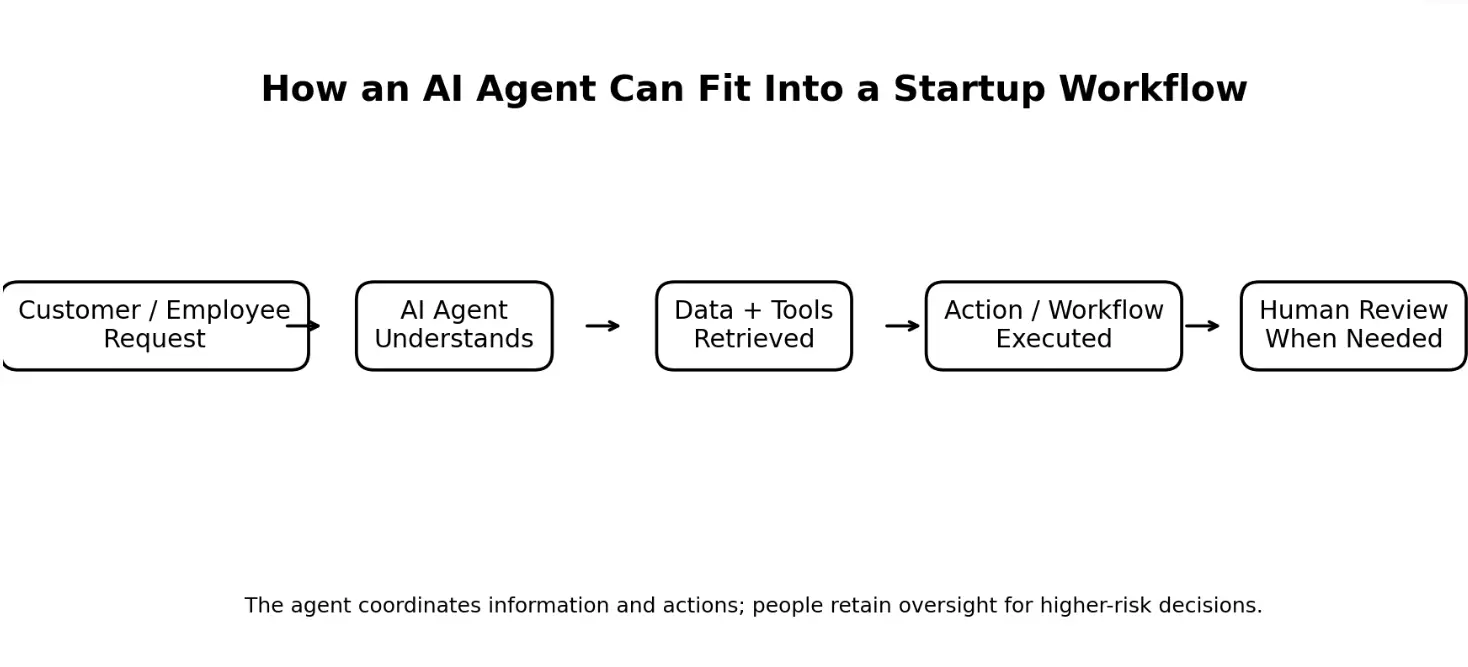
This approach can work well for repetitive processes, particularly when several systems are involved. Startups also need to consider access controls, privacy, security, and human review when introducing agents into business processes.
Business Problems AI Agents Can Solve for Aussie Startups
| Business problem |
How an AI agent helps |
Possible result |
| Repetitive manual work |
Handles routine steps |
More time for the team |
| Growing support requests |
Answers common questions |
Faster responses |
| Manual lead qualification |
Sorts and checks enquiries |
Better sales focus |
| Scattered information |
Finds approved information |
Less time searching |
| Lengthy onboarding |
Guides customers through steps |
Smoother onboarding |
| Disconnected workflows |
Coordinates tasks between tools |
Fewer manual handovers |
| Limited product intelligence |
Adds useful in-product help |
Better user experience |
| Time-consuming reporting |
Collects and organises information |
Less reporting work |
1. Repetitive Manual Work Takes Time Away From More Important Tasks
Startup teams often spend part of their day on small jobs that have to be done but do not directly move the business forward. These might include updating CRM records, sorting support tickets, copying information between systems, or preparing regular reports.
This is where AI workflow automation services in Australia can help, allowing startups to automate selected parts of these processes while keeping people involved where needed.
For example, a SaaS startup could have an agent review a new support request, identify the type of issue, find the relevant documentation, and create a ticket if a support specialist needs to step in.
The aim is not to remove people from the process. It is to reduce the amount of routine work they have to deal with.
2. Customer Support Gets Harder to Manage as the Customer Base Grows
More customers usually means more questions. Account setup, billing, product features, integrations, and common troubleshooting issues can take up a lot of support time.
An AI support agent can handle straightforward questions using approved information. It can also collect details about an issue before sending it to a support team member.
For example, if a customer wants to connect a reporting platform, the agent can explain the required steps and point them to the relevant documentation. If the issue is more complicated, they can pass the conversation to a person.
This gives startups a way to deal with simple requests without making customers wait for every answer.
3. Sales Teams Can Spend Too Much Time Checking Leads
Founders and small sales teams often have to review enquiries themselves. They may need to check the company, industry, requirements, buying interest, and whether the lead fits their target customer profile.
An AI sales agent can help with the first round of checking. It can pull useful details from an enquiry, sort leads into categories and apply qualification rules set by the business.
The sales team can then spend more time on leads that need a personal conversation.
For important accounts and commercial decisions, human review should remain part of the process.
4. Finding Internal Information Becomes More Difficult as a Startup Grows
When a startup is small, people generally know where information is stored. As the company grows, useful information can end up across internal documents, CRM records, emails, wikis, and support platforms.
An internal knowledge agent can give employees a simpler way to find information.
For example, an employee could ask about the latest enterprise onboarding process and receive an answer based on the company's approved documentation.
Permissions still matter. Employees should only be able to access information they are allowed to see, even when that information exists in a connected system.
5. Customer Onboarding Can Become Time-Consuming
New customers may need help with account setup, configuration, integrations, and learning how to use key features.
An onboarding agent can guide users through the relevant steps and answer common questions along the way.
If a customer has missed an important setup step, for example, the agent can explain what needs to be completed and direct them to the next action.
For SaaS startups, this can sit alongside existing customer-success processes. Useful measures could include activation rate, time to first value or the number of support requests during onboarding.
6. Employees Often Become the Link Between Different Business Tools
Startups commonly use separate platforms for CRM, email, analytics, support and product management. When these systems do not connect properly, employees have to move information between them.
An agent can help coordinate a defined sequence of actions.
For example:
Website enquiry → CRM update → lead classification → follow-up task → team notification
This is where AI agent integration with business systems becomes useful. The agent needs to work with the existing setup, permissions, and business rules instead of becoming another isolated tool.
7. Existing Products May Need More Useful Intelligent Features
A startup with an established SaaS or digital product does not necessarily need to build a separate product to introduce new intelligent features.
Possible additions include smarter search, in-app assistance, document processing, recommendations, workflow support, and natural-language interfaces.
These capabilities can form part of AI & ML development services, depending on the product and its data.
For example, a PropTech platform could help users find property information, an HR platform could help employees locate relevant policies, and a SaaS product could provide guidance based on what a user is doing inside the application.
The customer problem should come first. Before development starts, the team should check whether the feature is useful, whether the necessary information is available, and how it will fit into the existing product.
8. Reporting and Data Collection Can Take Up Valuable Team Time
Before information can be used, someone often has to collect and organise it. This can become a regular burden for product, sales and management teams.
An agent can gather approved information from different systems and prepare it in a form that is easier for people to review.
A product team could use one to group customer feedback into common themes. A sales team could use it to summarise recent customer conversations and follow-up actions.
The agent can make information easier to work with, but important financial, legal, customer and strategic decisions should remain with the people responsible for them.
How Should Australian Startups Prioritise AI Agent Use Cases?
Not every repetitive task needs an agent. Before investing in AI agent development services in Australia, startups should first look at the problem itself.
Consider:
- Frequency: How often does the task happen?
- Business impact: How much time, money or customer effort does it involve?
- Data: Is reliable information available?
- Risk: Does the task need human approval or judgement?
- Integration: Which systems would need to be connected?
- Measurement: How will you know the new approach is working?
A task that happens every day and takes several hours across the team is likely to be a better starting point than an occasional task.
A Simple AI Agent Use-Case Framework for Australian Startups
Step 1: Find the Bottleneck
Choose a process that regularly causes delays, extra work, or customer frustration.
Step 2: Map the Current Process
Write down the steps, systems, information, and people involved from start to finish.
Step 3: Check the Fit
Look at the likely benefit, available data, integrations, risks, and effort involved.
Step 4: Start With One Use Case
Test one focused workflow before expanding the approach to other parts of the business.
When Should an Australian Startup Work With an AI Agent Development Company?
An Australian startup may benefit from an external partner when it knows the problem it wants to solve but needs additional development or integration expertise.
This can be useful when:
- The agent needs to work with an existing product
- Several APIs or business systems are involved
- The internal team has limited agent-development experience
- Security, permissions, and human handovers need to be considered
- The startup wants to test a use case before making a larger investment
The right AI agent development partner should understand the business process as well as the technology. The discussion should cover the workflow, data, integrations, user access, and how the result will be judged.
Turning Australian Startup Problems Into AI Agent Opportunities
AI agents can help Australian startups with support, sales qualification, onboarding, internal information, workflow coordination, reporting, and selected product features.
The best starting point is usually one specific problem rather than a broad plan to "add AI". Identify the process, understand how it works today, check what information and integrations are required, and decide where people should remain involved.
Once one use case proves useful, the startup can look at whether the same approach makes sense elsewhere.
For a company with an existing product, this keeps the work focused and helps avoid spending time on features that do not address a real business or customer need.
Questions Asked for AI Agent Development
1. What business problems can AI agents solve for Australian startups?
They can help with repetitive work, customer support, lead qualification, internal knowledge, onboarding, connected workflows, reporting and selected product features.
2. Are AI agents suitable for Australian startups?
They can be useful when a startup has a regular process that takes significant time or affects the customer experience. Starting with one focused use case is usually more practical.
3. How can Australian startups choose the right AI agent use case?
Look at the frequency of the problem, business impact, available data, risk, integrations and whether the result can be measured.
4. Can AI agents integrate with existing SaaS products?
Yes. Depending on the architecture, agents can work with APIs, CRMs, databases, support platforms and other connected systems.
5. What is involved in AI agent development in Australia?
It can include use-case planning, workflow mapping, development, integrations, testing, deployment and ongoing improvements.
6. Should an Australian startup build or outsource AI agent development?
The choice depends on internal skills, product complexity and available development capacity. External support can help when the project involves complex integrations or specialist development work.
 Web Proxy Tools
 Free Tools
 Cookie Plugin
 UA Generator
 MAC Address Generator
 IP Generator
 IP Address List
 2FA Code Generator
 World Clock
 Anonymous Check
 WebRTC Leak Test
 UUID Generator
 Free Web Proxy Site
 Proxy Checker
 FB Ad Checker
 AI Web Scraping
 Free SMM Tools
 Twitter Shadowban Checker
 Instagram Name Checker
 UTM Generator
 Username Generator
 AI Hashtag Generator
 LinkedIn Headline Generator
 Social Media Image Resizer