In the 2026 digital ecosystem, the friction between scaling operations and platform security has reached a critical inflection point. For practitioners involved in account farming, traffic arbitrage, and high-volume e-commerce, the primary obstacle is no longer just access to data, but the avoidance of behavioral heuristics and sophisticated detection algorithms. As platforms refine their IP trust scoring mechanisms, the necessity for robust network isolation has transitioned from a competitive advantage to a fundamental requirement for infrastructure survival. This guide explores how to integrate cost-effective network resources without compromising the integrity of your digital assets.
Understanding the Role of Network Isolation in Multi-Account Management
Modern security stacks rely heavily on IP reputation and fingerprint consistency to distinguish between legitimate human users and automated scripts. When multiple accounts originate from data center IP ranges, they are instantly categorized with a high risk score because these ranges are associated with server-side infrastructure rather than organic human activity. This often results in immediate "sybil" flags, where an entire cluster of accounts is terminated due to shared network entropy.
Residential IPs, however, are assigned by Internet Service Providers (ISPs) to genuine households. Utilizing these IPs allows traffic to blend into the noise of legitimate residential data, making it significantly harder for heuristic detection systems to isolate the traffic. True network isolation ensures that each digital identity remains siloed, preventing "fingerprint leakage" where the activities of one account inadvertently compromise another.
Pro-Tip: Practitioners must maintain absolute separation of network signatures. Mixing residential and datacenter proxies within a single campaign or account cluster creates an inconsistent network profile that triggers cross-platform detection, leading to rapid account termination.
Why a Cheap Residential Proxy is Essential for Account Longevity
In the context of 2026 infrastructure, a "cheap residential proxy" refers to a solution that provides an optimal performance-to-price ratio rather than simply the lowest market entry point. For high-stakes operations such as Social Media Marketing (SMM), Airdrop Farming, and Ticket Scalping, profitability is directly tied to minimizing the "condition of failure."
The condition of failure occurs when a platform executes a "checkpoint" (requesting identity verification) or a "shadowban" (silent restriction of reach). These events are frequently triggered by the use of static, blacklisted, or low-reputation IPs. By utilizing a scalable residential proxy network, operators can rotate identities or maintain persistent sessions with high trust scores, ensuring that the cost of the network resource remains a fraction of the cost required to replace or recover banned digital assets.
10 Reliable Providers for Finding a Cheap Residential Proxy
The following providers are recommended based on their current market positioning and reliability for professional growth operations:
- Nodemaven: Positioned as an optimal choice for startups and developer-focused teams requiring flexible integration for automation.
- SOAX: Recognized for maintaining high-reputation pools suitable for sensitive geo-targeted operations on restrictive platforms.
- Proxy-Cheap: A recommended entry-level option for practitioners initiating small-scale automation or geo-bypassing tasks.
- Oxylabs: A top-tier provider for large-scale e-commerce operations and high-volume data acquisition.
- Shifter: An efficient choice for continuous data collection where a constant flow of network identities is required.
- NetNut: Positioned for performance-focused practitioners who require high-speed ISP-grade network resources at scale.
- Proxyrack: Recommended for ad verification and multi-accounting where diverse session types are needed.
- IPRoyal: A simplified solution for solo marketers and boutique operations focusing on ease of access.
- Smartproxy: A scalable infrastructure choice for micro-agencies and social media automation workflows.
- PacketStream: An efficient peer-to-peer network model suitable for non-intensive tasks and general SEO operations.

Technical Mechanisms: How Cheap Residential Proxy Networks Evade Anti-Bot Systems
Successful identity management requires choosing between request-based rotation and session persistence. IP rotation—changing the IP for every request—is optimal for high-volume scraping to evade rate-limiting. Conversely, "sticky sessions" maintain a single IP for a defined duration (e.g., 20–30 minutes). This is vital for manual account management and SMM, as "geographic hopping" (changing IPs mid-session) is a primary indicator of automated account hijacking.
Bypassing Advanced Bot Protections
Modern bot protections use IP trust scoring to evaluate incoming traffic. By utilizing ISP-grade residential IPs, users can mimic the network signature of a real consumer. Because these IPs are tied to legitimate residential contracts, they bypass the initial "packet inspection" filters that typically flag data center traffic, allowing practitioners to operate within the same trust tier as organic users.
Geo-Targeting and Network Diversity
Global IP pools enable localized content verification and "geo-unlocking." This allows an operator in one region to manage accounts as if they were physically located in another, which is essential for accurate traffic arbitrage and regional market testing. Network diversity ensures that if one IP segment faces a temporary trust dip, the operator can shift to a different subnet without downtime.
Criteria for Evaluating a Cheap Residential Proxy Provider
Before committing to a provider, a senior analyst must evaluate the infrastructure based on the following metrics:
- IP Pool Cleanliness: The presence of blacklisted IPs is a direct threat to account longevity. High-quality providers cycle out burned IPs regularly.
- Session Consistency: The ability to maintain stable, persistent sessions without unexpected disconnects.
- Protocol Support: Compatibility with standard protocols (HTTP/HTTPS, SOCKS5) to ensure seamless integration with management software.
Professional operators should strictly avoid "free" proxies, which are often "honeypots" for data harvesting or are already heavily blacklisted. Instead, focus on "Pay-per-GB" models for precision tasks or flat-rate plans for high-bandwidth requirements to maintain predictable overhead.
Advanced Workflows: Integrating Network Isolation with Antidetect Browsers
A high-quality IP is only one layer of defense. Platforms also track browser fingerprints, including Canvas fingerprinting, WebGL metadata, and hardware identifiers. If a residential IP is paired with a browser profile that exhibits "fingerprint consistency" issues—such as suggesting a virtualized environment—the account will be flagged. True identity isolation requires the IP and the browser fingerprint to tell the same story.
Browser Core Emulation and OS Simulation
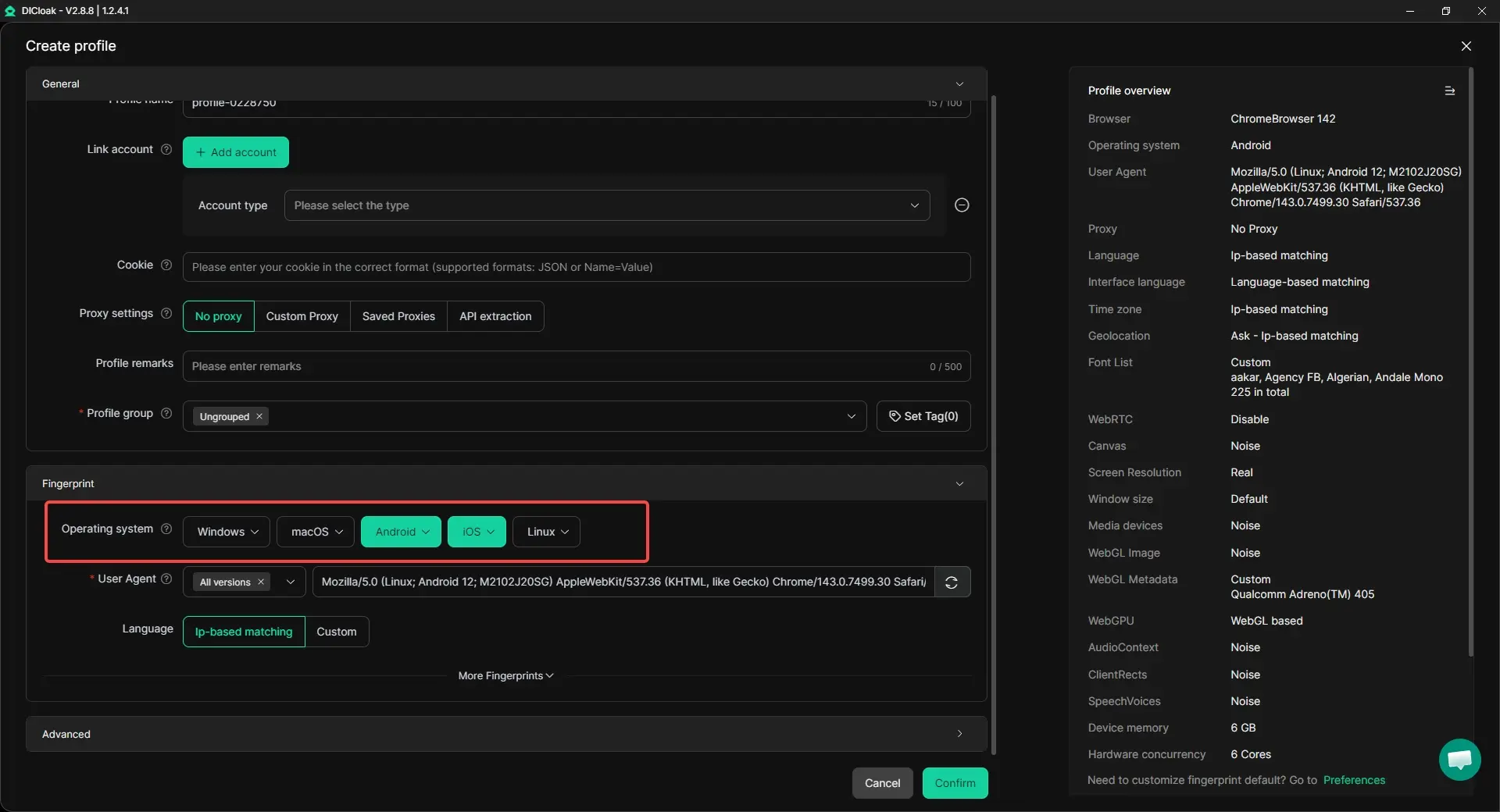
Reliable isolation requires simulating the hardware environment perfectly. This includes emulating Windows, Mac, iOS, or Android operating systems. If the residential IP indicates a mobile ISP but the browser fingerprint suggests a desktop Chrome version, the "identity entropy" will be too high, leading to a manual review or an immediate ban.
Team-Based Data Isolation
When scaling to 1,000+ accounts, data isolation becomes a logistical hurdle. Professional-grade infrastructure must include permission management, operation logs, and siloed data profiles to ensure that a mistake by one team member does not lead to the cascading failure of the entire account portfolio.
Implementing Secure Infrastructure with DICloak and a Cheap Residential Proxy
DICloak serves as the essential management layer for maintaining digital identity integrity. By creating isolated browser profiles, DICloak ensures that each account has a unique, non-leaking environment. When combined with a cheap residential proxy, DICloak provides the fingerprint consistency necessary to maintain high IP trust scores.
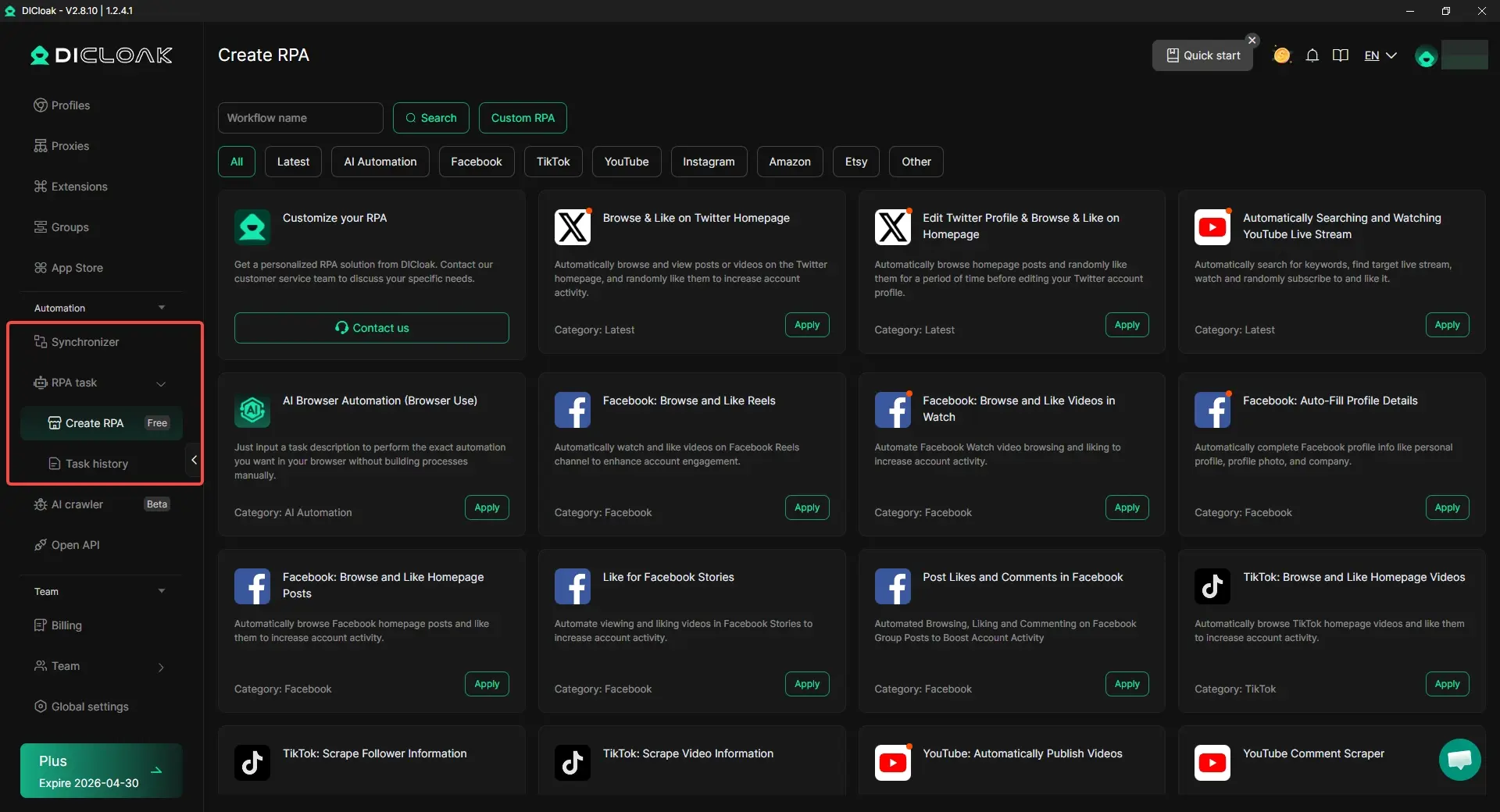
The platform includes a "Synchronizer" for bulk window control and RPA (Robotic Process Automation) to handle repetitive, high-volume tasks. These features allow teams to scale their operations without increasing their hardware footprint.
Unmanaged Browser Environment vs. DICloak Managed Infrastructure
| Feature |
Unmanaged Browser Environment |
DICloak Managed Infrastructure |
| Hardware Costs |
High (Requires physical device per account) |
Low (1,000+ accounts on one device) |
| Account Safety |
High Ban Risk (Fingerprint leakage) |
Scalable Safety (Siloed profiles) |
| Management Efficiency |
Manual / Highly Fragmented |
High (Bulk operations and RPA) |
| Team Collaboration |
Difficult / Vulnerable to data leaks |
Efficient (Permission logs/isolation) |
DICloak Analysis
Pros:
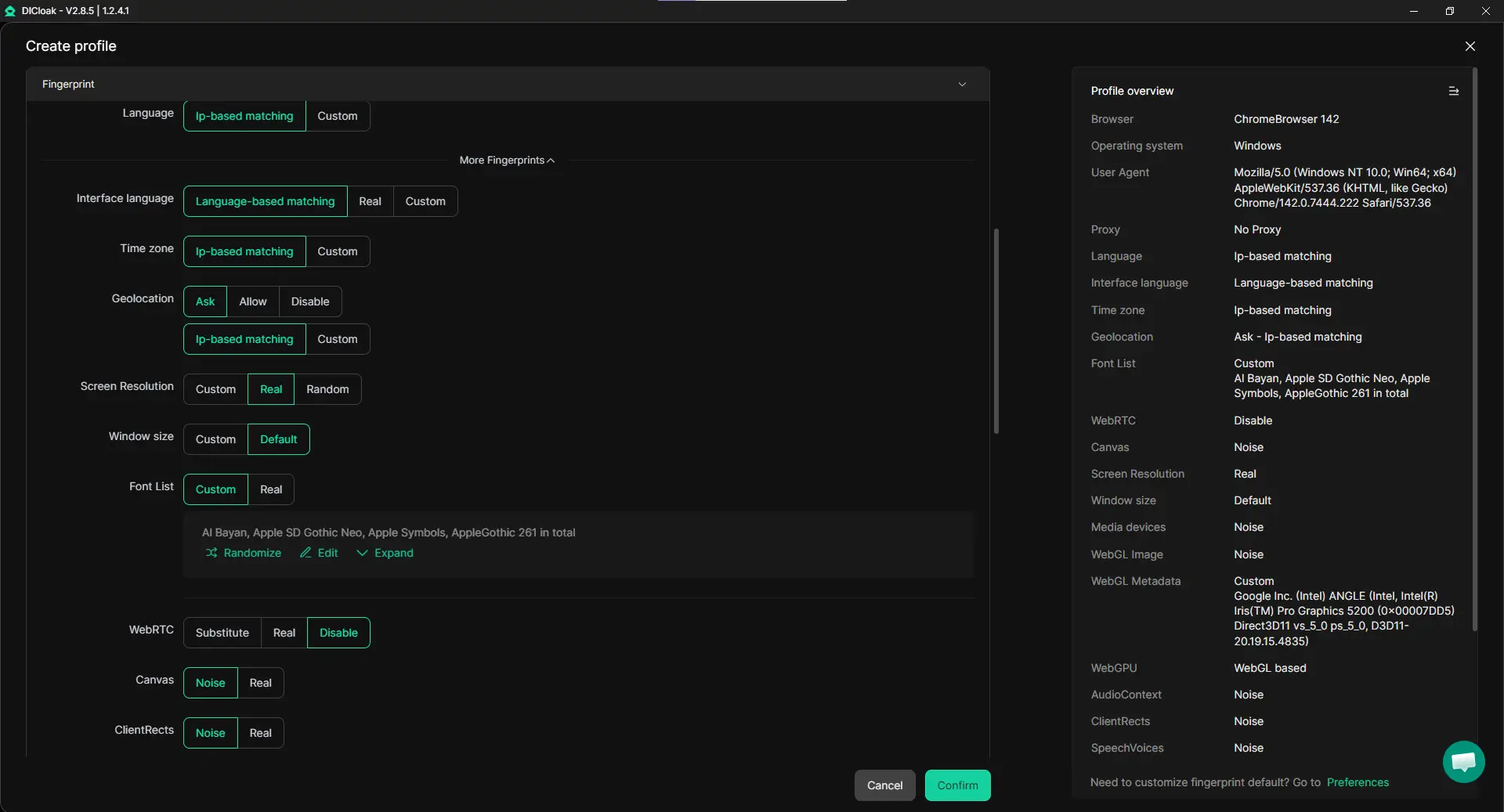
- Virtualizes thousands of unique environments on one machine, with customizable fingerprints per profile to keep identities separated.
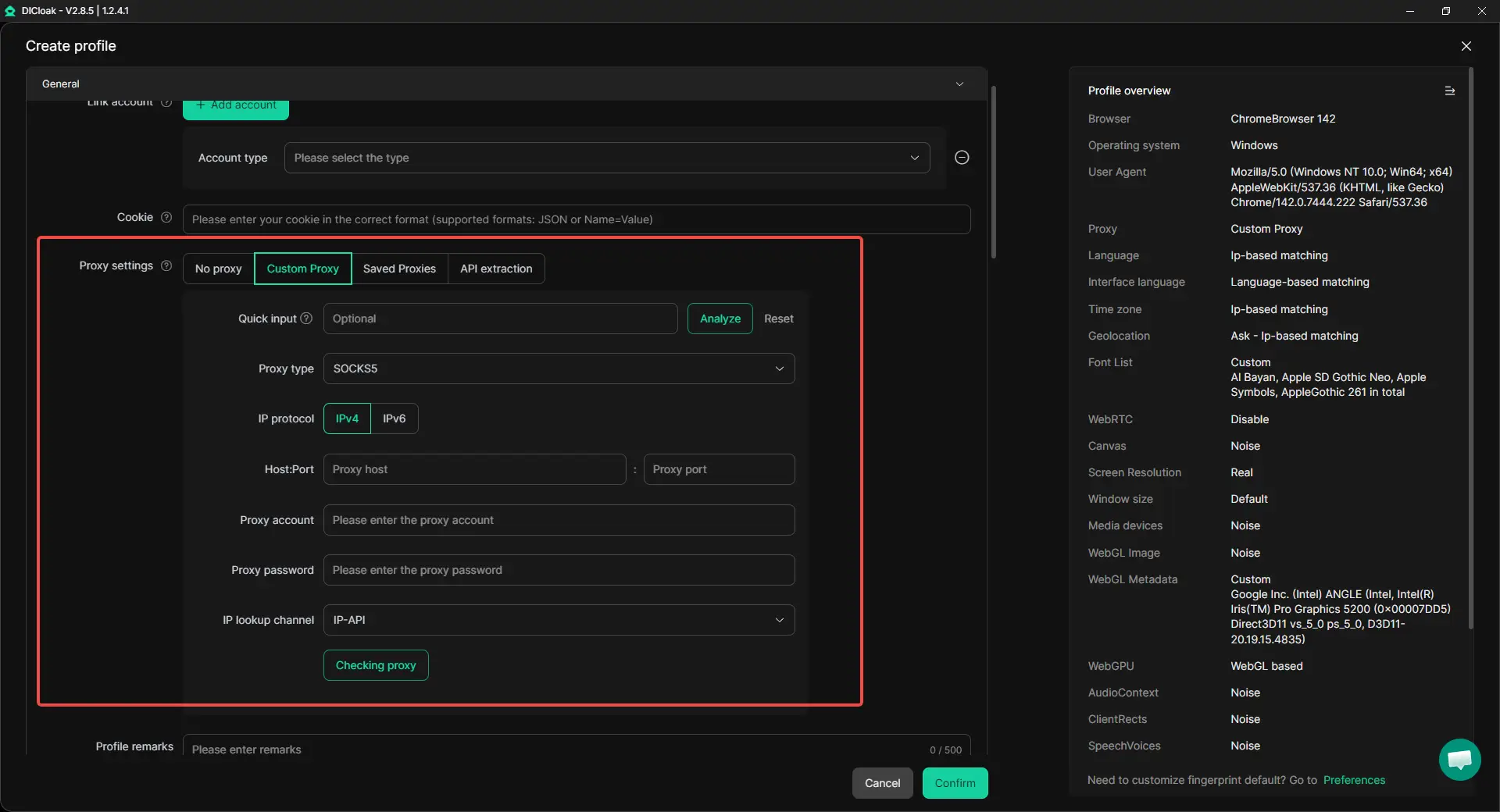
- Allows users to configure custom proxies so each profile can match residential IP metadata.
- Simulates multiple operating systems (Windows, Mac, iOS, Android, Linux) for true identity isolation.
Cons:
- Limited OS Support: Currently only available for Windows and macOS.
FAQ: Maximizing Success with Cheap Residential Proxy Protection
Are cheap residential proxies safe for high-value accounts?
Safety is a function of provider reputation and fingerprint consistency. A residential proxy is safe if it originates from a clean pool and is used within an isolated environment like DICloak. Without identity isolation at the browser level, even the most expensive proxy will fail.
What is the practical difference between static and rotating proxies?
Static proxies (sticky sessions) are optimal for account persistence where a stable identity is required over several days or weeks. Rotating proxies are efficient for high-volume data collection and scraping where the goal is to bypass request-based rate limits.
How can I minimize ban risks when using cost-effective proxies?
Success requires "fingerprint consistency." Your browser metadata (OS, timezone, resolution) must align with the proxy's location and ISP data. Using DICloak ensures these elements are synchronized, preventing the heuristic flags that lead to bans.
Can these proxies be used for mobile-only platforms?
Yes. By utilizing the mobile OS simulation (iOS/Android) within DICloak alongside a residential proxy, you can mimic a mobile device signature, which is frequently prioritized by platforms like TikTok or Instagram.
Final Thoughts: Strategy Over Tools
Scaling a digital operation in 2026 requires more than a collection of tools; it requires a cohesive infrastructure strategy. A high-quality network resource, such as a cheap residential proxy, is only effective when paired with a management layer like DICloak that ensures identity isolation. By focusing on fingerprint consistency and IP trust scoring, practitioners can build a scalable, resilient operation that survives the increasing sophistication of network detection.
 Web Proxy Tools
 Free Tools
 Cookie Plugin
 UA Generator
 MAC Address Generator
 IP Generator
 IP Address List
 2FA Code Generator
 World Clock
 Anonymous Check
 WebRTC Leak Test
 UUID Generator
 Free Web Proxy Site
 Proxy Checker
 FB Ad Checker
 AI Web Scraping
 Free SMM Tools
 Twitter Shadowban Checker
 Instagram Name Checker
 UTM Generator
 Username Generator
 AI Hashtag Generator
 LinkedIn Headline Generator
 Social Media Image Resizer