Understanding the Shift Toward rsoc feed providers in Modern Arbitrage
In the 2026 digital advertising landscape, Related Search On Content (RSOC) has shifted from a niche monetization strategy to a primary infrastructure for sustainable media buying. This evolution is driven by the increasing sophistication of content discovery platforms and native ad networks, which demand a more cohesive and value-driven user experience. Unlike historical models that relied on broad keyword matching, RSOC functions by interpreting the nuanced context of a page—such as deep-dive articles or expert comparison guides—to facilitate intent-matching.
The industry-wide transition toward RSOC represents a strategic pivot from domain-centric models to content-driven intent matching. In this environment, "rsoc feed providers" offer a mechanism where the monetization unit is integrated directly into high-quality editorial content. This approach reduces the footprint of "aggressive" advertising, which is commonly observed to trigger high bounce rates and platform audits. By prioritizing long-term feed stability over short-term click-through spikes, analysts can mitigate the risks of account flags and maintain more reliable revenue streams.

RSOC vs AFD: Why Content-Driven Models are Winning
The technical divergence between RSOC and Ads for Domains (AFD) is the defining factor in current media buying longevity. While both aim to capture search intent, their structural differences dictate their viability within modern compliance frameworks.
The Decline of Domain-Based AFD Monetization
Ads for Domains (AFD) is a domain-driven model traditionally utilized for parked domains, typo-squatting, or direct navigation traffic. In this architecture, a user lands on a domain and is immediately presented with ad-heavy search results. Platforms are increasingly sunsetting or pausing support for AFD due to its perceived lack of user value. Today, AFD is generally restricted to specific scenarios involving high-trust domain history and direct navigation traffic, where the user's intent is already explicitly tied to the domain name.
How rsoc feed providers Prioritize User Intent
Conversely, RSOC is a content-first model. It functions by embedding "related search" units within a legitimate reading experience. Units from a Google RSOC feed, for instance, are designed to feel native to the publication. By providing helpful content before presenting search options, publishers can align with the current industry trend where networks favor "natural" user journeys. This model is particularly effective for traffic sourced from social platforms and native discovery networks, where users expect informative content rather than immediate ad redirection.
Technical Workflow of the Google RSOC Feed
Anatomy of a Compliant RSOC User Journey
A standard, professional RSOC workflow follows a multi-step sequence designed to maximize intent refinement:
- Initial Click: The user interacts with a native ad or content discovery link.
- Contextual Landing: The user reaches a landing page featuring high-quality content that answers their specific query.
- Intent Refinement: Intent-matching units (RSOC blocks) appear. These units do not display static ads; instead, they use the page’s metadata and topic to dynamically generate search terms that allow the user to refine their interest.
- Monetization: Upon selecting a refined term, the user is directed to a final results page populated with sponsored ads.
The Google RSOC feed relies heavily on the quality of the landing page layout. An operational scenario for a "clean" page involves clearly separating the search units from the primary text and ensuring the content remains visible without excessive scrolling. In contrast, "bad" RSOC pages—which are frequently flagged—often utilize deceptive tactics such as "fake buttons," hiding primary content behind massive ad units, or using misleading labels that misrepresent the next step in the user journey.
Operational Risks and the Necessity of Account Isolation
Scaling search arbitrage requires managing a diversified portfolio of feed providers and traffic sources. However, this creates a significant risk of "account linking." When platforms detect that multiple accounts are being operated from the same environment, they can apply a "cascade ban," restricting the entire network based on a single account's violation.
The Critical Role of Fingerprint Isolation
Modern tracking systems identify users through browser fingerprinting—a collection of technical parameters that create a unique digital identity. Key markers include Device IDs, OS versions, and, most critically, Canvas fingerprinting. Canvas fingerprinting is particularly dangerous because it draws a hidden image to the user's browser; the way that image is rendered reveals the underlying GPU and hardware driver combination, which is nearly impossible to change through standard browsing.
Pro-Tip: To mitigate risk, analysts must avoid creating "hybrid fingerprints." Mixing residential and datacenter proxies within a single browser profile, or reusing a hardware fingerprint across different feed provider logins, creates a contradictory profile that fraud detection algorithms quickly flag as a high-risk anomaly.
Leveraging DICloak for Scalable rsoc feed providers Management
For large-scale media buying teams, infrastructure must go beyond simple proxy management to include full environment isolation. DICloak provides a professional framework for implementing these strategies.
Simulating Diversified Operating Environments
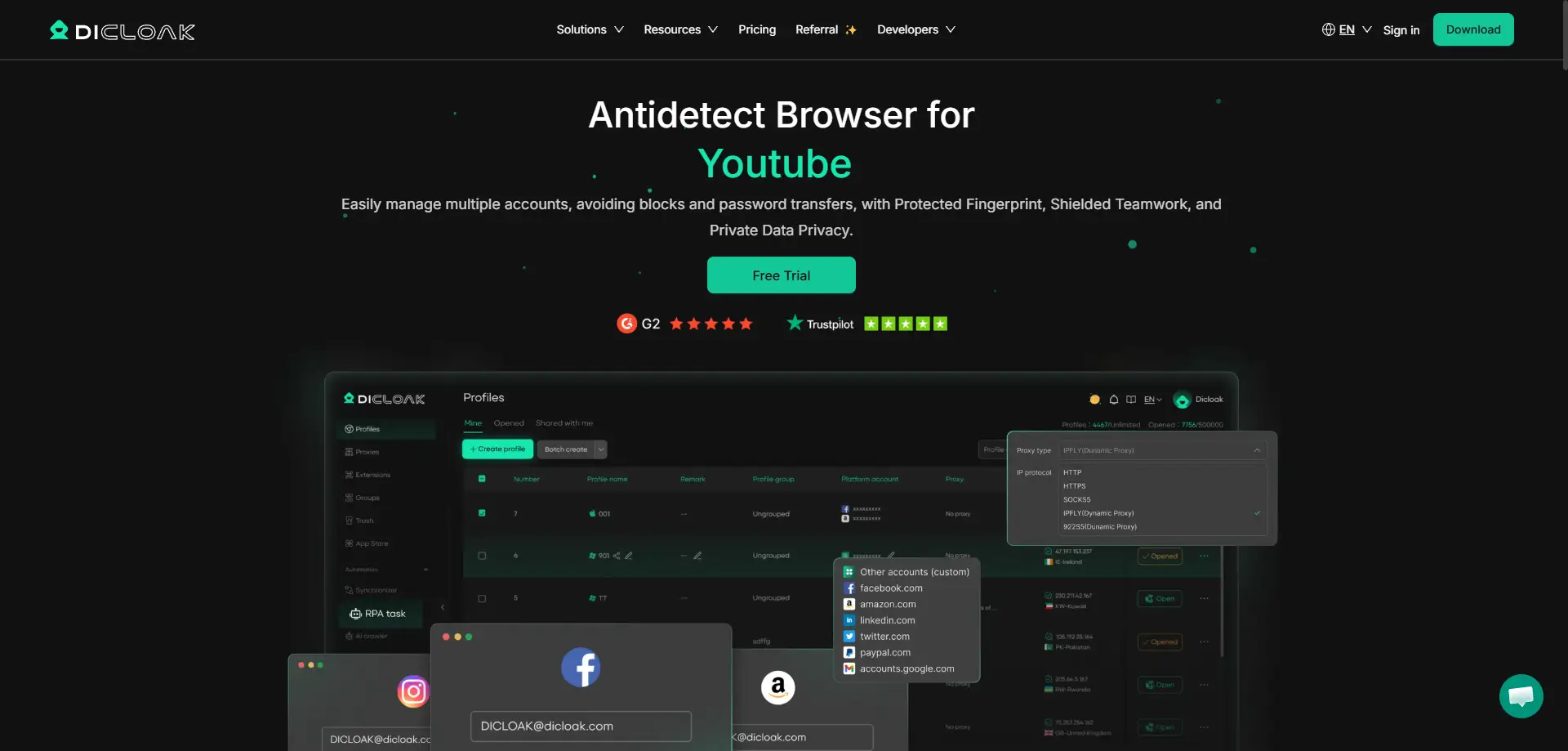
DICloak allows users to manage over 1,000 accounts on a single physical device by creating isolated browser profiles. Each profile can simulate a different operating system, including Windows, Mac, iOS, Android, and Linux. This ensures that the technical markers (User-Agent, OS markers) of one account never overlap with another.
Advanced Proxy Configuration for Network Isolation
Network isolation is achieved through the integration of HTTP, HTTPS, and SOCKS5 protocols. DICloak enables users to assign unique IP identities to each profile, ensuring that the network traffic remains consistent with the simulated device and geographic location.
Orchestration with Synchronizer and Local API
To manage high-volume operations, DICloak includes a Synchronizer feature, which allows a manager to control multiple browser profiles simultaneously—performing the same action across hundreds of accounts in real-time. Additionally, the Local API allows for deep integration with third-party tracking and management tools, enabling a level of technical oversight required for complex arbitrage ecosystems.
Automating Arbitrage Workflows with RPA
Repetitive tasks such as profile "warm-ups" (browsing to establish a cookie history) or account checking are handled via built-in Robotic Process Automation (RPA). This mechanism automates the mechanical "grind," allowing teams to focus on keyword optimization and creative strategy.
Comparative Analysis: Standard Methods vs. DICloak Infrastructure
| Feature |
Standard Browsing Methods |
DICloak Infrastructure |
| Hardware Requirements |
Heavy; requires multiple physical laptops or mobile devices. |
Scalable; manages 1,000+ accounts on one physical device. |
| Account Safety |
High risk of linking due to hardware and GPU leakage. |
Isolated profiles with unique Canvas, WebGL, and OS fingerprints. |
| Operational Efficiency |
Manual setup and login for every account/feed provider. |
Bulk creation, import, and launch; Synchronizer tool. |
| OS Simulation |
Limited to the native machine's operating system. |
Simulates Windows, Mac, iOS, Android, and Linux. |
| Automation |
Entirely manual execution of tasks. |
Built-in RPA for workflow automation and Local API support. |
Team-Based Workflows and Permission Management
Orchestrating Large-Scale Media Buying Teams
In professional media buying, operations are governed by the Principle of Least Privilege (PoLP). This cybersecurity standard dictates that team members should only have access to the specific data and accounts necessary for their roles.
DICloak facilitates PoLP through advanced team management tools. A lead analyst can share specific profiles with media buyers without revealing the account credentials themselves. By utilizing permission settings and data isolation, the infrastructure prevents accidental cross-contamination. Furthermore, operation logs provide a transparent audit trail of every action taken within a profile, ensuring data integrity and enabling rapid troubleshooting when a specific rsoc feed provider shows a performance dip.
Objective Analysis of DICloak for Search Arbitrage
Pros:
- Infrastructure Scalability: Capacity for 1,000+ accounts reduces hardware overhead significantly.
- Multi-OS Compatibility: Essential for testing how RSOC units render on mobile (iOS/Android) vs. desktop environments.
- Workflow Automation: RPA and Synchronizer tools reduce manual labor for profile maintenance and repetitive tasks.
- Comprehensive Protocols: Full support for SOCKS5 and HTTP/S ensures robust network isolation.
Professional Considerations:
- Proxy Sourcing Requirements: The effectiveness of network isolation is dependent on the quality of third-party proxies; users must source high-authority residential IPs independently.
- Configuration Depth: Mastering advanced fingerprint customization and RPA sequences requires a technical learning curve for team members.
Best Practices for Deploying rsoc feed providers Campaigns
To ensure sustainable ROI, analysts should adhere to the following four pillars of campaign hygiene:
- Content Quality: Landing pages must provide genuine value. Use real articles that solve a user problem before presenting search options.
- Intent Alignment: Keywords used in traffic acquisition must match the landing page topic and the dynamically generated search terms to ensure high conversion and low bounce rates.
- Fingerprint Hygiene: Never use "stock" browser profiles. Regularly rotate or customize technical markers (Canvas, WebGL, AudioContext) using DICloak to prevent long-term footprinting.
- Natural Layouts: Avoid deceptive design patterns. Ensure that RSOC units are clearly labeled and do not block the user's ability to read the primary content.
Frequently Asked Questions About rsoc feed providers
How do rsoc feed providers reduce the risk of account bans compared to AFD?
RSOC prioritizes a content-first journey, which aligns with the transparency and quality standards set by providers like Google. By embedding monetization into a helpful user experience rather than relying on direct-to-ad domain redirection, the risk of "low-quality traffic" flags is significantly reduced.
Can I manage multiple Google RSOC feeds on a single computer?
Yes. Through an antidetect environment like DICloak, you can create isolated browser profiles that simulate entirely different hardware and software environments. This prevents the feed provider from linking multiple accounts to a single physical device.
What proxy types are recommended for search arbitrage?
For the highest level of security, use high-quality residential proxies that support SOCKS5 or HTTP/S. These should be assigned to specific profiles to maintain a consistent IP identity, matching the simulated OS and location of the account.
How does RPA improve the efficiency of content-driven arbitrage?
RPA is used to automate the "warm-up" phase of profile management, such as building up a natural cookie history or performing regular account status checks. This ensures that browser profiles appear as "active, legitimate users" to tracking algorithms without requiring manual labor.
 Web Proxy Tools
 Free Tools
 Cookie Plugin
 UA Generator
 MAC Address Generator
 IP Generator
 IP Address List
 2FA Code Generator
 World Clock
 Anonymous Check
 WebRTC Leak Test
 UUID Generator
 Free Web Proxy Site
 Proxy Checker
 FB Ad Checker
 AI Web Scraping
 Free SMM Tools
 Twitter Shadowban Checker
 Instagram Name Checker
 UTM Generator
 Username Generator
 AI Hashtag Generator
 LinkedIn Headline Generator
 Social Media Image Resizer