Is Web Scraping Legal for Modern Businesses?
In the data-driven landscape of 2026, web scraping has evolved from simple script-based harvesting into a sophisticated industry practice essential for growth infrastructure. At its core, web scraping is the automated extraction of website data where tools request pages and parse the underlying HTML to retrieve specific data points—ranging from real-time pricing and market sentiment to competitive reviews.
As a Senior Cybersecurity Analyst, I must emphasize that legality is not a binary "yes" or "no" but a spectrum of regulatory volatility. Whether an operation is compliant depends on three variables: the nature of the data, the regional legal framework, and the technical method of access. While extracting public data is generally considered an acceptable industry practice, the risks escalate sharply when scripts bypass technical barriers or ingest personal identifiers.
Public Data vs. Personal Information
The most critical distinction for any digital infrastructure expert is the divide between public and private data. Public data—information accessible without an account—occupies the lowest risk tier. Conversely, private data sequestered behind "login walls" or authentication barriers triggers a higher level of legal scrutiny.
Pro-Tip: Scraping data behind authentication barriers without explicit authorization is a high-stakes activity. Accessing non-public data is frequently interpreted as "unauthorized access" under modern cybersecurity frameworks and can lead to immediate litigation or criminal referral.
The Distinction Between Public and Private Data Access
The condition of compliance rests on the concept of attribution risk. Accessing data that is not intended for the general public signals that a platform has established a technical boundary. Bypassing these boundaries via automation is often viewed as "exceeding authorized access," a transgression that shifts the activity from mere data collection to a potential breach of security protocols.
Is Web Scraping Legal When Handling Personal Data?
The European legal landscape is dominated by the General Data Protection Regulation (GDPR), which prioritizes the "what" over the "how."
Consent Mechanisms and Identifiable Information
In the EU, scraping personal data—names, emails, or social media handles—requires a documented lawful basis, usually explicit consent.
- The UK and Germany: Both jurisdictions maintain rigorous standards. In the UK, post-Brexit GDPR applications remain strict regarding personal identifiers. Germany’s Federal Data Protection Act, working alongside the GDPR, enforces some of the world's most stringent privacy protections; scraping personal data there without consent is fundamentally illegal.
Even if data is "publicly available," the act of automated harvesting for a new purpose without the subject's consent is a high-risk GDPR violation, often resulting in significant administrative fines.
Is Web Scraping Legal in India, Canada, and Singapore?
As businesses scale globally, they must navigate a patchwork of regional requirements:
- India: While no law explicitly bans scraping, the IT Act provides a framework for prosecuting the extraction of sensitive information. Violating a website’s ToS in India can lead to civil litigation.
- Canada: Under PIPEDA, the collection of personal data via scraping is prohibited without consent. Non-personal public data remains generally permissible for extraction.
- Singapore: The PDPA governs data privacy. Like Canada, Singapore allows the scraping of public information but strictly forbids the automated collection of personal data without explicit authorization.
Is Web Scraping Legal When Sites Use Bot Detection?
In 2026, platforms utilize AI-driven behavioral analysis to protect their assets. To mitigate attribution risk, analysts must understand how they are being tracked.
Understanding Browser Fingerprinting and Identification Mechanisms
Websites use browser fingerprinting and behavioral analysis to identify patterns across sessions.
- Canvas Fingerprinting: This is a highly effective tracking mechanism where the website instructs the browser to draw a hidden image. Because of subtle differences in hardware (GPU) and software (drivers), the resulting pixel data is unique to that specific device.
- IP Reputation and Behavioral Analysis: Platforms monitor for high-frequency requests and non-human patterns (e.g., perfectly consistent 1.0-second intervals), deploying IP bans or "checkpoints" to neutralize detected scrapers.
How Is Web Scraping Legal Technology Used to Manage Operational Risk?
When discussing is web scraping legal, the focus should not be on avoiding detection, but on responsible and structured data collection. Businesses that rely on public data must manage traffic volume, session separation, and compliance carefully.
Network Separation and Traffic Management
Instead of concentrating traffic through a single IP address, organizations often distribute requests across properly custom configured proxy connections. This approach helps maintain organized traffic patterns and prevents session overlap between different workflows. Proxy usage should always comply with local regulations and the target website’s terms of service.
Managing Multiple Profiles for Operational Organization
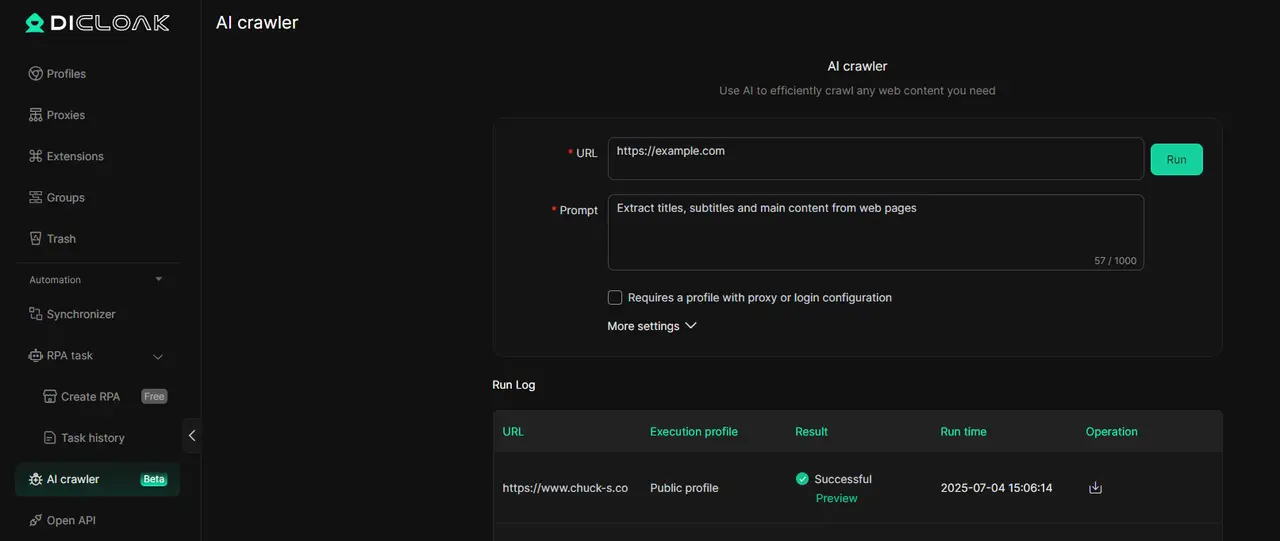
When operating multiple accounts or data sessions, separation is critical. Using isolated browser profiles allows each session to maintain its own cookies, storage, and fingerprint configuration. You can use tools like DICloak to provide with isolated browser profiles, so each account or scraping session runs independently. This reduces structural overlap between sessions and improves operational clarity. Each profile maintains its own browser fingerprint (DICloak does not provide with proxy purchasing service), keeping workflows separated rather than mixed together.
Staying Compliant While Scaling Data Collection with DICloak
DICloak serves as the technical tool for implementing these security and compliance strategies.
RPA and the Synchronizer for Scaling Operations
DICloak’s built-in Robotic Process Automation (RPA) is designed to automate repetitive browser tasks, such as scrolling or clicking. Furthermore, the Synchronizer feature allows analysts to control multiple profiles simultaneously, performing actions in one window that are replicated across others, drastically reducing the "manual grind" while maintaining individual profile integrity.
Data Isolation and Security Logs
For teams, DICloak provides Attribution Control. Through permission settings and operation logs, managers can ensure that team members do not overlap in a way that compromises account security. This data isolation is vital for sensitive operations like affiliate marketing, traffic arbitrage, and airdrop farming, where account linking is the primary cause of failure.
Comparing Standard Extraction vs. Isolated Profile Methodology
| Feature |
Standard Scraping Methods |
DICloak Integrated Workflow |
| Risk Profile |
High; susceptible to "chain-reaction" bans |
Low; profile-Based Isolation |
| Fingerprinting |
Shared; easily identified via Canvas/WebRTC |
Configurable browser fingerprints per profile |
| Proxy Integration |
Manual; prone to "browser leakage" |
Bulk custom proxy configuration |
| Automation |
Basic, predictable scripts |
RPA for workflow automation |
| Scaling Mechanism |
Limited by hardware signatures |
Synchronizer and Bulk Tools for large-scale profile management |
| Platform Scope |
Web-only |
Supports windows and macos with configurable device profiles |
Objective Analysis of DICloak for Data Operations
Pros:
- Scalability: Effortlessly manages 1,000+ isolated profiles on a single device, reducing reliance on multiple physical devices.
- Versatility: Chrome-core based with supporting configurable browser fingerprint profiles across different device types
- Efficiency: Powerful Bulk Tools and Synchronizer features streamline the creation and management of large-scale account fleets.
- Security: Profile isolation reduces structural overlap between browser sessions.
Cons:
- Setup Overhead: Developing custom fingerprints and integrating proxy pools requires an initial time investment.
- Learning Curve: Mastering the RPA logic for advanced human mimicry requires technical proficiency.
Final Professional Summary
In 2026, web scraping remains a foundational pillar for growth, but it is no longer a "set-and-forget" activity. Success requires an acute awareness of regional regulations like the GDPR and CFAA, paired with a robust technical infrastructure. By using advanced tools like DICloak, businesses can implement profile Isolation and RPA automation, effectively managing the risks of bot detection while maintaining a scalable, compliant, and professional data operation.
FAQs Regarding Web Scraping Compliance
Is web scraping legal for commercial use?
Generally, yes, if targeting public data. However, it becomes high-risk if it violates a site’s Terms of Service or involves personal data without a lawful basis.
Can you get banned for scraping Amazon?
Frequently. Amazon utilizes some of the world's most advanced anti-bot measures. Without sophisticated identity isolation and human-mimicking RPA, IP bans are nearly certain.
Is it legal to scrape LinkedIn?
Based on the hiQ Labs ruling, scraping public LinkedIn profiles is legal in the US under the CFAA. However, scraping data from logged-in sessions is a violation of their ToS and carries significant legal and account-ban risks.
How do isolated browser profiles reduce scraping risks?
They prevent browser leakage. By isolating cookies, cache, and hardware fingerprints (like Canvas), each profile acts as a unique entity, making it impossible for platforms to link multiple automated sessions to a single source.
 Web Proxy Tools
 Free Tools
 Cookie Plugin
 UA Generator
 MAC Address Generator
 IP Generator
 IP Address List
 2FA Code Generator
 World Clock
 Anonymous Check
 WebRTC Leak Test
 UUID Generator
 Free Web Proxy Site
 Proxy Checker
 FB Ad Checker
 AI Web Scraping
 Free SMM Tools
 Twitter Shadowban Checker
 Instagram Name Checker
 UTM Generator
 Username Generator
 AI Hashtag Generator
 LinkedIn Headline Generator
 Social Media Image Resizer