For the dedicated anime enthusiast, few things are more disruptive than a broken bookmark or the dreaded "Site Not Reachable" error. WCOFun net continues to serve as a massive, albeit unofficial, repository for subbed and dubbed content, but its status in 2026 is more precarious than ever. From a privacy standpoint, interacting with unencrypted third-party streams represents a high-risk vector for data harvesting. Navigating this space requires a clear understanding of the trade-off between free access and digital safety.
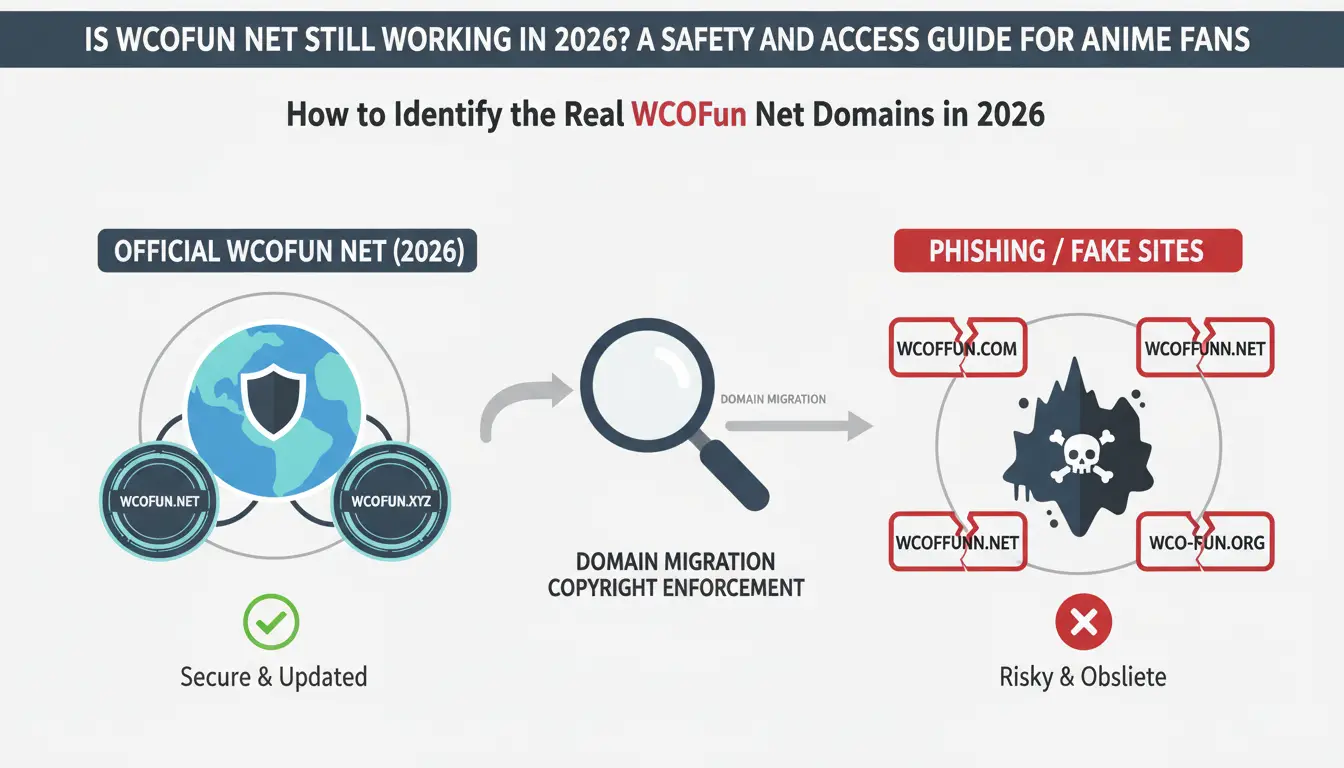
How to Identify the Real WCOFun Net Domains in 2026
WCOFun net operates outside the boundaries of official licensing, placing it squarely in the crosshairs of global copyright enforcement. Because it lacks the legal protections of a mainstream streamer, the platform is forced into a perpetual state of migration.
Identifying Official Domains vs. Phishing Mirrors
As the site migrates, malicious actors frequently launch "phishing clones." These dangerous imitations are designed to mimic the original interface to deceive users into surrendering sensitive data. A primary red flag is any request for credit card information or personal login credentials—legitimate WCOFun mirrors typically prioritize a friction-less, registration-free experience. Historically, the community has seen official variations using .net, .tv, and .org suffixes, but users must remain vigilant against look-alike URLs designed for data theft.
Why the URL Changes So Frequently
By 2026, the cycle of domain migration has reached a fever pitch, driven largely by AI-driven automated takedown systems that flag and delist unofficial mirrors within hours of their appearance. These shifts are a direct response to local copyright enforcement and geo-restrictions. When an ISP receives a formal notice, the specific domain is effectively "burned," forcing the site administrators to deploy a new mirror to maintain service for their global audience.
Is WCOFun Net Safe to Use Without Protection?
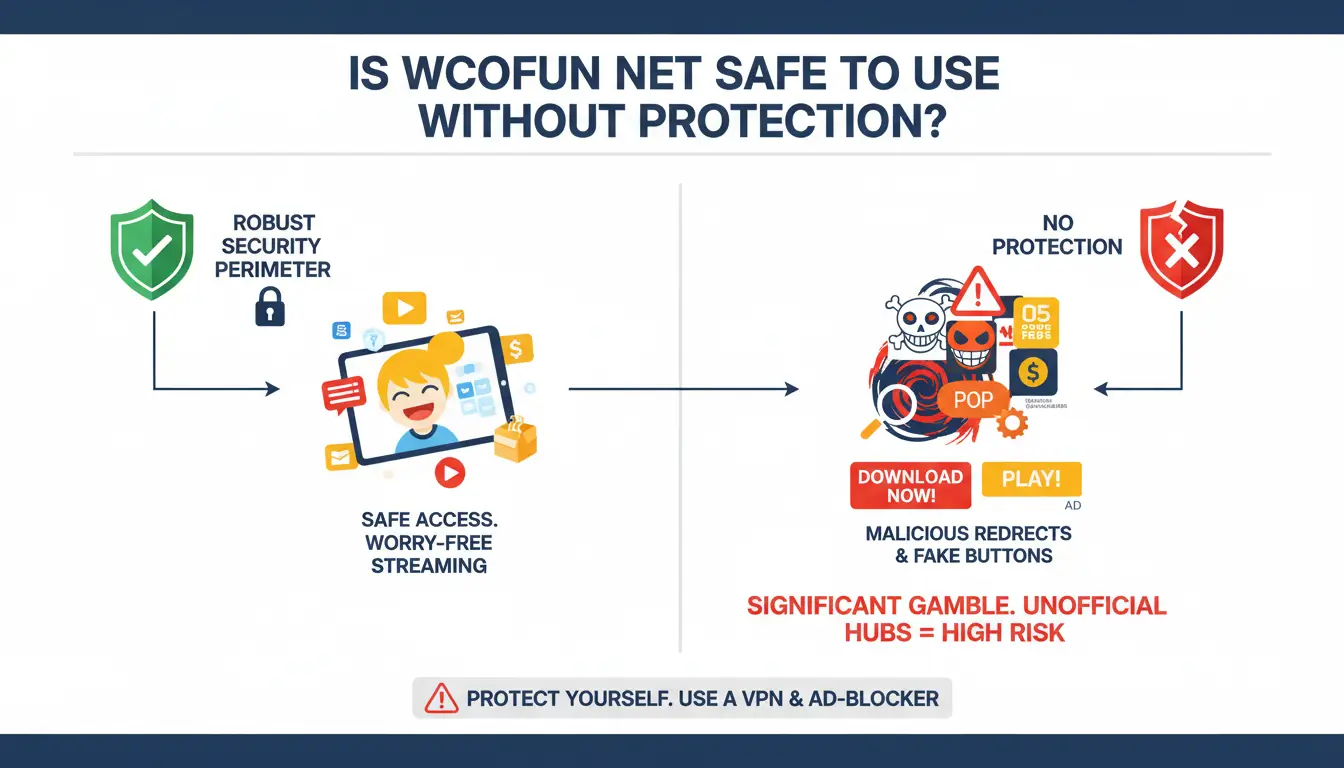
Engaging with unofficial streaming hubs without a robust security perimeter is a significant gamble. These platforms operate without oversight, often subsidizing their hosting costs through aggressive advertising networks.
The Danger of Malicious Redirects and Fake Buttons
One of the most persistent threats on WCOFun is the "fake download" button. These elements are not linked to video files but are programmed to trigger the installation of unwanted software or potentially unwanted programs (PUPs). Furthermore, malicious redirects can hijack a browser session the moment a user clicks the video player, sending them to external sites designed to exploit browser vulnerabilities.
The threat landscape has evolved significantly by 2026. Beyond simple cookies, unofficial sites now utilize advanced browser fingerprinting scripts embedded directly in video players. These scripts bypass standard "Incognito" modes by collecting hardware IDs, canvas rendering signatures, and installed font lists to create a unique digital ID. This allows third-party trackers to follow your activity across the web, compromising your privacy even after you have finished your stream.
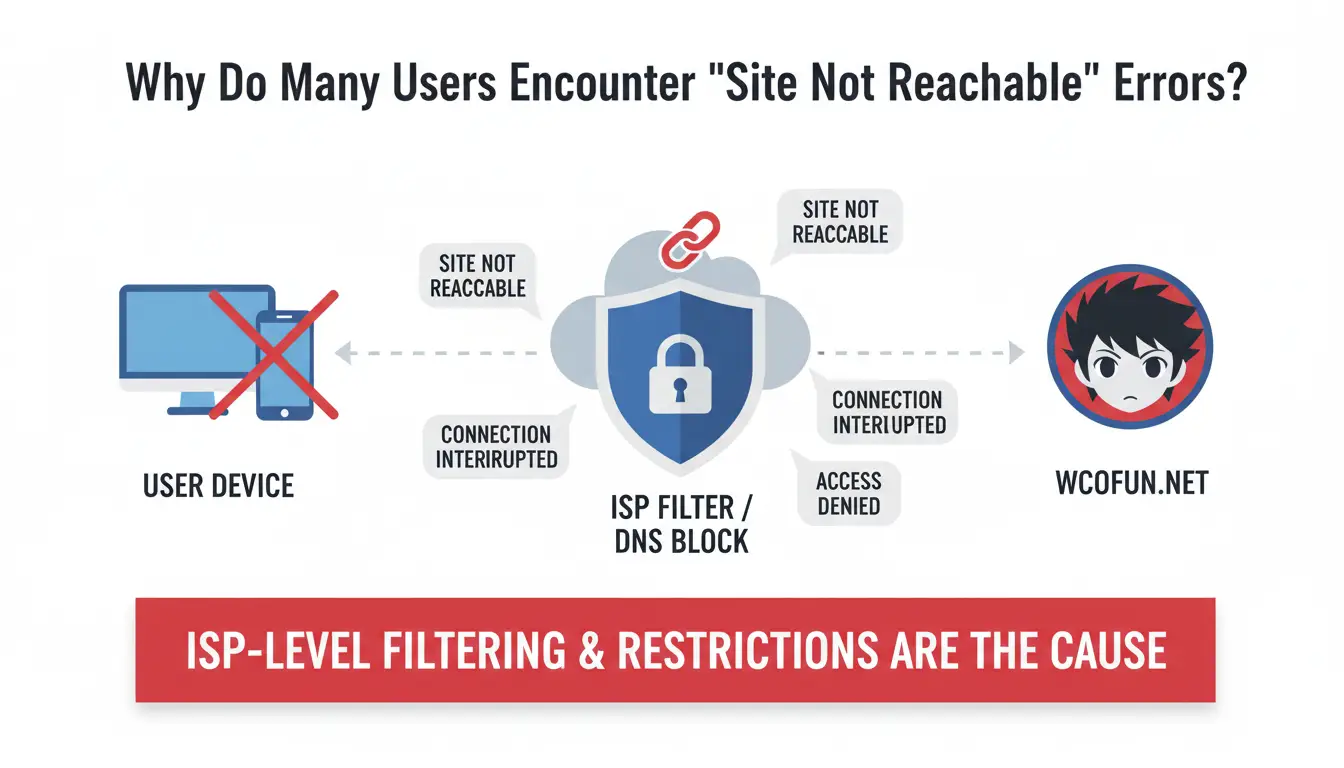
Why Do Many Users Encounter "Site Not Reachable" Errors?
When WCOFun appears to be "down," it is rarely a total site failure. Instead, it is usually a result of the user’s connection being intercepted or restricted.
ISP-Level Filtering and DNS Blocks
Internet Service Providers (ISPs) are the primary enforcers of regional blocking policies. Most commonly, they employ DNS blocks, where the ISP’s server essentially "lies" to your browser. When you request the WCOfun address, the ISP returns an incorrect IP or a "null" result, leading to a connection timeout. Understanding this mechanism is the first step toward implementing a viable workaround.
Geo-Restrictions and Regional Copyright Enforcement
Access is highly contingent on your physical location. Due to the fractured nature of global copyright laws, a domain that is perfectly accessible in one country may be completely blacklisted in another. These geo-blocks are the frontline tools used by authorities to enforce intellectual property rights within their specific borders.
How to Access WCOFun Net More Securely
Mitigating the risks associated with third-party streaming requires a proactive defense-in-depth strategy. Reliance on default browser settings is no longer sufficient.
Essential Browser Settings and Ad-Blockers
A high-performance ad-blocker is your primary shield. It effectively neutralizes fake download buttons and most intrusive pop-ups. Beyond software, users must adhere to strict manual protocols: never download "required" codecs or players, and immediately exit any mirror site that demands registration or financial information.
Using Proxies to Bypass Regional Restrictions
To circumvent ISP-level filtering, routing your traffic through a proxy is the standard industry recommendation. By masking your real IP address with one from a different geographic region, you can bypass local DNS blocks and access the site as if you were in a non-restricted territory. High-anonymity residential proxies are particularly effective here, as they mimic the connection of a standard household, making them much harder for automated blocking systems to detect.
Can Antidetect Browsers and Proxies Improve Your Streaming Experience?
While basic ad-blocking is a start, professional-grade privacy requires moving from manual safety protocols to an isolated browsing environment. Antidetect browsers represent the evolution of private streaming in 2026, offering a level of compartmentalization that standard browsers cannot match.
By using isolated browser profiles, you ensure that any scripts or trackers encountered on WCOFun are trapped within a single, disposable profile. This prevents the "leakage" of tracking data into your main browser, where your personal accounts and sensitive sessions are stored.
Integrating DICloak Into Your Privacy Workflow
Utilizing a tool like DICloak allows for a sophisticated management of these isolated environments. It allows you to streamline the security process through the following actions:
- Create isolated browser profiles to keep streaming cookies and trackers completely separate from personal or financial accounts.
- Pair these individual profiles with high-anonymity residential proxies to bypass ISP-level filtering and access content from different regions.
- Minimize the unique digital signature that streaming sites use to track and identify user behavior through advanced fingerprint masking.
Comparing WCOFun Net to Legal Anime Alternatives in 2026
For many, the complexity of securing an unofficial stream leads back to the reliability of licensed platforms.
Paid Platforms: Crunchyroll, Netflix, and Hulu
Licensed distributors like Crunchyroll, Netflix, and Hulu provide a premium, threat-free experience. These services offer official apps, high-bitrate streams, and the peace of mind that comes with knowing your data is not being harvested by unknown third parties.
When to Choose Official Apps Over Third-Party Sites
The choice is a balance of convenience and content availability. Fans often turn to WCOFun for rare or older titles like Naruto or One Piece when they are unavailable on local legal platforms due to licensing gaps. However, for current seasonal hits, official apps remain the gold standard for quality and security.
Common Mistakes to Avoid When Using Unofficial Streaming Sites
Security failures are almost always the result of predictable user errors. Avoiding these pitfalls is essential for maintaining your digital integrity.
Falling for "Required" Software Downloads
No modern browser requires you to download a specific "codec," "media player," or "update" to stream video. Any prompt that asks you to install software is a delivery mechanism for malware. If the video does not play in a standard, updated browser, the site should be abandoned immediately.
Using the Same Browser for Streaming and Sensitive Logins
The risk of cross-site tracking is magnified when you use the same browser session for anime streaming and sensitive tasks like online banking. Using isolated profiles is not just a recommendation; it is a necessity for preventing session hijacking or credential harvesting.
Frequently Asked Questions
Do I need a proxy for WCOFun?
While the site may technically load without one, a proxy is highly recommended to bypass regional ISP blocks and mask your IP address. This provides a layer of anonymity that helps protect you from the site's internal tracking scripts.
Why is the video on WCOFun net buffering so much?
Buffering is frequently caused by ISP throttling, where providers intentionally slow down traffic to known streaming hubs. Utilizing a clean residential proxy can often bypass this throttling, resulting in a more stable, high-speed connection.
Is WCOFun.tv the same as WCOFun.net?
WCOFun often migrates between domains like .tv, .net, and .org to stay ahead of takedowns. However, always verify the URL carefully, as phishing clones frequently use similar names to harvest user data.
Can I get a virus from just watching anime on WCOFun?
While the video file itself is rarely the source of infection, the surrounding infrastructure—malicious redirects, fake buttons, and scripts—can be used to deliver malware. Using an ad-blocker and avoiding all software downloads is the only way to stream safely.
Final Verdict on Accessing WCOFun Net Safely
WCOFun net remains a resilient resource for the anime community in 2026, offering access to expansive libraries of titles like One Piece and Naruto that official platforms may lack. However, the site’s unofficial status means that the user assumes all the risk.
The most effective way to engage with the platform is through a "proxy-friendly setup." By combining robust ad-blocking with isolated browsing profiles and high-anonymity residential proxies, you can help bypass regional blocks while supporting the insulation of your digital identity from trackers and malicious redirects. In the current landscape, safe browsing isn't just an option—it's the only way to ensure your passion for anime doesn't come at the cost of your personal security.
 Web Proxy Tools
 Free Tools
 Cookie Plugin
 UA Generator
 MAC Address Generator
 IP Generator
 IP Address List
 2FA Code Generator
 World Clock
 Anonymous Check
 WebRTC Leak Test
 UUID Generator
 Free Web Proxy Site
 Proxy Checker
 FB Ad Checker
 AI Web Scraping
 Free SMM Tools
 Twitter Shadowban Checker
 Instagram Name Checker
 UTM Generator
 Username Generator
 AI Hashtag Generator
 LinkedIn Headline Generator
 Social Media Image Resizer