Marketers possess a distinct capability — handling numerous tasks concurrently without losing focus. Juggling advertisements, overseeing several client spheres, publishing content, and monitoring results across different venues, our schedules are constantly packed. While we utilize numerous aids for almost everything, certain snags persist, particularly when managing numerous accounts simultaneously.
The reality is, if you access Meta, Google Ads, LinkedIn, Shopify, or TikTok using multiple logins, you understand the chaos that can ensue. One moment you're refining an ad set, the next you're encountering a login failure, a flagged session, or worse — an account suspension. Sometimes it stems from a shared IP, other times from a mismatched device signature. In any case, progress halts.
This is the reason why antidetect browsers are gaining traction. Not due to fads, but because they address a genuine need. These browsers establish distinct, walled-off digital spaces that imitate genuine users. For those of us in marketing, this allows us to securely operate several accounts, free from the fear of being deactivated just for doing our jobs.
Marketer Browser is a newer entrant in the antidetect browser arena. It purports to be tailored for marketers, providing features such as signature cloaking, multi-account oversight, and proxy integration. However, assertions are simple to make. What concerns us is its performance when deeply involved in an ongoing campaign, juggling numerous personas, and under tight deadlines.
In this assessment, we're taking a close look at Marketer Browser with a singular aim: to provide the unvarnished truth from a marketing professional's viewpoint. We will examine its strong points, pinpoint its shortcomings, and detail how it holds up against the rigorous demands of contemporary, high-output marketing units. And if you're contemplating a switch, don't miss DICloak's final mega sale—Save up to 50%! Get 30% Cashback!
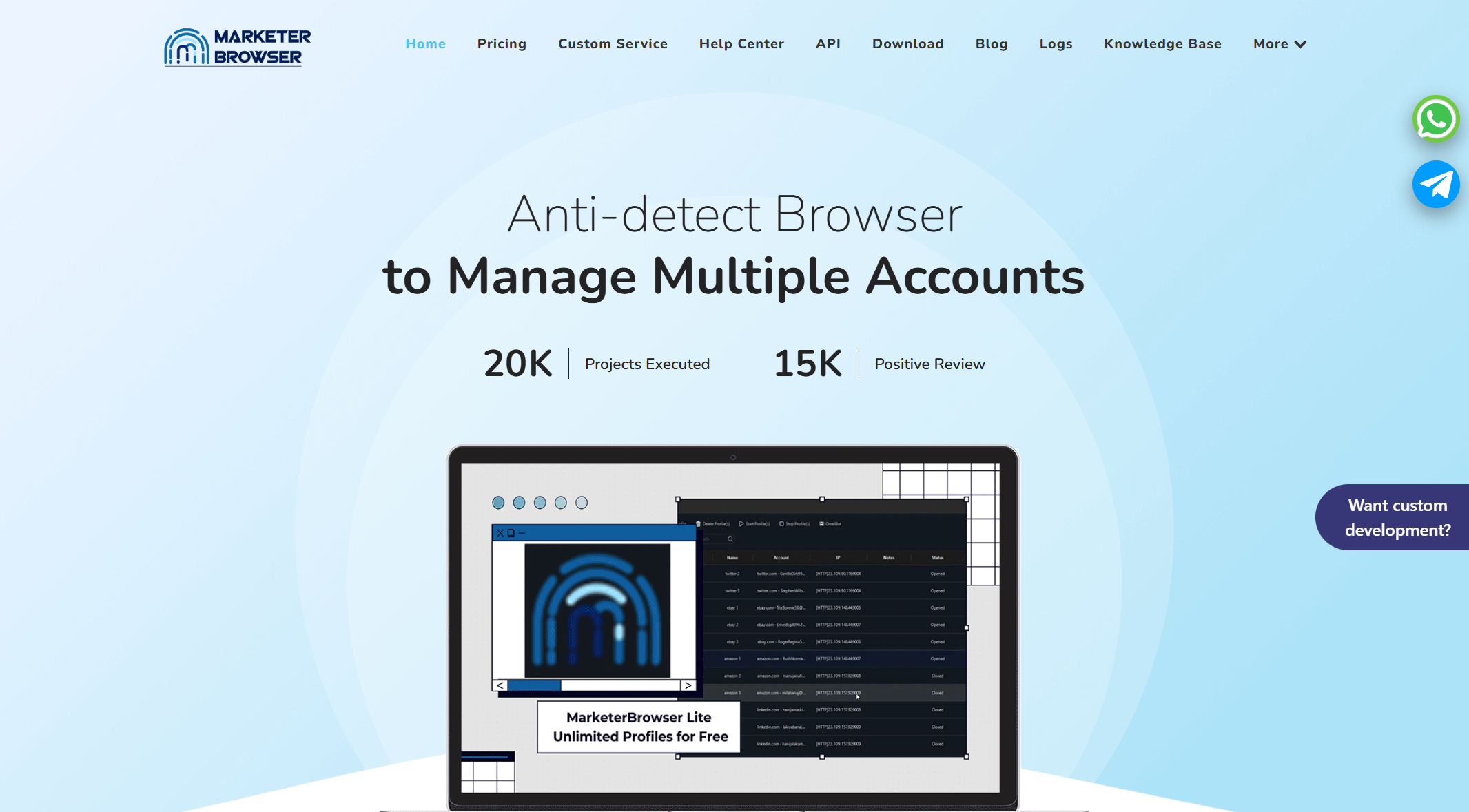
What Defines Marketer Browser?
Marketer Browser presents itself as a professional antidetect utility intended to assist digital promoters in supervising numerous online presences without triggering detection. It advertises capabilities like centralized account handling, defenses against tracking and digital signatures, profile organization, proxy functionality, and cloud-based storage with syncing.
The primary commitment is to deliver a secure and untraceable setting for diverse online pursuits, ranging from social media promotion to e-commerce operations, by crafting unique digital identifiers for every browser instance. This aims to prevent platforms from connecting several accounts to one individual, thereby lessening the risk of account penalties and restrictions. Nevertheless, as we investigate further, we will scrutinize how these touted features translate into practical effectiveness for the exacting needs of a marketer.
Marketer Browser: Compatibility Across Operating Systems
Today's marketing teams are varied, often including staff members who prefer or are required to utilize different operating systems, such as Windows, macOS, and Linux. A truly adaptable antidetect utility must integrate smoothly into such diverse environments, ensuring all personnel can access and manage profiles effectively, irrespective of their chosen OS.
MarketerBrowser operates chiefly on Windows. Although it might suggest alternative methods or workarounds for macOS users, like virtualization, these remedies frequently carry considerable downsides. Virtualization introduces an added layer of complexity, necessitates supplementary software and computing power, and can lead to diminished performance. This results in slower profile loading paces, less immediate feedback, and a less seamless user journey. For a marketer, these inefficiencies directly translate to wasted hours and reduced output. Moreover, relying on makeshift solutions can bring about technical obstacles and potential points of failure, making troubleshooting harder and increasing the chance of operational interruptions. These constraints can foster divisions within teams, impede joint efforts, and ultimately limit the scalability of operations if users are restricted to a single OS.
Marketer Browser: Digital Activity Automation
In the realm of digital promotion, automated processes are essential for expanding reach and maximizing effectiveness. Marketers employ web automation for numerous functions, spanning from automated account nurturing and mass content dissemination to complex data extraction and intricate social media engagement. The capacity to programmatically manage browser actions enables the execution of routine tasks rapidly and at scale, redirecting valuable human talent towards strategic planning and creative work.
Marketer Browser provides some fundamental automatic sign-in functions, which can be useful for straightforward, recurring account access. However, for marketers aiming to deploy advanced automated strategies, these basic features are often inadequate. Genuine scalability and efficiency in current marketing require deep compatibility with powerful web automation toolkits such as Selenium, Playwright, or Puppeteer. These toolkits offer robust application programming interfaces (APIs) that permit developers and technically proficient marketers to script intricate browser interactions, manage dynamic page elements, and connect with other utilities in their existing software ecosystem.
If Marketer Browser lacks solid, native connectivity with these industry-standard automation frameworks, marketers will find their automation capabilities significantly curtailed. This compels them toward manual, time-intensive fixes that defeat the very purpose of automation. Without the ability to effortlessly link with these systems, tasks like automated profile nurturing (which demands simulating human-like browsing habits over time), broad data gathering for market intelligence, or multi-faceted ad campaign oversight become laborious, if not impossible, to automate effectively.
Marketer Browser: Sophisticated Signature Cloaking
Let's discuss digital identifiers — not the ones on your handset, but the traces browsers leave behind. Every major online service employs its own methods for spotting suspicious activity. As marketers, we constantly switch between different utilities and networks: LinkedIn, TikTok, Reddit, Facebook, you name it. Each platform possesses unique detection sensitivities. Reddit, for example, is attuned to mobile usage patterns — so accurate mobile mimicry is crucial. TikTok’s detection mechanisms heavily scrutinize how authentic your digital setting appears. LinkedIn? It focuses intensely on those subtle identifying characteristics.
That's why a single approach to anti-detection doesn't suffice. You need a browser that can customize its digital signature to suit the specific task. This entails moving far beyond simply swapping IP addresses or altering the user-agent string.
MarketerBrowser claims to feature advanced signature cloaking — yet specifics are scarce. There's little openness regarding how its signature protection actually functions or how frequently it's updated. That poses a risk, as online platforms are continuously becoming more astute. If your browser isn't constantly adjusting, you are heading straight into detection pitfalls.
Robust signature defense requires masking everything from Canvas and WebGL data to AudioContext and WebRTC information. It's about convincingly imitating how real hardware behaves — not just what it reports itself to be. If those protective layers aren't strong, your "separate" sessions begin to resemble duplicates, and platforms will notice quickly.
For marketers handling numerous accounts across various sites, resilient, adaptable signature masking is imperative. And unless MarketerBrowser can demonstrate it's keeping pace with the newest detection techniques, that remains a substantial uncertainty regarding its dependability.
Not all activity happens on desktops. Mobile interaction is paramount — especially on platforms like Instagram, TikTok, and Snapchat. If your antidetect utility cannot accurately simulate mobile device environments or provide true-to-life browser settings, you are operating blindly.
Quality simulation involves more than just changing the user-agent string. It requires precisely replicating screen dimensions, device pixel ratios, GPU rendering behavior, and more. Ad networks can easily spot artificial emulation.
MarketerBrowser does offer some basic simulation options, but the depth of this capability is uncertain. Can it precisely mirror how mobile browsers render pages? Does it support distinct versions of Chrome or Firefox? Can you load a promotional campaign as if it were being viewed from an actual iPhone 13 located in London?
These are the minute factors that count. Without them, you are making educated guesses — and guesswork is insufficient in the field of digital promotion.
Marketer Browser: Browser Kernels & Handheld Emulation
For those in digital promotions, particularly in ad vetting, affiliate promotion, or social space oversight, the capacity to precisely mimic diverse browser kernels and handheld gadgets is essential. Various online destinations and sites present visuals and function uniquely throughout different web navigators (like Chrome, Firefox, Safari) and gadget kinds (desktop, handheld, slate). To guarantee promotions display appropriately, user journeys remain consistent, and spotting is averted, promoters require an instrument that can faithfully reproduce these settings.
An antidetect browser ought to ideally supply an array of browser kernel selections and capable handheld mimicking features. This entails more than simply altering the user-agent code, but genuinely simulating the core rendering engine, screen dimensions, device pixel ratio, and other hardware-specific characteristics platforms employ to recognize gadgets. This degree of imitation is vital for:
- Precise promotion verification: Confirming that advertisements are presented correctly and are viewable to the intended audience across different gadgets and web navigators.
- Region-specific content review: Checking how web pages and landing sections appear and operate in distinct geographical areas and on varied gadgets.
- Social media oversight: Engaging with social platforms as though from a genuine handheld unit, which can be crucial for certain types of interaction or content posting.
- Evading identification: Platforms frequently look for discrepancies between reported user-agents and actual browser/gadget signatures. Accurate duplication aids in preserving uniformity and bypassing alerts.
While Marketer Browser might provide a certain degree of web navigator and gadget simulation, the depth and exactness of this simulation are paramount. If it only alters surface-level metrics without truly recreating the underlying browser kernel processes or handheld gadget traits, promoters face the risk of being found. Moreover, the breadth of obtainable browser versions and handheld gadget layouts is important. A thorough answer ought to permit promoters to choose from a wide spectrum of prevalent and specialized configurations to meet their specific targeting requirements. Limits in this area might compel promoters to use multiple instruments or revert to less effective manual checking, affecting the accuracy and reach of their marketing efforts.
Marketer Browser: Staff Coordination
Promotions are a collective endeavor in the present day. Marketing firms, distributed development groups, and independent contractors collaborating with virtual assistants — everyone needs to share entry points without causing interference.
MarketerBrowser provides some cloud synchronization functionality, enabling access to profiles from distinct devices or colleagues. This is a useful starting point, but it falls short of genuine team coordination.
Here's what's lacking:
- Detailed access controls: You cannot designate particular functions or restrict profile access based on team individual. Thus, if someone unintentionally modifies proxy configurations or clears cookies, there's no mechanism to prevent it.
- Instantaneous updates: Synchronization exists, but it isn't engineered for simultaneous teamwork. If two individuals operate on the identical profile without appropriate coordination, you risk clashes or even account suspensions.
- Accountability and activity records: There's no transparent method to trace who performed what and when — important when managing intricate promotions across clients or channels.
Although Marketer Browser presents itself as marketer-focused, for serious promotional collectives, it necessitates improved access management, shared work areas, and integrated safety measures that support growth and synchronized effort.
Marketer Browser: Proxy Arrangement
One cannot discuss antidetect browsers without mentioning proxies. They are the means by which we execute campaigns in different territories, review localized material, and safeguard identity. However, proxies are only beneficial if the browser you are utilizing can handle them effectively.
MarketerBrowser supports the standard proxy classifications — HTTP, HTTPS, and SOCKS5 — and permits the association of distinct proxies with individual profiles. It also features an embedded proxy testing utility, a useful instrument for rapidly verifying if your proxies are functioning as intended. Protection against DNS and WebRTC leaks is also incorporated, which assists in preserving confidentiality during operations.
Nevertheless, there are certain shortcomings. MarketerBrowser does not feature embedded proxies or native coupling with external proxy vendors. Everything must be acquired and manually added, which introduces extra phases for promoters. If you are overseeing scores of profiles, every moment counts — and needing to go outside the application simply to get proxies running can impede progress.
Additionally, there is no automatic proxy cycling or mass proxy allocation, making the management of large-scale tasks more challenging. These are functionalities many promoters would anticipate from an instrument claiming to cater to their specific requirements.
For a product specifically designed for promoters, incorporating built-in proxy solutions or simpler third-party connections would be a significant advantage. Not everyone desires to spend their time fine-tuning proxy configurations. We would prefer to initiate campaigns, not diagnose settings.
Marketer Browser: Client Assistance
Support is one of those aspects one overlooks — until it becomes critically necessary. And when you are under pressure from campaign deadlines or struggling with an account suspension, every moment spent waiting for a response feels extended.
Currently, MarketerBrowser has just one evaluation on Trustpilot, with a score of 3.3. This doesn't automatically indicate a poor product, but it does suggest a restricted or underwhelming user experience — which encompasses support.
Users have voiced worries regarding sluggish responses, vague communication, and limited assistance avenues (no instant messaging, for instance). When something fails — and it inevitably will — the last thing you need is to be stuck refreshing your inbox while your campaign suffers.
For a web navigator built with promoters in mind, this area requires greater attention. Prompt, knowledgeable assistance isn't merely an added perk — it forms part of the offering. Until it aligns with the demands of active promoters, it will remain a point of weakness.
Marketer Browser: Expenditure Structure
Expenditure is significant — though it isn't solely about being inexpensive. It concerns the perceived worth.
You might utilize a $20 monthly instrument that results in $2,000 in foregone ad revenue. Conversely, a $100 instrument might save your staff five hours a week. That's return on investment.
MarketerBrowser provides categorized structures to suit varying requirements:
- Lite (Complimentary) – $0 monthly: Incorporates up to 50 profiles, standard digital footprint creation, fundamental proxy compatibility, cookie retention, and manual profile import/export. Suitable for trials or light usage.
- Pro – $29 monthly: Adds limitless profiles, advanced digital footprinting, web navigator categorization, extension support, and automated sign-in utilities for main platforms like Facebook, TikTok, and LinkedIn.
- Ultimate – $49 monthly: Includes all Pro benefits plus cloud profile storage, API accessibility for automation utilities (Selenium, Puppeteer), and a Master Control Program for smoother operational flows.
- Full – $69 monthly: Adds integrated performance metrics and an Android simulator for mobile-centric review and ad monitoring.
Marketer Browser’s expenditure appears budget-friendly. However, the caveat is this: MarketerBrowser lacks integrated proxies — meaning you must procure and manage your own, leading to recurring expenditures. Furthermore, automation capabilities are restricted unless you opt for the higher tiers, and even then, they don't support deep connections like some rivals.
So while the monthly outlay might appear appealing, the supplemental spending on proxies, the absence of embedded cycling, and the need for manual remedies for automation can render the instrument more costly — in both capital and time — than initially perceived. For a browser crafted expressly for promoters, these omissions suggest you might need to allocate more than anticipated to cover the shortfalls.
Best Alternative to Marketer Browser: DICloak Antidetect Browser
⚡The DICloak Antidetect Browser has become a global favorite for its unparalleled ability to efficiently and securely manage multiple accounts. Designed for professionals in social media management, affiliate marketing, traffic arbitrage, e-commerce, account farming, airdrops, and more, DICloak offers powerful features like RPA automation, bulk operations, and synchronizer. Additionally, it allows you to customize fingerprints and integrate proxies for each profile, ensuring top-level security and operational efficiency. It’s the ultimate tool for seamless, secure, and scalable operations.
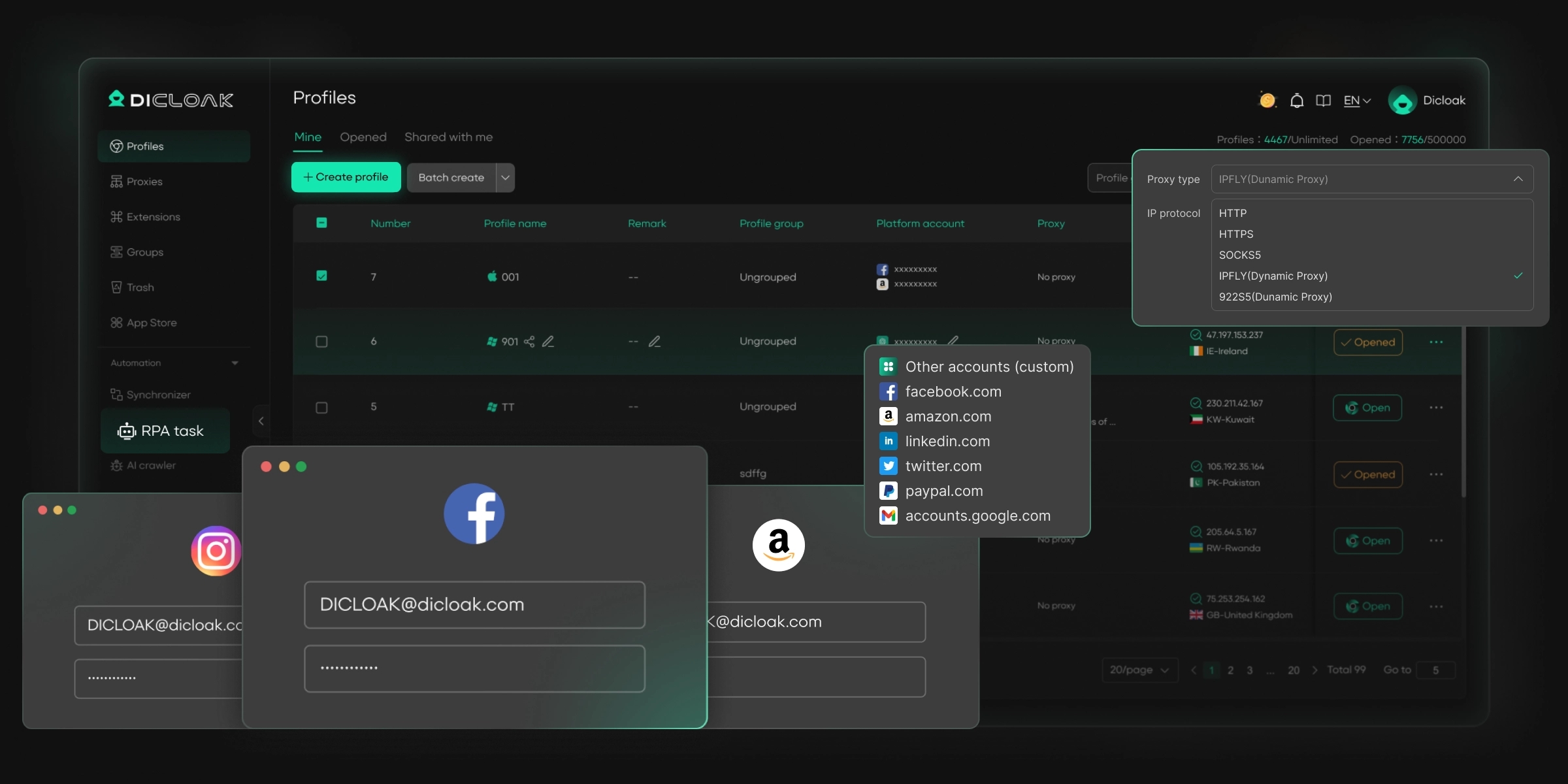
What Makes DICloak Stand Out?
✅ Manage 1,000+ Accounts on One Device: Stop wasting money on extra hardware! DICloak allows you to manage multiple accounts on a single device, cutting costs and boosting efficiency.
✅ Guaranteed Account Safety, No Ban Risks: Every account gets its own isolated browser profile with custom fingerprints and IPs, drastically reducing the risk of bans. Your accounts, your control!
✅ Flexible Proxy Configuration for Maximum Performance: Seamlessly integrate with all major proxy protocols (HTTP/HTTPS, SOCKS5) and manage your proxy pool with bulk operations. No more struggling with IP management—DICloak has you covered.
✅ Streamlined Team Collaboration for Better Results: Easily manage your team with advanced tools like profile sharing, permission settings, data isolation, and operation logs. Your team works smarter, not harder.
✅ Automate the Grind with RPA: DICloak's built-in RPA saves you hours of manual work. Automate repetitive tasks, streamline workflows, and focus on what really matters—growing your business.
✅ Powerful Bulk Tools to Scale Your Operations: Create, import, and launch multiple browser profiles in one click. DICloak makes scaling your business as easy as it gets.
✅ Compatible with All Major Operating Systems: Based on the Chrome core, DICloak supports simulating Windows, Mac, iOS, Android, and Linux operating systems. No matter what platform you need, DICloak has you covered.
🔗 Ready to Get Started?
Visit the DICloak website to explore more details and choose the plan that’s right for you. Start for free today and experience the power of secure, efficient, and scalable multi-account management!
Summary: Is Marketer Browser a sound investment in 2025?
MarketerBrowser shows potential as an anti-detection tool, addressing key challenges in the field. However, it's better suited for smaller-scale operations or those just beginning with anti-detection strategies. If you're running a large-scale campaign, require automation, or need advanced digital footprint management and team collaboration, MarketerBrowser might fall short.
For businesses or marketers scaling up or running more intricate operations, alternatives like DICloak can offer a more robust solution. DICloak excels with features like custom proxy configurations, full profile isolation, and powerful automation tools, ensuring smoother and more secure management of multiple accounts. If you're looking to expand your strategy, DICloak might be the better choice for the long term.
FAQs About Marketer Browser
Is Marketer Browser compatible with Mac or Linux?
It does not run natively. Marketer Browser is presently only available for Windows; there is no direct macOS or Linux version.
Does Marketer Browser include integrated proxies?
No, Marketer Browser doesn't provide internal proxy functionality. You must acquire your own proxies and configure them for your profiles manually. It does feature a proxy validator, but automatic proxy switching is absent.
Is task automation possible with Marketer Browser?
Only to a degree. It supports simple automation such as automatic sign-in and cookie handling. However, it isn't compatible with standard automation tools like Selenium or Puppeteer, meaning intricate jobs still need manual effort or external solutions.
Is Marketer Browser suitable for group use?
Not particularly. Even though it has cloud synchronization, it lacks strong teamwork features like user roles, access restrictions, and live profile updates. It's workable for individual users, but teams might find its capabilities restrictive.
 Web Proxy Tools
 Free Tools
 Cookie Plugin
 UA Generator
 MAC Address Generator
 IP Generator
 IP Address List
 2FA Code Generator
 World Clock
 Anonymous Check
 WebRTC Leak Test
 UUID Generator
 Free Web Proxy Site
 Proxy Checker
 FB Ad Checker
 AI Web Scraping
 Free SMM Tools
 Twitter Shadowban Checker
 Instagram Name Checker
 UTM Generator
 Username Generator
 AI Hashtag Generator
 LinkedIn Headline Generator
 Social Media Image Resizer