Understanding the Landscape of Account Integrity and Enforcement
From the perspective of a senior cybersecurity analyst, maintaining Operational Security (OPSEC) for digital growth infrastructure is a prerequisite for survival in 2026. Whether managing e-commerce portfolios, affiliate marketing networks, or traffic arbitrage operations, the attack surface—the points where Instagram’s automated systems can detect and disable your assets—has expanded significantly.
Instagram now utilizes a multi-layered heuristic analysis to monitor for "abnormal" patterns that deviate from baseline human interaction. These automated integrity systems do not simply look for rule-breaking content; they scan for technical inconsistencies and hardware-level identifiers. For high-scale operators managing 1,000+ profiles, the stakes are existential: a single fingerprint leak can trigger a network-wide collapse. This guide provides a technical blueprint for mitigating infrastructure vulnerability through hardware isolation and behavioral randomization.
Decoding the Technical Reasons Why Does Instagram Suspend Accounts
Instagram’s enforcement logic is governed by AI-driven integrity systems that prioritize the detection of non-human entities and malicious actors.
- Heuristic Community Guideline Scanners: Instagram employs advanced AI to monitor content in real-time. This includes Natural Language Processing (NLP) for detecting hate speech and computer vision for identifying banned imagery or copyright-infringing assets. Repetitive violations lead to a progressive escalation from temporary limits to permanent disability.
- Probabilistic Behavioral Red Flags: Internal spam filters track the velocity and frequency of actions. Rapid-fire following, mass commenting, or joining engagement pods are identified as "bot-like" because they lack the entropy (randomness) of human behavior.
- Impersonation and Identity Verification (The 180-Day Window): Under the "Fraud and Deception" protocol, accounts suspected of misrepresentation are flagged for mandatory identity verification. This mechanism requires selfie-video authentication or government ID submission. Crucially, if valid proof is not provided within 180 days, the account is permanently purged from the database, rendering it unrecoverable.
The Role of Browser Fingerprinting in Why Does Instagram Suspend Accounts
Canvas and WebGL Fingerprint Isolation
Standard browsers leak a wealth of hardware data. Instagram’s scripts use Canvas and WebGL APIs to render hidden images, analyzing the specific rendering offsets, GPU driver versions, and clock speeds of your hardware. These values are combined to create a unique Hardware UUID or "fingerprint." If multiple accounts share a cluster of these identical hardware hashes, they are linked in the backend.
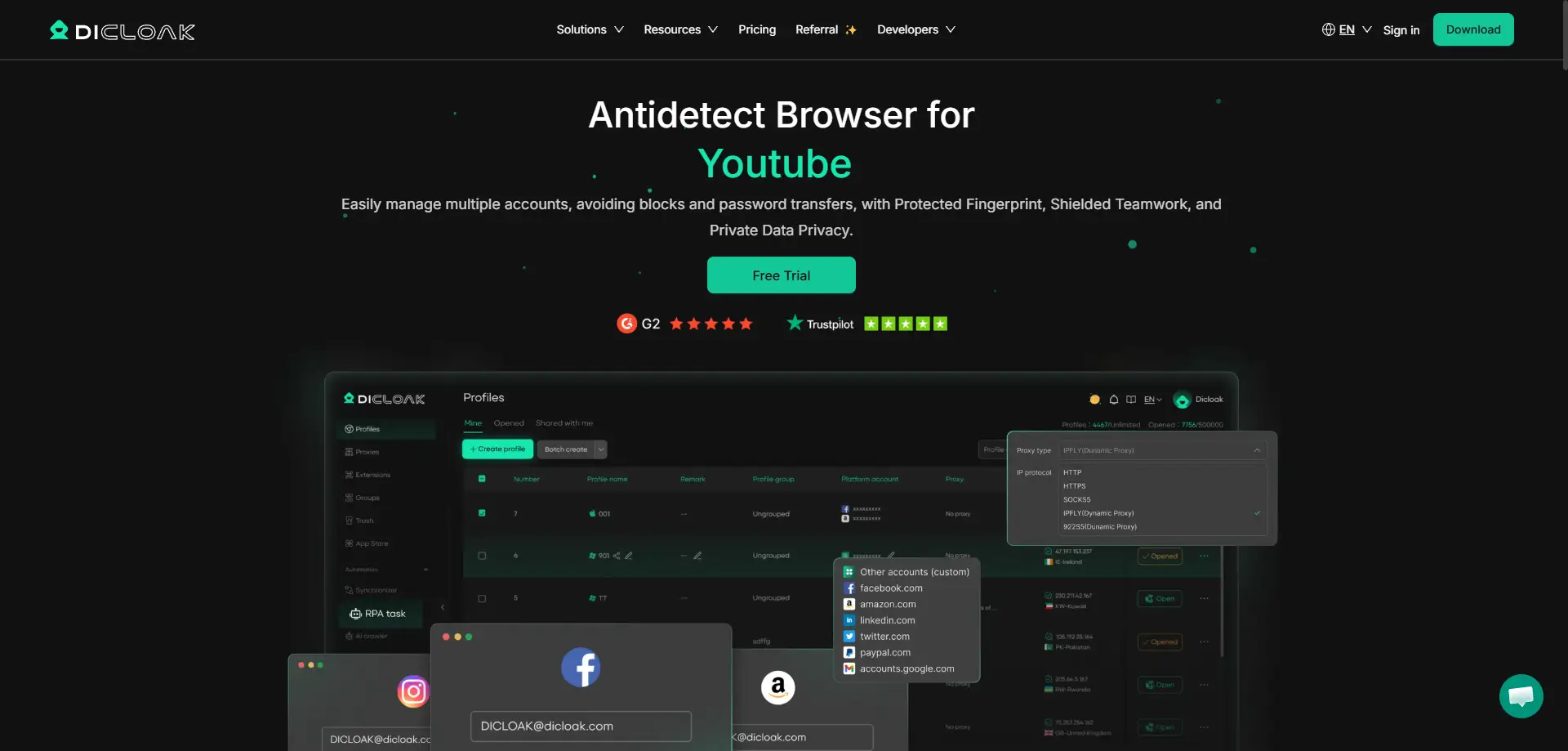
High-security infrastructure like DICloak does not merely "hide" these values; it spoofs unique, mathematically plausible configurations for each profile. By isolating Canvas, WebGL, and AudioContext hashes, operators ensure that each account appears to exist on a physically distinct device, effectively neutralizing the risk of association.
Hardware Identity and OS Simulation
Instagram looks for "OS Mismatch" signals—instances where a browser reports it is running on macOS but behaves like a Windows kernel. To maintain profile credibility, security tools must simulate different environments (Windows, Mac, iOS, Android, Linux) at the kernel level. This prevents Instagram’s tracking scripts from detecting the inconsistencies that typically flag multi-account management tools.
Proxy Management and IP Reputation: ASN Node Integrity
IP reputation is determined by the Autonomous System Number (ASN) node associated with the address.
- Datacenter IPs: These belong to known server ranges (e.g., AWS, DigitalOcean) and are easily mapped and blacklisted as high-risk by Instagram.
- Residential IPs: These are associated with legitimate ISP-provided nodes, making them appear as standard home users.
Pro Tip: To minimize the attack surface, high-value accounts must utilize dedicated residential proxy management via HTTP/SOCKS5 protocols. This ensures each profile maintains a clean, isolated reputation, preventing the "dirty IP" flags that trigger immediate security checkpoints.
Behavioral Patterns: Why Does Instagram Suspend Accounts for Automation
RPA and Workflow Randomization
Traditional automation is detected because it follows static, predictable click-paths. Instagram’s AI tracks the "mechanical" nature of these interactions. Advanced Robotic Process Automation (RPA) within DICloak mitigates this by introducing human-like entropy:
- Variable Dwell Times: Profiles pause on content for randomized intervals.
- Non-Linear Mouse Movements: Simulating the organic, imperfect path of a physical mouse.
- Randomized Scroll Velocities: Varying the speed at which a user navigates the feed to prevent "velocity flags."
Batch Operations and the "Cascade Effect"
In high-scale operations, the "Cascade Effect" occurs when the suspension of one account leads to the immediate flagging of an entire "fingerprint cluster" (linked by IP, hardware hash, or browser cookies). Secure infrastructure prevents this by ensuring that profiles are launched in a synchronized yet technically isolated manner, preventing cross-contamination between different accounts in a single network.
Understanding Suspension Durations and Enforcement Tiers
- Temporary Limits (Action Blocks): Shadow blocks or 24–48 hour restrictions on specific actions (likes/follows), usually triggered by high-velocity activity.
- Standard Suspension (30-Day Cool-off): A total lockout often applied to repeat offenders or those flagged by more severe heuristic violations.
- Permanent Disability: The terminal state for accounts that fail the 180-day verification window or commit severe breaches of Meta’s community standards.
How to Appeal a Suspension and Recover Access
Step 1: Status Verification
Attempt a login to distinguish between a "Temporary Action Limit" and a "Disabled" notice. If the latter, you must initiate the formal appeal immediately to beat the 180-day deletion clock.
Step 2: Formal Appeal Submission
Choose the template that best fits the nature of the suspension:
Template A: Human Error / Mistake
"I believe my account [Username] was suspended in error. I have meticulously followed Instagram's Community Guidelines and have not engaged in any prohibited behavior. I request a manual review of my account history to rectify this misunderstanding. Thank you."
Template B: Account Safety / Suspicious Login
"My account [Username] appears to have been suspended due to unrecognized activity. I suspect my security may have been compromised. I am the legitimate owner and can provide all necessary documentation to verify my identity and secure the account. Please advise on the recovery steps."
Step 3: Identity Verification Protocol
Be prepared to submit a photo of yourself holding a handwritten code, business invoices, or a selfie video. Failure to complete this step within 180 days results in permanent account deletion.
Step 4: Persistence Protocol
Instagram’s support is often non-responsive. If no feedback is received within 72 hours, follow up through alternative Meta support channels or the "Request Review" forms in the Help Center.
Proactive Infrastructure: Mitigating Risk via Data Isolation
Team Permissions and Operation Logs
Internal threats and accidental cross-contamination are significant risks for large teams. Robust infrastructure utilizes granular permission settings, ensuring team members only access their assigned profiles. Furthermore, Operation Logs provide an audit trail of every action taken within a profile, allowing analysts to pinpoint the exact action that triggered a flag.
Scaling Without Hardware Overhead
The traditional method of scaling (buying more physical phones/laptops) is inefficient. Modern antidetect browsers like DICloak allow for the management of 1,000+ accounts on a single device by creating isolated environments that satisfy Instagram's device-limit checks (which usually cap at 5 accounts per standard device).
Standard Methods vs. High-Security Multi-Account Management
| Feature |
Standard Browsing |
DICloak Antidetect Browser |
| Fingerprint Protection |
None; hardware hashes are leaked |
Isolated, unique hardware spoofing |
| Kernel-Level Simulation |
No (Reports actual OS) |
Yes (Simulates Win, Mac, iOS, Android) |
| IP Management |
Manual / Shared IP |
Bulk Proxy Management |
| Automation (RPA) |
Detected via static paths |
Randomized human-like workflows |
| Team Collaboration |
Cross-contamination risk |
Data isolation & operation logs |
| Hardware Costs |
High (1 device per 5 accounts) |
Minimal (1,000+ accounts on 1 device) |
Objective Analysis of DICloak Antidetect Browser Infrastructure
Pros
- Mitigation of Cross-Contamination: Prevents the "Cascade Effect" through fingerprint isolation.
- Cost Efficiency: Removes the need for physical device farms.
- Scalability: Bulk creation tools allow for rapid expansion of digital assets.
- Operational Security: Integrated proxy and fingerprint management streamlines Operational Security.
Cons
- Technical Threshold: Requires an understanding of proxies and browser fingerprinting.
- Dependency on Proxy Quality: Even the best browser cannot save an account using a blacklisted datacenter IP.
- Management Overhead: Requires consistent monitoring of licenses and IP reputations.
Frequently Asked Questions About Instagram Security
How many accounts can I safely run on one device?
Standard devices are technically limited to 5 accounts before Instagram’s AI flags the device for "industrial" activity. Antidetect browsers remove this ceiling by assigning each account a unique hardware UUID.
Why was my account suspended for "no reason"?
This is typically the result of an AI "false positive" or a fingerprint leak. If your browser profile is inconsistent (e.g., your Canvas hash matches a banned profile), you will be caught in a collateral sweep.
Can Instagram detect the use of a proxy?
Instagram can easily detect datacenter IPs because they originate from known server farms. To Instagram, a proxy is only "undetectable" if it is a high-quality residential IP associated with a legitimate ISP ASN node.
How long does the appeal process actually take?
While some appeals are resolved in 48 hours, complex cases can take weeks. If you do not provide identity verification within the 180-day window, Instagram's systems are programmed to delete the data permanently.
 Web Proxy Tools
 Free Tools
 Cookie Plugin
 UA Generator
 MAC Address Generator
 IP Generator
 IP Address List
 2FA Code Generator
 World Clock
 Anonymous Check
 WebRTC Leak Test
 UUID Generator
 Free Web Proxy Site
 Proxy Checker
 FB Ad Checker
 AI Web Scraping
 Free SMM Tools
 Twitter Shadowban Checker
 Instagram Name Checker
 UTM Generator
 Username Generator
 AI Hashtag Generator
 LinkedIn Headline Generator
 Social Media Image Resizer