As online privacy and security become increasingly important, finding reliable ways to stay anonymous and access restricted content is essential. One effective solution is using residential proxies, but what is a residential proxy exactly?
A residential proxy allows you to route your internet traffic through real residential IP addresses, making your online activity appear like it’s coming from a regular user. This simple yet powerful tool can help with tasks like web scraping, SEO monitoring, ad verification, and social media management. Whether you’re a marketer, researcher, or business owner, understanding what is a residential proxy and how to use it can enhance your digital strategy.
In this guide, we’ll break down everything you need to know about residential proxies: how they work, their different types, practical use cases, and tips for choosing the best provider. Ready to learn how you can boost your online operations? Let’s dive in!
What is a Residential Proxy?
A residential proxy is a special kind of proxy that uses a real home IP address. A home IP address is one given by an Internet Service Provider (ISP) to a real house or apartment.
Normally, when you open a website, your computer sends a request directly. The website sees your IP address. That address may show your city or region. But when you use a residential proxy, your request first goes to a proxy server. Then the proxy sends your request to the website using a real residential IP.
Because the IP belongs to a real home, the site sees the request as coming from a real user. The website often treats it like a normal person browsing from home. That makes residential proxies harder to spot than other proxy types.
For example, imagine you are in San Jose. You want to check how a store website looks to a user in New York. With a residential proxy in New York, your request will look like a real New York home. The store shows you the New York version of the site —the same as someone living there.
In short, a residential proxy hides your real IP and gives you a normal home‑type IP from another location. That helps you appear like a real user from another place.
How Residential Proxies Work
Now that you know what a residential proxy is, let's take a closer look at how it functions and the benefits it offers. In this section, we'll explore the mechanism behind residential proxies and the key advantages they bring to the table. Whether you're using them for privacy, web scraping, or managing multiple accounts, understanding how they work is essential.
Mechanism of Action
When you use a residential proxy, here is what happens behind the scenes. First, you send a request from your computer or browser to the proxy server. The proxy server is not a big data‑center. It uses a real IP address from a real home or device.
Then the proxy forwards your request to the website you want to visit. The website sees the request coming from that home-type IP address. To the website, your request looks like it is from a regular user at home, not a bot or a server.
When the site sends back data (for example a web page), the proxy receives it first. Then the proxy sends the data back to you. This hides your real IP from the website.
For example, you live in San Jose. You want to check how a news website looks to a user in London. You connect to a residential proxy that uses a London home IP. When you open the news site through the proxy, the site sees a London IP. You see the website just as if you are in London. The site does not know your real IP or location.
Because of this flow — you → proxy → website → proxy → you — your real IP stays hidden. And the site sees a normal home‑internet user. That is how a residential proxy works.
Benefits of Using Residential Proxies
There are several key benefits when you choose a residential proxy instead of other proxy types.
High trust and low detection Because a residential proxy uses a real home IP from an Internet Service Provider, websites treat traffic as coming from a normal user. That lowers the chance the site will flag or block you.
Access to content in different locations If you pick a proxy IP from another city or country, you can access content that is limited to that location. For example, some online stores or services show different pages for different regions. With a residential proxy from that region you can see the local version. This is useful for price checks, location‑based reviews or ad verification.
Better success for web scraping, data collection, or multiple account use If you run many requests (like checking dozens of product pages, or managing many accounts), a residential proxy helps you avoid being flagged. The traffic looks natural. You appear like many different real users. That helps you succeed in tasks where datacenter proxies may fail.
Flexibility depending on needs Some residential proxies are “static” (same IP for a longer time), good for login sessions or account management. Others are “rotating” (IP changes often), good for large‑scale tasks or scraping many pages. You can pick what suits your use case.
Enhanced anonymity and privacy Since the proxy hides your real IP and uses genuine home IPs, your real location and identity stay hidden. That gives more privacy than regular connections — useful if you want to protect your online footprint.
Types of Residential Proxies
In the world of residential proxies, you have several kinds to choose from. Each kind works a little differently. Each kind has its own pros and cons. Below we show the main types. This will help you pick the right one for your needs.
Rotating vs. Static Proxies
One major choice when you ask yourself what a residential proxy is whether to use a rotating or a static proxy.
A static proxy means the proxy gives you the same IP address for all your requests during a session. The IP stays stable. This is good when you need to log in to an account and stay there for a while. For example, if you manage a social‑media account or log in to an online store many times, a static proxy keeps your identity steady. Static proxies give stable speed and less chance of disruption.
A rotating proxy works differently. It gives you a different IP address for each request — or after a short time. Every new request can come from a new IP. This helps you hide that all requests come from the same source. Rotating proxies are very useful if you need to browse many pages, gather data, or check many accounts. This reduces the chance websites will block or throttle you.
For example, if you run a price‑monitoring script to check dozens of product pages on an online store, a rotating proxy might use one IP for the first page, another IP for the second page, and so on. The store will think many different people looked at the pages, not just one person. That makes detection harder.
But rotating proxies can be slower. Because the IP changes often, sometimes you wait more for the page to load.
In short: static proxies = stable and good for long login or account tasks; rotating proxies = flexible and good for many requests or data collection.
Dedicated vs. Shared Proxies
Another important difference lies in proxy exclusivity. Some residential proxies give you a dedicated IP. Others share IPs among many users.
A dedicated proxy means only you use that IP. No one else uses it at the same time. This gives you more control. It lowers risk that someone else’s bad behavior makes your IP banned. It is ideal when you do important tasks — like running business accounts or managing sensitive logins.
A shared proxy means many users share the same IP pool. The provider rotates or reassigns those IPs among users. For tasks like casual browsing, simple scraping, or testing geo‑locations quickly, this can work and cost less. But because many people use the same IPs, there is a greater chance of slow speed or previous misuse that may cause blocks.
For example, if you share a proxy with 50 other people who all scrape the same site, the site might block that IP because of heavy use. Then you lose access until the IP changes. A dedicated proxy avoids that risk.
Choosing between dedicated or shared depends on how critical your task is: if reliability and consistency matter, go for dedicated. If cost and flexibility matter, shared might suffice.
Mobile Proxies and Their Unique Advantages
There is a third type related to residential proxies: mobile proxies. These proxies use IPs from real mobile devices on cellular networks, not home‑ISP lines.
Mobile proxies are useful when you want traffic to look like it comes from a phone. Some websites or apps treat mobile traffic differently. Maybe they show a different version, block desktop IPs, or have stricter rules. Using a mobile proxy can help you bypass those limits.
Also, mobile IPs can rotate often. This makes them more dynamic and harder to detect. For tasks like social‑media account creation, mobile‑only content testing, or ad verification, mobile proxies can be very effective.
For example, suppose you run a campaign to test how a mobile‑only app shows content in different countries. You can use a mobile proxy from a mobile carrier in that country. Then when you open the app or website, it looks like a real phone user from there. That can help you see mobile‑specific layouts or ads.
But mobile proxies often cost more. And their speed or stability may vary with mobile network quality. So they are best when you need stealth and mobile‑like traffic, not for heavy downloads or stable sessions.
Use Cases and Applications of Residential Proxies
Now that you know what a residential proxy is and the main types, you might wonder — what can you actually do with it? Below are common and useful applications.
Web Scraping: Collecting Data Efficiently
A big use of a residential proxy is web scraping. Sometimes people or companies need to collect data from many web pages. But many sites block bots or datacenter IPs. A residential proxy helps your requests look like they come from real home users.
For example, imagine you run a site that tracks product info on online stores. You want to check product names, prices, descriptions across many pages. If you use a residential proxy with IPs from real homes, the store may not block you. You get data continuously. That makes data gathering faster and more reliable.
This helps in market research, price comparison projects, or building a public database.
SEO Monitoring: Tracking Competitor Strategies
Another helpful use is SEO monitoring. Search engine results often change depending on location. With residential proxies from different cities or countries, you can see how a website ranks in different places. That gives you a clearer picture of global search performance.
For example, a business in the U.S. might want to know how its site shows up to visitors in Europe. By using a residential proxy in Europe, you get real search results from that region. This helps you compare how your site and your competitors do across regions.
This method helps SEO analysts study trends and adapt strategies based on location‑specific behavior.
Ad Verification: Ensuring Accurate Ad Display
Ads often target people by location. Sometimes advertisers need to check if ads show properly in different regions. A residential proxy can show you what a real user in that region would see.
For example, a marketing team runs ads for a product in New York, Paris, and Tokyo. Using residential proxies with IPs from those cities, they open the ad as if they are local users. They can check if the right ad appears, if the right currency or offer shows, and if layout works on that region’s page.
This helps them catch mistakes before they cost money, and ensures accurate ad placement and targeting.
Social Media Management: Automating Tasks
Many social media platforms block or flag multiple accounts if they all use the same IP. If you run several accounts (for marketing, brand support, or content), a residential proxy helps you make each account look like a separate normal user.
For example, a social media manager handles 5 brand accounts. With a residential proxy giving each account a unique home‑type IP, the platform sees them as separate users from different locations. This reduces risk of being flagged or banned.
Also, automation tools—like posting, scheduling, or data collection—residential proxies help avoid blocks. That keeps management smooth and safe.
Price Monitoring: Keeping Up with Market Changes
If you run e‑commerce or buy/sell products, price monitoring is very useful. A residential proxy lets you check prices from many regions, as if you are a local shopper. This helps you see regional price differences or stock changes.
For example, a seller wants to track prices of gadgets in different country stores. With residential proxies from those countries, they see local prices and how they change over time. This helps set competitive price strategies or spot promotions early.
Residential proxies also help avoid blocks when you visit many product pages often, which is common in price‑tracking tools.
Legal and Ethical Considerations of Residential Proxies
Now that you know what a residential proxy is, how it works, its types, and what you can use it for — it is also very important to think about legal and ethical issues. Using a residential proxy wisely helps you stay safe and respectful. Below we talk about two big concerns: whether residential proxies are legal, and how to get them ethically.
Legality of Using Residential Proxies
Using a residential proxy by itself is often legal. A proxy is just a tool — like a mask for your IP. As long as you do not break other laws, using a proxy is okay.
For example, if you use a residential proxy to look at public pages on a website, or test how a site appears in another country, that is generally fine. Many experts say web scraping or data collection of public information is allowed.
But legality depends on what you do while using it. If you try to grab private data, hack accounts, break login walls, or ignore copyright or the website’s rules — you might be breaking the law.
Also, rules vary by country. What is legal in one place might be banned in another. So you must check the local laws and the website’s terms of service before you act.
In short, using a residential proxy can be legal — but only if your actions stay within law and ethics.
Ethical Sourcing of Proxies
Even if a residential proxy is legal, the way the proxy provider gets IP addresses matters. It can be good — or harmful.
Good providers get proxy IPs in a clean, legal, and transparent way. For example, they work with real users who opt in — people agree that their home internet or device becomes a proxy node. These providers show proof and keep logs, so the proxy pool stays honest and safe.
Bad or unethical providers might use shady methods. Some may take IPs from users without consent. Others might use hacked devices, public‑WiFi sniffing, or malware to build proxy pools. These methods are risky and may break privacy laws or expose users to security harms.
For example, if you buy a “free” residential proxy from a low‑cost provider but later learn those IPs came from infected home devices or without user permission — you risk legal trouble or data leaks. That can also hurt your reputation.
Therefore, if you decide to use a residential proxy, you should check how the provider gets IPs. Choose a provider that clearly states they use ethical sourcing. Avoid unknown, super‑cheap, or “free” proxy pools with unclear origin.
Ethical sourcing also helps ensure long-term stability. Legitimate proxies are less likely to be blocked or banned. Their IPs are cleaner (not flagged for abuse). This matters if you run business tasks or long‑term projects.
Residential Proxies vs. Datacenter Proxies
Now you know what is a residential proxy. It is useful to see how it differs from another common option — a datacenter proxy. Each has its strengths and trade‑offs. The right choice depends on your needs.
What Are Datacenter Proxies
A datacenter proxy uses IP addresses that come from servers in big data centers. These IPs are not from a home or a real user. Instead, many users share them. Because the server is powerful and optimized, datacenter proxies are usually fast and cheap.
For example, if you just want to load many pages fast, or do a quick check on lots of websites, a datacenter proxy may work well. Because speed and cost matter more than “looking like a normal user.”
Key Differences: Residential vs. Datacenter
Legitimacy and detection risk A big difference is legitimacy. A residential proxy uses a real home‑type IP from an Internet Service Provider. This helps the traffic look like a real user. Many websites treat it as normal users, and rarely block it.
A datacenter proxy, by contrast, uses server IPs. Some websites can detect such IPs more easily. They may flag or block them if they look like bulk traffic or automation.
Cost and speed Datacenter proxies are often cheaper than residential proxies. They cost less because they come from servers designed for many users.
Also, datacenter proxies are faster. They usually have strong bandwidth and stable connection because data centers optimize for performance.
Residential proxies tend to cost more. They need real‑world home IPs, which are harder to source and maintain.
Speed of residential proxies may be a bit slower, because traffic travels through real‑user networks which vary in quality.
Use‑case suitability If your task needs high anonymity, needs to mimic real user behavior, or must avoid detection (for example geo‑restricted content access, multiple account management, sensitive scraping), a residential proxy is often better.
For example, a marketing team might use residential proxies to test how a website appears in different countries. With real home IPs, the site treats them as normal users. That helps avoid blocks or CAPTCHAs.
On the other hand, if your task needs many quick requests, big data flow, or heavy bandwidth — like downloading large files, or scraping lots of data where detection is not strict — datacenter proxies can save cost and give speed.
When to Use Each: Mixed Approach
Some people use a mix. For sensitive tasks or those needing stealth, they use a residential proxy. For heavy tasks where speed matters more than stealth, they use a datacenter proxy.
For example, when scraping a public site that does not block proxies, a datacenter proxy may work well. But when scraping a protected site with strong anti‑bot systems, a residential proxy gives better success.
This way, you get the best of both worlds: speed and cost when you can, safety and legitimacy when you need it.
Choosing a Residential Proxy Provider
Now that you understand what is a residential proxy and how it works, you may wonder how to choose a good provider. Not all providers are equal. The right one makes your tasks easier, safer, and more reliable. Here are the key things to check when you pick a provider.
Key Selection Criteria
Reputation and Reviews
The first thing to check is a provider’s reputation. A trusted provider has many real users and good reviews. A large network of users and a long history often show reliability. According to a 2025 industry review of top services, good providers offer broad IP pools, stable speed, and real residential IPs.
For example, before you pay, search online for user feedback or third‑party reviews. If many users report frequent disconnects or blocked IPs, that provider is risky. On the other hand, providers with high success rates in tests — for example those listed among “best residential proxy providers of 2025” — tend to deliver consistent service.
Pricing Models
Cost matters. Residential proxies are usually priced per amount of data (bandwidth) you use or by plan.
A good provider offers clear pricing and flexible plans. For casual use, small pay‑as‑you‑go plans may be enough. For heavy tasks (scraping, many accounts, long sessions), a plan that gives discounts for larger data volume may save money.
Also, avoid extremely cheap offers that seem “too good to be true.” Sometimes, such offers come with poor IP quality or unstable connection. A trustworthy provider explains the cost, what you get (data, IP pool, support), and has no hidden fees.
Customer Support and Assistance
Even a good proxy can run into problems. Maybe some IPs get blocked. Maybe you need help setting up rotation or targeting by city. A good provider offers clear support and help.
Good support includes fast response, clear documentation, and helps to fix issues like proxy errors or location mismatch. If the provider offers trial or refund options, that also shows confidence in their quality.
For example, some top services provide live chat or 24/7 support. That can help you quickly solve problems during time‑sensitive tasks like price monitoring or ad verification.
Conclusion
In this guide, we explored what a residential proxy is and how it works. A residential proxy is a tool that helps you browse the internet using real home IPs, making your online activities look like they come from regular users. This is useful for tasks like web scraping, SEO monitoring, ad verification, and social media management.
We also discussed the main types of proxies, including rotating vs. static proxies, dedicated vs. shared proxies, and mobile proxies. Each type has its own strengths depending on your needs. Whether you want better anonymity, faster speed, or cheaper costs, choosing the right proxy depends on your specific use case.
When selecting a residential proxy provider, it’s important to consider factors like reputation, pricing models, and customer support. Always choose a provider with a good track record and clear, ethical proxy sourcing.
By understanding the differences between residential proxies and datacenter proxies, you can make informed decisions about which proxy is best for your project, balancing speed, cost, and security.
Why choose DICloak Antidetect Browsers for your business?
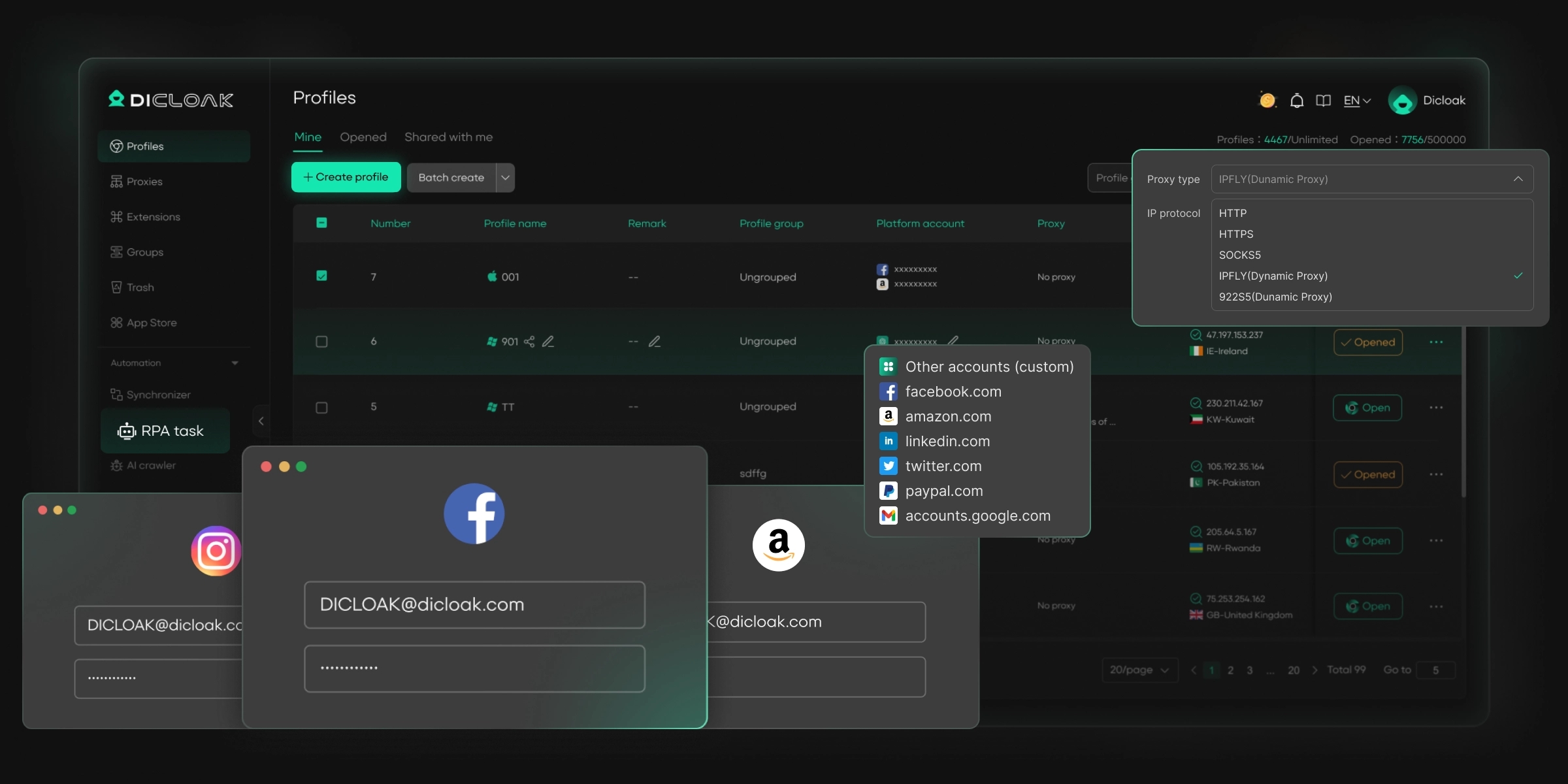
⚡The DICloak Antidetect Browser has become a global favorite for its unparalleled ability to efficiently and securely manage multiple accounts. Designed for professionals in social media management, affiliate marketing, traffic arbitrage, e-commerce, account farming, airdrops, and more, DICloak offers powerful features like RPA automation, bulk operations, and a window synchronizer. Additionally, it allows you to customize fingerprints and integrate proxies for each profile, ensuring top-level security and operational efficiency. It’s the ultimate tool for seamless, secure, and scalable operations.
What Makes DICloak Stand Out?
✅ Manage 1,000+ Accounts on One Device: Stop wasting money on extra hardware! DICloak allows you to manage multiple accounts on a single device, cutting costs and boosting efficiency.
✅ Guaranteed Account Safety, No Ban Risks: Every account gets its own isolated browser profile with custom fingerprints and IPs, drastically reducing the risk of bans. Your accounts, your control!
✅ Flexible Proxy Configuration for Maximum Performance: Seamlessly integrate with all major proxy protocols (HTTP/HTTPS, SOCKS5) and manage your proxy pool with bulk operations. No more struggling with IP management—DICloak has you covered.
✅ Streamlined Team Collaboration for Better Results: Easily manage your team with advanced tools like profile sharing, permission settings, data isolation, and operation logs. Your team works smarter, not harder.
✅ Automate the Grind with RPA: DICloak's built-in RPA saves you hours of manual work. Automate repetitive tasks, streamline workflows, and focus on what really matters—growing your business.
✅ Powerful Bulk Tools to Scale Your Operations: Create, import, and launch multiple browser profiles in one click. DICloak makes scaling your business as easy as it gets.
✅ Compatible with All Major Operating Systems: Based on the Chrome core, DICloak supports simulating Windows, Mac, iOS, Android, and Linux operating systems. No matter what platform you need, DICloak has you covered.
🔗 Ready to Get Started?
Visit the DICloak website to explore more details and choose the plan that’s right for you. Start for free today and experience the power of secure, efficient, and scalable multi-account management!
Frequently Asked Questions (FAQs)
What is a residential proxy and how does it work?
A residential proxy is a type of proxy that uses real home IP addresses provided by Internet Service Providers (ISPs). This type of proxy makes online activities appear like they are coming from real, everyday users. It works by routing your internet traffic through these real residential IPs, hiding your real location and identity. This makes it harder for websites to detect and block your traffic.
Why should I choose a residential proxy over a datacenter proxy?
What is a residential proxy compared to a datacenter proxy? A residential proxy uses real home IPs, making it appear like you are browsing from a regular user's device. This results in higher trust and less risk of being blocked by websites. In contrast, datacenter proxies use server-based IPs, which are easier for websites to detect and block. Residential proxies are ideal for tasks requiring high anonymity, like web scraping or managing multiple accounts.
Can I use a residential proxy for SEO monitoring?
Yes, you can. What is a residential proxy in the context of SEO? It's a valuable tool for tracking search engine rankings and monitoring competitors. By using residential proxies, you can check how a website ranks in different locations, giving you an accurate view of regional SEO performance. Residential proxies allow you to avoid detection, helping you get reliable search data without the risk of being blocked.
Are residential proxies legal to use?
Yes, what is a residential proxy in terms of legality? Using residential proxies is generally legal, as long as they are used for ethical purposes like browsing public websites or gathering publicly available data. However, using proxies for activities that violate terms of service or data scraping private information could lead to legal issues. Always ensure that your use of a residential proxy complies with local laws and website policies.
How do I choose the best residential proxy provider for my business?
When selecting a residential proxy provider, consider factors such as the provider's reputation, the quality of their IP pool, and their customer support. What is a residential proxy in this context? It's a service that provides you with access to real residential IPs, helping you maintain privacy and avoid detection. Look for a provider with clear pricing models, positive reviews, and reliable support to ensure you get the best value for your business needs.
 Web Proxy Tools
 Free Tools
 Cookie Plugin
 UA Generator
 MAC Address Generator
 IP Generator
 IP Address List
 2FA Code Generator
 World Clock
 Anonymous Check
 WebRTC Leak Test
 UUID Generator
 Free Web Proxy Site
 Proxy Checker
 FB Ad Checker
 AI Web Scraping
 Free SMM Tools
 Twitter Shadowban Checker
 Instagram Name Checker
 UTM Generator
 Username Generator
 AI Hashtag Generator
 LinkedIn Headline Generator
 Social Media Image Resizer