As we navigate the academic landscape of 2026, Artificial Intelligence has matured from a controversial disruption into an essential learning partner. For the modern student, tools like Unblocked ChatGPT for School are no longer mere “shortcuts” for generating text; they function as sophisticated engines for brainstorming research ideas, deconstructing complex scientific theories, and supporting multi-step problem-solving. In an era where digital literacy is a core competency, the ability to leverage AI responsibly and effectively is now as vital as traditional research skills.
The goal of this guide is to provide safe, legal, and policy-aware methods for using Unblocked ChatGPT for School within educational environments. While the strategic value of AI in learning is undeniable, institutional network restrictions and content filters often create access barriers. This guide serves as an authoritative resource to help students regain access responsibly—maintaining productivity without compromising academic integrity. Understanding the technical and administrative reasons behind why ChatGPT is blocked in schools is the essential first step toward sustainable and compliant access.
Why Schools Filter Access to Unblocked ChatGPT for School
Institutional network restrictions are rarely arbitrary; they are strategic responses to pedagogical, legal, and technical pressures. When a school administrator implements a block, they balance the benefits of innovation against the risks of the open web.
Addressing Academic Integrity and Misuse
The primary driver for AI restrictions is the protection of academic standards. Educators remain concerned about "ghostwriting," where automated systems generate essays or solutions without student engagement. By 2026, the challenge has evolved; schools aren't just worried about text matching, but about the bypass of the learning process itself. Tightening controls on campus Wi-Fi is often the first line of defense to ensure that student output reflects genuine individual cognitive effort.
Privacy Protection and Network Constraints
Beyond academic honesty, schools must navigate a complex web of data privacy laws. Many AI platforms collect user data to refine their models, which can conflict with strict regulations regarding the data of minors. Additionally, high-traffic AI applications can strain campus infrastructure. Administrators often use filters to conserve bandwidth, ensuring that essential school resources—like Cloud-based learning management systems—remain stable and performant for all users.

Common Environments Where AI Access is Restricted When Using Unblocked ChatGPT for School
Students typically encounter "Access Denied" messages in environments where IT administrators utilize centralized management tools to govern digital behavior.
Managed Chromebooks and School Wi-Fi
School-issued Chromebooks are the most restricted environments due to admin-level Google Workspace policies. These devices often run managed profiles that prevent the installation of unauthorized extensions and block specific DNS-level domains.
- DNS Filtering: Blocking the "address book" of the internet to prevent AI domains from resolving.
- Disabled Incognito: Most school-managed profiles explicitly disable Incognito Mode, making it harder to bypass local tracking.
- Technical Pro-Tip: If you are on a Chromebook, your first attempt should always be Guest Mode. According to source data, some restrictions are tied specifically to the student's logged-in account; restarting the device and signing in as a Guest can sometimes bypass these account-level blocks.
Regional and Individual Account Limitations
In some instances, the block is geographic or account-specific rather than institutional.
- National Censorship: Based on publicly available online data, ChatGPT remains inaccessible in some countries due to local internet laws.
- Account Flags: OpenAI may temporarily flag or ban individual accounts for "unusual activity," which can lead to a loss of access even on personal hardware.
The Safety and Legality of Using Unblocked ChatGPT for School
Navigating Unblocked ChatGPT for School access requires a strategic understanding of the difference between technical capability and institutional policy. While modern tools make AI access increasingly flexible, maintaining Experience, Expertise, Authoritativeness, and Trustworthiness (EEAT) in your digital habits is essential for long-term academic success.
Navigating Institutional Policy vs. Personal Use
While unblocking ChatGPT is not illegal in most democratic jurisdictions, it may constitute a violation of your school's Acceptable Use Policy (AUP). To assess your standing, use this Checklist for Responsible Use:
- Review the AUP: Does the handbook explicitly forbid the use of proxies?
- Syllabus Compliance: Has your instructor provided specific guidelines for AI assistance on this assignment?
- Device Context: Is the hardware school-owned or personal? (School-owned devices have higher compliance expectations).
- Transparency: Are you prepared to cite AI as a "consultant" in your bibliography?
Synthesis: The Access Severity Scale
To choose an appropriate and responsible method for Unblocked ChatGPT for School, it is important to identify the type of restriction you are facing:
- Soft Blocks (DNS/URL Level): The school has simply "hidden" the site. These can be bypassed with simple DNS changes.
- Hard Blocks (Fingerprinting/IP Level): The network uses sophisticated "Advanced Detection" to identify the device and its behavior. These require professional-grade tools like anti-detect browsers.
Avoiding High-Risk "Free" Workarounds
Students should avoid unverified "free" proxy sites. These services often profit by injecting trackers or collecting your personal data, which can compromise your school credentials and violate privacy laws. Trusting unverified tools is a significant security risk that outweighs the temporary convenience of access.
Methods to Use Unblocked ChatGPT for School
Schools often apply network or device restrictions that limit access to AI tools like ChatGPT. As a result, students look for practical ways to use unblocked ChatGPT for school while staying mindful of school policies and responsible AI use. This section outlines common methods, explaining how they work and when they may be appropriate in an educational setting.
Utilizing DICloak for Secure and Private AI Access
For students requiring a "hard block" bypass that prioritizes privacy and account longevity, an antidetect browser like DICloak is the premier strategic solution.
Professional-Grade Fingerprint Protection
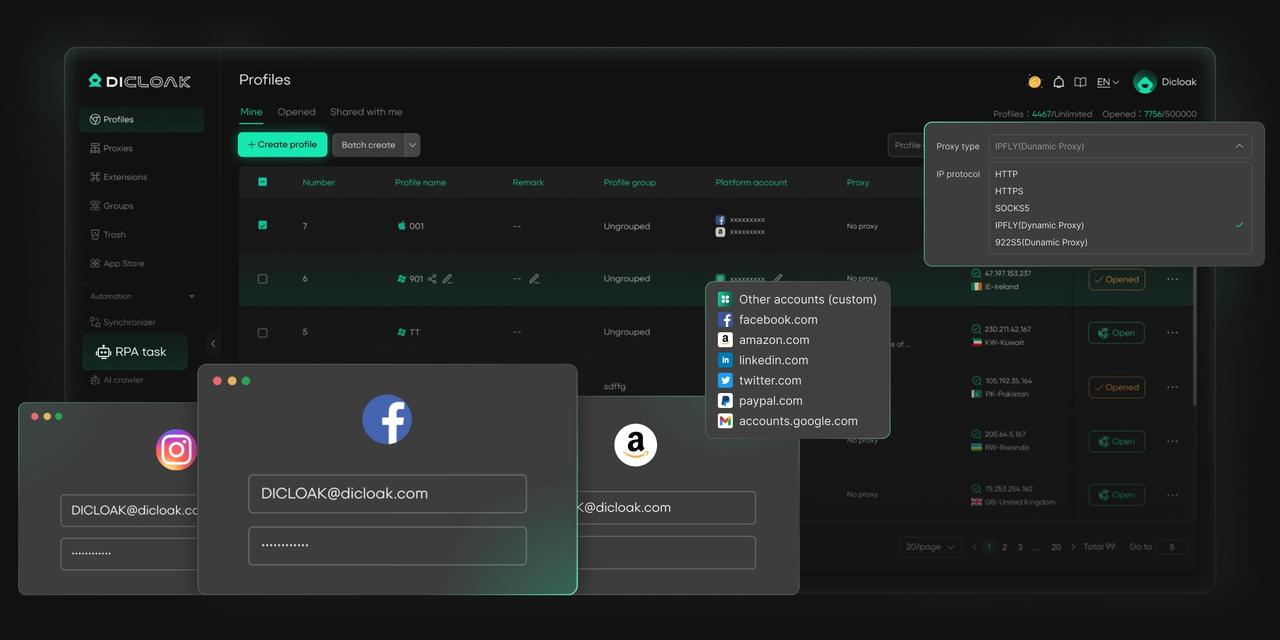
DICloak provides an isolated profile that masks your device's unique digital identity. Unlike standard browsers, it generates hyper-realistic fingerprints to bypass modern platform detection systems. Key technical elements masked include:
- IP and Geo-location: Spoofing your location via integrated proxy settings.
- Canvas and WebGL: Masking hardware-level identifiers used to track devices.
- Advanced Identifiers: Controlling AudioContext, WebRTC, and Client Hints to ensure each profile passes even the most rigorous detection tests used by OpenAI.
The DICloak Share+ Plan is an ideal solution for study groups or families. It offers Unlimited Seats (Members), allowing a team to share a single ChatGPT Plus license securely.
- Unified Fingerprints: All members appear as the same consistent user, preventing "suspicious activity" bans.
- Credential Hiding: Team members can access the AI without ever seeing or needing the actual password, protecting the primary account holder.
- Data Isolation: Keeps research sessions separate to prevent cross-tracking by school surveillance tools.
Adjusting DNS Settings to Bypass Content Filters
DNS filtering is a "low-level" block that functions like a restricted phone book. Changing your DNS settings can often restore access without requiring new software.
Switching to Google or Cloudflare DNS
- Navigate to Network Settings: On Windows or macOS, find your active Wi-Fi connection.
- Modify DNS Server: Select "Manual" or "Static" IP settings.
- Enter Public Addresses: Use Google (8.8.8.8) or Cloudflare (1.1.1.1).
- Save and Flush: Save settings and restart your browser to clear the cache.
The Limitations of DNS Modification
DNS changes are effective against simple URL blocks. However, they will fail against advanced firewalls that use IP-level blocking or application-layer inspection. If your school uses managed Chromebooks with deep device lockdowns, you will likely need to escalate to a mobile hotspot or an anti-detect browser.
Leveraging Mobile Data and Personal Hotspots
When institutional Wi-Fi is too restrictive, the most reliable "fail-safe" is to leave the school's network entirely.
Tethering Managed Devices to Mobile Networks
Using your smartphone as a mobile hotspot is the most effective way to bypass school firewalls. By connecting your Chromebook or laptop to your phone’s cellular data, you bypass all school-mandated content filters and DNS blocks. Since you are using a mobile carrier’s network, the school has no visibility into your traffic.
Managing Data Costs and Connectivity
While this method is highly reliable, it is data-intensive. Monitor your usage during long study sessions to ensure it remains cost-effective. This method is best reserved for high-stakes research or drafting phases where uninterrupted access is critical.
Accessing Unblocked ChatGPT via the Tor Network
For students in highly censored environments where privacy is the paramount concern, the Tor network offers the strongest protection.
How Tor Bypasses Strict Censorship
The Tor Browser routes your traffic through three layers of anonymous relays worldwide. This multi-layered encryption makes it nearly impossible for school IT or even government ISPs to see that you are accessing ChatGPT. It is designed specifically to bypass the most aggressive internet censorship.
The Trade-off: Speed vs. Anonymity
Tor's primary disadvantage is latency. Because your data is bounced across the globe, connection speeds are significantly slower. This makes it suitable for long-form drafting and research but less ideal for rapid, back-and-forth brainstorming sessions.
Strategic AI Alternatives When ChatGPT is Unavailable
In 2026, academic productivity depends on having a "Plan B." If OpenAI's domains are unreachable, these alternatives provide similar—and sometimes superior—functionality.
Top-Tier Replacements for ChatGPT
| Alternative |
Key Strength |
Academic Use Case |
| Claude AI |
Nuanced Writing |
Complex essay drafting and creative storytelling. |
| Google Gemini |
Real-Time Data |
Finding up-to-date sources via Google Search integration. |
| Perplexity AI |
Citations & Research |
Fact-checking with direct links to academic papers. |
| ChatTide |
No-Signup Gateway |
Instant, unblocked access to GPT-4o without an account. |
Specialized Educational Tools: Lumie AI
When general-purpose chatbots are blocked, specialized tools like Lumie AI often remain accessible because they are recognized as educational aids.
- Lumie Live Note Taker: Records and organizes lectures in real-time, allowing you to focus on the teacher while the AI handles the transcription and summary.
- AI Homework Solver: Helps deconstruct difficult problems and memorizes concepts via a built-in Flashcard Generator.
Best Practices for Ethical AI Use in 2026 When Using Unblocked ChatGPT for School
By 2026, AI detection has evolved. Teachers no longer look just for "word patterns"; they use behavioral pattern analysis to see if a student's drafting style matches their historical work. To stay safe and ethical, use the "Tutor-First" Methodology.
Prompting Tips for High-Value Results
Per source data from ChatTide, you can get significantly better academic results by refining your approach:
- Assign a Role: Start your prompt with "Act as a [Biology Professor]" to get focused, expert responses.
- Add Context: Provide your specific goal and target audience. The more detail you give, the better the AI can help you brainstorm.
- Refine, Don't Replace: Use AI to generate an outline or explain a theorem, then write the final submission in your own voice.
Disclosure and Citation Standards
Transparency is your best defense against disciplinary action. If you used AI for brainstorming or editing, disclose it. Most academic institutions in 2026 have specific citation formats for AI-assisted work. Following these demonstrates academic maturity and protects your standing.
Common FAQs for Unblocked ChatGPT for School
Is it legal to use unblocked ChatGPT at school?
Yes, it is generally legal, but it may violate your school's Acceptable Use Policy. Always check your student handbook to understand the consequences of bypassing network filters.
Can I use ChatGPT on a school Chromebook?
Yes. The most effective methods are using Guest Mode, a mobile hotspot, or a privacy-focused browser extension if the school has not disabled them.
Why does my school block AI sites?
Schools block these sites to protect academic integrity (preventing cheating), comply with minor data privacy laws, and ensure network bandwidth isn't overwhelmed.
What is the best way to get unblocked without installing extra software?
Changing your DNS settings to Google (8.8.8.8) can help bypass basic network restrictions. For more reliable access, using a lightweight web-based proxy or a no-signup gateway like ChatTide allows you to access blocked content without installing any additional software.
Will my teacher know I used AI?
In 2026, teachers use advanced tools that track behavioral writing patterns. If your submission style changes drastically or lacks your personal "voice," it may be flagged. Always use AI as a study partner, not a replacement for your own work.
Conclusion: Empowering Your Academic Journey
In 2026, AI is a permanent fixture of modern educational experience. By choosing professional tools like DICloak for secure and private access, and utilizing specialized platforms such as Lumie AI, students can responsibly benefit from Unblocked ChatGPT for School without compromising security or academic standards. When used correctly, AI becomes a powerful learning companion rather than a shortcut.
The key to long-term academic success lies in a balanced approach: prioritizing personal privacy, respecting your school’s core mission of education, and selecting the right technical tools to support learning. By integrating Unblocked ChatGPT for School in an ethical and policy-aware manner, and focusing on active learning over passive automation, students can strengthen their academic journey and build the digital skills that will define their future careers.
 Web Proxy Tools
 Free Tools
 Cookie Plugin
 UA Generator
 MAC Address Generator
 IP Generator
 IP Address List
 2FA Code Generator
 World Clock
 Anonymous Check
 WebRTC Leak Test
 UUID Generator
 Free Web Proxy Site
 Proxy Checker
 FB Ad Checker
 AI Web Scraping
 Free SMM Tools
 Twitter Shadowban Checker
 Instagram Name Checker
 UTM Generator
 Username Generator
 AI Hashtag Generator
 LinkedIn Headline Generator
 Social Media Image Resizer