Understanding Bravedown and the Need for Anonymous Story Viewing
Facebook Stories represent a repository of ephemeral, high-value intelligence. For the professional analyst, these snippets offer real-time data on engagement heuristics and promotional cycles. However, the technical architecture of Facebook creates a persistent security risk: the platform natively triggers a "view" notification to the content owner. This alert serves as a digital breadcrumb that compromises professional anonymity and can alert competitors to active surveillance.
To mitigate these cross-site tracking vectors, researchers must utilize a tactical proxy. Bravedown serves as a specialized infrastructure layer that allows for the retrieval of Story data without establishing a direct, authenticated session with Facebook’s servers. By decoupling the viewing action from the researcher’s identity, Bravedown ensures that competitive intelligence gathering remains a strictly one-way operation.
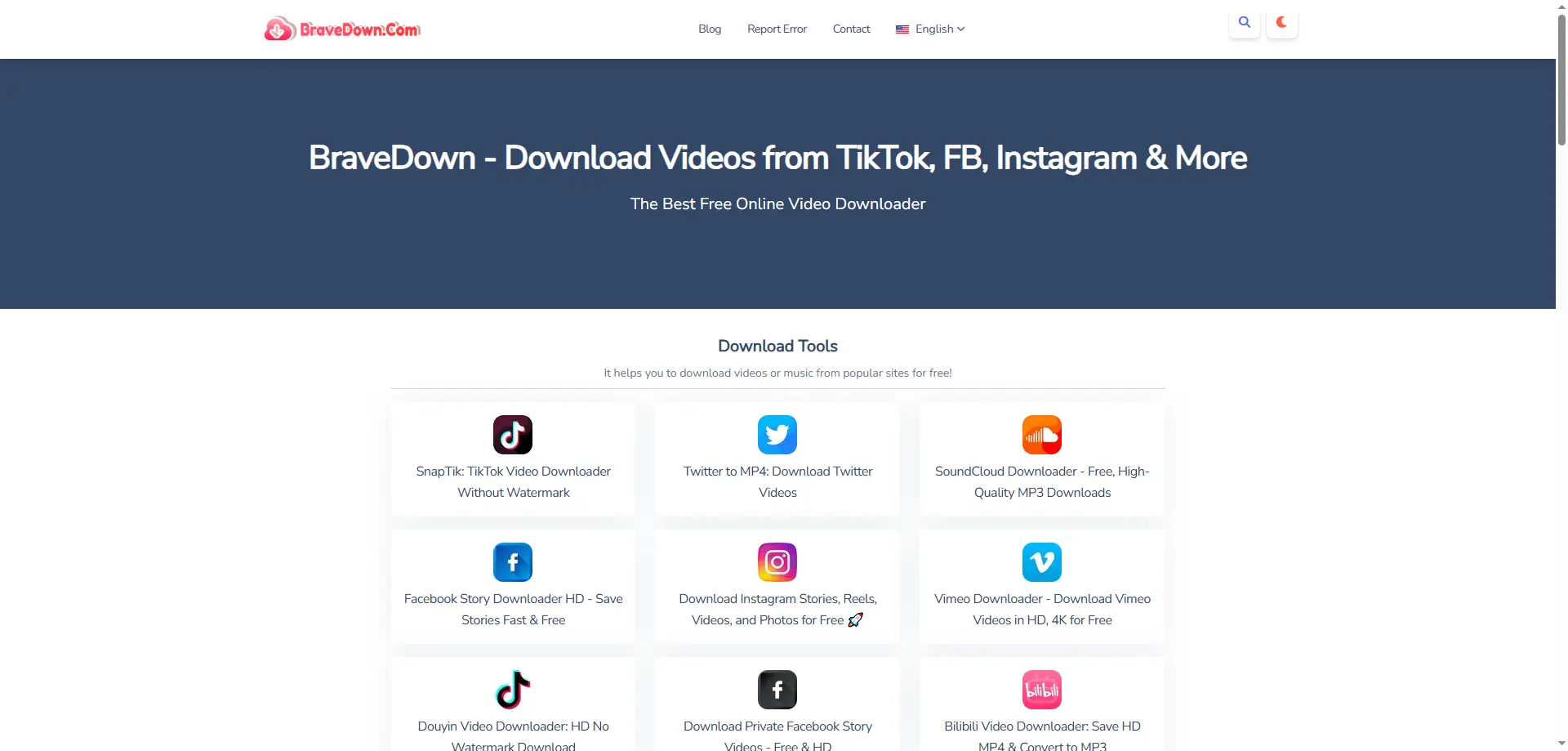
Technical Mechanisms of the Bravedown Downloader
Bravedown functions by acting as an intermediary content fetcher. It leverages server-side requests to bypass the need for a logged-in user session, which is the primary trigger for Facebook's notification heuristics.
Operational Flow and Data Extraction
The extraction process is engineered to minimize the researcher's digital footprint while ensuring data integrity:
- Direct Object Reference: The analyst inputs the specific URL of the Story or profile.
- Bot Mitigation: A captcha verification step ensures the tool is used for targeted research rather than automated scraping that could trigger platform-wide defensive measures.
- Asset Retrieval: The tool queries the media asset and presents it for download.
Because no account login is required, the platform never generates a "view" event. This technical bypass is essential for maintaining total anonymity during the reconnaissance phase.
Media Resolution and Analytical Fidelity
For professional-grade analysis, the granularity of the data is paramount. Bravedown offers technical options that allow analysts to optimize their data collection:
- Format Flexibility: Extraction of video as MP4 or high-fidelity audio as MP3 for transcription and sentiment analysis.
- Resolution Control: The ability to select specific video resolutions. High-resolution assets are critical for visual forensics, OCR (Optical Character Recognition) of on-screen text, and archival-grade reporting.
Evaluating the Ecosystem: Triage vs. Archiving
A technical audit of available story viewers reveals a significant variance in reliability and security. Based on current detection benchmarks, the tools are categorized as follows:
- Bravedown (The Analytical Standard): Offers the best balance of resolution selection and format flexibility, including MP3 extraction.
- Hitube (High-Velocity Triage): The fastest option for rapid intelligence gathering; it lacks captcha requirements but provides fewer format options.
- FDownloader (High-Fidelity Archiving): Reliable for high-quality downloads, though it requires additional server-side rendering time for the highest resolution files.
Conversely, tools like FBTake, Publer, and FDown often fail to bypass private profile restrictions or demand the installation of browser extensions. From a cybersecurity perspective, extensions are high-risk vectors that can inject scripts or leak session tokens, and should be avoided in professional workflows.
Pro-Tip: Free utility sites are often monetized via aggressive ad networks. To mitigate the risk of drive-by downloads or malicious redirection, always operate these tools within a hardened environment equipped with a robust ad blocker.
Transitioning from Research to Execution: The Account Matrix
Once the research phase using Bravedown is complete, the marketer must shift to "execution mode." This involves the deployment of an Account Matrix—a redundant network of independent profiles designed to withstand localized bans without compromising the entire marketing infrastructure.
Scaling this matrix requires neutralizing two primary "Kill Switches":
- Detection of Browser Fingerprinting: The identification of linked accounts through shared hardware and software signatures.
- Manual Scaling Limitations: The physical impossibility of managing dozens of accounts without high-level automation.
The Risk of Browser Fingerprinting and Canvas Entropy
Standard browsers are unsuitable for multi-account operations because they leak a unique "fingerprint." Platforms like Facebook track more than just IP addresses; they analyze WebGL constants, hardware IDs, and Canvas hashes.
The Mechanics of Canvas Fingerprinting
Canvas fingerprinting is a sophisticated tracking technique where a browser is instructed to render a hidden image or text. The resulting hash is unique because of the entropy created by minute variations in:
- GPU Drivers: How different graphics cards process sub-pixel rendering.
- Hardware Clock Cycles: Variations in rendering speed and anti-aliasing algorithms.
- System Fonts: The specific kerning and hinting used by the operating system.
If a marketer attempts to log into 10+ accounts via a standard browser, Facebook’s heuristics will identify that the Canvas hash and hardware signatures are identical across all profiles, leading to an immediate "chain ban" of the entire matrix.
Mitigating Detection with DICloak Infrastructure
DICloak provides the isolation layer necessary to manage a 1,000+ account matrix on a single device. It utilizes environment isolation to ensure each profile presents a unique set of hardware and software hashes to the platform's detection algorithms.
Standard Browsers vs. DICloak Infrastructure
| Feature |
Standard Browsers |
DICloak Infrastructure |
| Detection Risk |
High (Accounts linked via Canvas entropy) |
Low (Isolated, unique fingerprints) |
| Environment Isolation |
None (Shared cache and WebGL hashes) |
Complete (Independent profile containers) |
| Scalability |
Minimal (Prone to chain bans) |
Extreme (1,000+ accounts per device) |
| Network Integrity |
Shared IP (High detection risk) |
Proxy Management (SOCKS5/HTTP/HTTPS) |
Network Isolation and IP Reputation
Successful multi-account management requires "Network Isolation." You can configure SOCKS5 and HTTP/HTTPS proxy in DICloak to assign a unique IP to each profile. In the professional space, the IP Reputation is critical; using high-quality residential proxies is often the difference between a long-lived account and an immediate flag, as datacenter IPs are frequently blacklisted by Facebook’s security heuristics.
Implementing Scalable Workflows and RPA
Transitioning from manual labor to automated systems is facilitated by DICloak’s Bulk Operations and Synchronizer features. The Synchronizer allows an operator to perform actions in one "master" window that are replicated across dozens of "slave" windows simultaneously, drastically reducing the time required for account setup.
RPA and Content Distribution
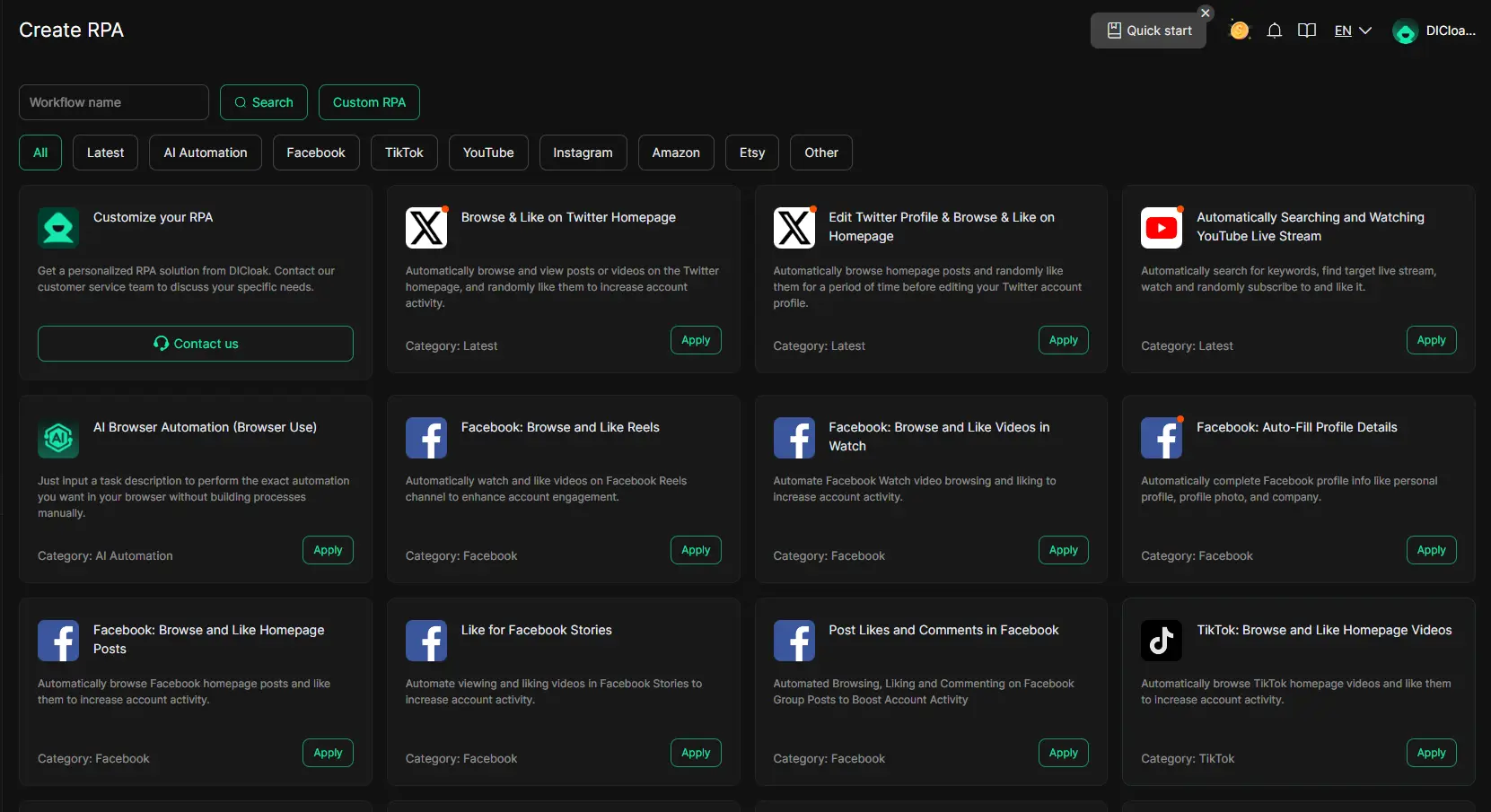
DICloak’s built-in Robotic Process Automation (RPA) allows for the deployment of complex workflows. A common scenario involves taking content identified during the Bravedown research phase and distributing it across the matrix.
- Specific Template Support: Utilizing templates like "Post Reels video on Facebook" to automate content delivery.
- Authentic Interaction: Automating "likes" and comments to warm up accounts and simulate genuine user behavior.
Team-Based Infrastructure and Security
For large-scale marketing teams, DICloak offers administrative controls that prevent security breaches:
- Permission Control: Granular settings to restrict profile deletion or creation.
- Profile Sharing: Securely transferring account access without sharing sensitive login credentials.
- Operation Logs: Maintaining a full audit trail of all team actions to ensure accountability.
Objective Analysis of DICloak for Scaling Growth
Pros
- Advanced Fingerprint Isolation: Successfully masks Canvas, WebGL, and hardware hashes.
- Built-in RPA & Synchronizer: High-efficiency tools for bulk content distribution and account "farming."
- Multi-OS Simulation: Ability to mimic Windows, Mac, iOS, Android, and Linux environments to match target demographics.
- Team Collaboration: Professional-grade permission management and data isolation.
Cons
- Technical Learning Curve: Configuration of proxies and fingerprinting requires specialized knowledge.
- Operational Overhead: Maintaining high-quality proxies adds a necessary but significant external cost.
Frequently Asked Questions
Is it safe to use Bravedown without a login?
From an anonymity standpoint, it is the safest method. By avoiding a login, you ensure there is no cryptographic link between your research activity and your professional Facebook identity.
Can the user see if I downloaded their story via Bravedown?
No. Bravedown retrieves the data via its own server requests. Because the "view" event is never triggered by an authenticated user account, the owner’s notification list remains empty.
How can I manage 50+ Facebook accounts safely?
Managing an account matrix of this size requires an anti-detect browser like DICloak. You must combine profile isolation (to prevent fingerprint linking) with a pool of unique, high-reputation proxies to ensure network isolation.
Pro-Tip: Security is a binary state. Never enter your administrative Facebook credentials on any third-party downloader or story viewer. Professional tools like Bravedown only require a public URL to operate.
 Web Proxy Tools
 Free Tools
 Cookie Plugin
 UA Generator
 MAC Address Generator
 IP Generator
 IP Address List
 2FA Code Generator
 World Clock
 Anonymous Check
 WebRTC Leak Test
 UUID Generator
 Free Web Proxy Site
 Proxy Checker
 FB Ad Checker
 AI Web Scraping
 Free SMM Tools
 Twitter Shadowban Checker
 Instagram Name Checker
 UTM Generator
 Username Generator
 AI Hashtag Generator
 LinkedIn Headline Generator
 Social Media Image Resizer