Gmail is part of everyday life for millions of people. We use it for work, personal messages, online shopping, side projects, and team collaboration. As these needs grow, a common question appears again and again: how many Gmail accounts can I have? Some people worry about breaking Google’s rules. Others are afraid of sudden verification requests or account lockouts after creating multiple inboxes. The truth is, Gmail does allow users to manage more than one account, but the real limits are not as simple as a single number. They depend on how accounts are created, how they are used, and how well they are managed over time. In this guide, we will explain the real rules behind Gmail account limits, the benefits of using multiple accounts, the risks you should know about, and the best practices to manage everything safely and efficiently, without unnecessary stress or surprises.
How Many Gmail Accounts Can I Have?
Many users ask how many Gmail accounts can I have, especially when they need separate inboxes for work, personal use, or different projects. Google does not publish a fixed number that limits how many Gmail accounts one person can own. In most cases, users are allowed to create and manage multiple Gmail accounts as long as those accounts follow Google’s security and anti-abuse rules.
In real-world use, people usually hit limits not because Gmail restricts the total number of accounts, but because Google detects patterns that suggest automated behavior, spam, or account misuse. Understanding these limits helps you avoid sudden verification requests or account lockouts.
Factors Affecting Account Creation Limits
Google uses several technical and behavioral signals to decide whether new Gmail accounts are safe to approve. These checks exist to protect users and prevent large-scale abuse. When too many accounts share the same signals, Google may slow down account creation or block it entirely.
The most important factors include the type of Gmail account, phone number usage, IP address history, and browser behavior.
Standard vs. Google Workspace Accounts
There are two main types of Gmail accounts, and they follow different rules.
Standard Gmail accounts are free personal accounts created at gmail.com. Google does not set a public limit on how many personal Gmail accounts one person can have. You can sign in to multiple accounts at the same time and switch between them, which Google officially supports. This setup works well for people who want to separate personal email, online shopping, side projects, or job searches.
For example, a freelancer may use one Gmail account for clients, one for invoices, and one for personal messages. As long as these accounts behave like normal users, Gmail usually allows them without issues.
Google Workspace accounts, on the other hand, are managed by an organization such as a company or school. These accounts are created and controlled by an administrator, not by individual users. Workspace admins can enforce stricter security rules, limit account creation, and control access based on company policy. Because of this, users cannot freely create multiple Workspace accounts on their own.
This difference explains why the answer to how many Gmail accounts can I have often depends on whether you are talking about personal Gmail or organization-managed accounts.
Phone Number and IP Address Restrictions
Even though Gmail does not limit how many accounts you can own, it does limit how many accounts you can create and verify using the same phone number. During signup, Google may require phone verification to confirm that a real person is creating the account.
In practice, many users find that one phone number can verify only a few Gmail accounts before Google stops accepting it for new registrations. The exact number is not fixed and may change based on account history and risk signals, but repeated use of the same phone number often leads to verification blocks.
IP addresses also matter. Creating many Gmail accounts from the same network in a short time can trigger additional security checks. Shared home internet, office Wi-Fi, schools, or public networks often cause accounts to look connected, especially when signup activity happens quickly.
Benefits of Having Multiple Gmail Accounts When Understanding How Many Gmail Accounts Can I Have
After understanding how many Gmail accounts can I have and why limits usually come from verification and security checks, the next question is more practical. Why do so many people choose to use more than one Gmail account in the first place?
In real life, having multiple Gmail accounts is often about clarity, focus, and control, not about breaking rules. When accounts are used for clear and separate purposes, Gmail usually works smoothly and users feel less stressed managing daily communication.
Improved Organization and Efficiency
One of the biggest benefits of multiple Gmail accounts is better organization. When everything goes into one inbox, important emails can get lost. Messages from work, shopping sites, social platforms, and personal contacts all compete for attention.
By using separate Gmail accounts, each inbox has a clear role. This makes it easier to respond faster and make fewer mistakes.
For example, Emma works full time and also runs a small online store on the side. She uses one Gmail account only for her job and another Gmail account for customer orders and supplier emails. Because the inboxes are separate, she does not accidentally send a personal message from her work email or miss a client request buried under newsletters.
This is why many users who ask how many Gmail accounts can I have are really looking for a way to stay organized and productive, not just to create more accounts.
Use Cases for Multiple Accounts
Multiple Gmail accounts are useful in many common situations. When each account has a clear purpose, Gmail activity looks natural and easy to manage.
Personal vs. Professional Separation
Separating personal and professional email is one of the most common and safest use cases. A personal Gmail account can be used for family, friends, online shopping, and subscriptions. A professional Gmail account can be used for job applications, clients, freelance work, or business communication.
For example, Daniel applies for jobs and communicates with recruiters using one Gmail account. He keeps his personal Gmail private and only shares it with people he knows well. This separation helps him stay professional and protects his privacy.
This setup also reduces risk. If one account receives too much spam or needs extra verification, the other account remains unaffected. That is another reason people manage multiple accounts after learning how many Gmail accounts can I have in practice.
Project Management and Collaboration
Multiple Gmail accounts are also helpful for project-based work and teamwork.
Many freelancers, small teams, and startups use separate Gmail accounts for different projects. Each account can be linked to its own Google Drive, Google Docs, and shared calendars. This keeps files and conversations related to one project in one place.
For example, a small marketing team runs three campaigns at the same time. They create one Gmail account per campaign to manage client emails, shared documents, and task updates. When a project ends, they archive or reduce use of that account without affecting other work.
This approach improves collaboration and reduces confusion, especially when several people need access to the same project resources.
Limitations and Restrictions on Gmail Accounts When Understanding How Many Gmail Accounts Can I Have?
While Google allows multiple Gmail accounts, there are practical limitations that appear when accounts are not properly separated. These limits usually show up as verification prompts, temporary locks, or account suspensions.
Account Creation Limits Explained
Google focuses on identifying abuse patterns rather than enforcing a strict account number. When several Gmail accounts share the same technical signals, Google may treat them as one identity.
This is where many users misunderstand how many Gmail accounts can I have. The issue is not the total number of accounts, but how similar those accounts appear to Google’s systems.
Risks of Creating Multiple Accounts
Creating and managing multiple Gmail accounts without proper separation can lead to serious risks, especially when Google detects that accounts are linked.
Account Flagging and Suspension
Account linking often happens quietly. At first, everything looks normal. Then one day, Gmail may ask several accounts for extra verification or lock them at the same time. Gmail does not ban accounts one by one; it bans the pattern behind them.
Google links accounts using shared data such as browser fingerprints, IP addresses, cookies, and behavior patterns. Browser fingerprints include details like screen size, fonts, time zone, hardware, and GPU data. If many Gmail accounts share the same fingerprint, Google can quickly identify them as belonging to one user.
IP reuse strengthens this link. When multiple accounts repeatedly log in from the same IP or proxy range, Gmail connects them faster. Shared cookies, autofill data, or session storage also expose account connections. Even behavior matters, such as logging in at the same times every day or performing the same actions across accounts.
Once linked, bans spread quickly. A single flagged account can cause others to be frozen, even if they never sent spam.
Best Practices to Avoid Issues
To reduce risk when managing multiple Gmail accounts, it is important to treat each account as a separate user. Avoid logging all accounts into the same browser profile, spread account creation over time, and use accurate recovery information.
The safest long-term approach is isolation. Each Gmail account should have its own clean browser profile, unique cookies, stable IP usage, and natural behavior. When accounts are isolated, problems stay contained. If one account is flagged, others remain safe.
There is no single number that answers how many Gmail accounts can I have for everyone. In real use, Gmail allows many accounts, but only when they do not look linked. The true limit is not quantity, but how well accounts are separated and managed.
Best Practices for Managing Multiple Gmail Accounts: How Many Gmail Accounts Can You Have?
After understanding the risks of linked accounts, the next step is learning how to manage multiple Gmail accounts in a safe and practical way. Many users who ask how many Gmail accounts can I have already own several accounts. What they need is a system that keeps those accounts organized, efficient, and low risk. Good management habits help Gmail see normal, human behavior. They also save time and reduce mistakes in daily email work.
Essential Steps to Secure Your Accounts
Start with strong sign-in protection on every Gmail account. Google recommends using 2-Step Verification as an extra layer, because a password alone is not enough if it gets leaked or phished. A practical approach is to set up 2-Step Verification on all accounts, then store backup options safely, so you are not locked out when you switch devices or travel.
Recovery settings matter just as much as login settings. Google explains that your recovery phone number and recovery email are powerful tools to regain access if you get locked out. For multiple accounts, avoid “random” recovery info you might forget. Use a clear system that you can maintain long term.
For example, Sofia runs a personal Gmail and two project Gmail accounts. She enables 2-Step Verification on all three, but she forgets to update her recovery email on one account. Months later, she loses her phone and cannot get the verification codes. The account is not “banned,” but it is effectively frozen because she cannot prove it is hers. After that, she runs Google’s Security Checkup and updates recovery methods on every account, not just the main one.
If your accounts are of high value, consider stronger options. Google’s Advanced Protection Program is designed for people who face higher risk of targeted attacks, and it uses phishing-resistant sign-in methods like security keys or passkeys. Not everyone needs this, but it is worth mentioning because many people who manage many accounts also handle sensitive work, client data, or important assets.
Tips for Efficient Account Management
Managing multiple Gmail accounts does not have to feel confusing. With the right setup, switching and checking messages can stay simple and controlled.
Switching Between Accounts
Google allows users to sign in to multiple Gmail accounts at the same time and switch between them from the profile menu. This feature is designed for normal use, such as separating personal and work email.
For example, Lisa uses three Gmail accounts. One is for personal life, one is for freelance clients, and one is for online tools and subscriptions. She stays signed in to all three and switches accounts when needed instead of logging out every time. This saves time and reduces login errors.
However, it is important to remember what you learned earlier. While switching accounts is supported, logging too many accounts into the same browser profile can still create shared signals. For users with many accounts, clear structure and separation become more important as the number grows.
This is why the real answer to how many Gmail accounts can I have depends on how carefully those accounts are managed.
Combining Inboxes for Easier Access
Another useful method is combining inbox access without fully mixing accounts.
Gmail allows email forwarding, filters, and labels. You can forward messages from one Gmail account to another or use filters to sort incoming mail automatically. This lets you monitor important messages from one main inbox while keeping accounts separate in the background.
For example, a small business owner forwards order notifications from a support Gmail account to a main work inbox. The support account still exists and stays active, but daily checks happen in one place. This setup improves efficiency without forcing constant logins across many accounts.
Used correctly, inbox combining reduces stress and keeps email activity looking natural.
Tools and Techniques for Email Management
As the number of accounts grows, manual management becomes harder. This is where tools and structured techniques help.
Third-Party Applications and Extensions
Some users rely on trusted third-party tools to manage multiple Gmail accounts more efficiently. These tools can help with inbox organization, reminders, task tracking, or shared access for teams.
For example, project management tools that integrate with Gmail can turn emails into tasks, while team inbox tools help multiple people respond from one account without sharing passwords. These solutions are often used by freelancers, support teams, and small companies.
When using third-party apps, always choose well-known tools and review permission settings carefully. Only grant access that is truly needed. This protects account security and supports long-term stability.
Use an Antidetect Browser Like DICloak for Better Account Isolation
As the number of accounts grows, simple tools like inbox switching and forwarding may no longer be enough. For users managing many Gmail accounts, browser-level isolation becomes an important part of staying safe. This is where an antidetect browser like DICloak can help.
Earlier, we explained that Gmail links accounts through shared signals such as browser fingerprints, cookies, IP addresses, and behavior patterns. An antidetect browser is designed to reduce those overlaps by creating separate browser profiles that behave like different devices.
- With DICloak, each Gmail account runs inside its own browser profile.
- Each profile has its own cookies, local storage, and fingerprint settings.
- This makes accounts look independent instead of connected.
For example, a marketer manages several Gmail accounts for different client projects. In a normal browser, logging into all accounts can cause shared cookies and repeated device signals. Over time, Gmail may group those accounts together. By using DICloak, the marketer assigns one Gmail account to one browser profile and uses a stable IP for each. If one account needs verification, the others remain unaffected.
This approach supports what we discussed earlier about how many Gmail accounts can I have. The real limit is not the number of accounts, but how clearly they are separated. When Gmail sees clean, consistent signals per account, the risk of mass verification or suspension drops.
It is important to use this setup responsibly. Each account should still behave like a real user, with normal login times and realistic activity. Antidetect browsers are tools for isolation, not shortcuts for abuse.
When combined with good habits, such as spreading account creation over time and using proper recovery information, tools like DICloak can make managing multiple Gmail accounts more stable and scalable.
How This Connects Back to Account Limits
The best practices above exist for one reason. Gmail does not block users simply for owning multiple accounts. Problems appear when accounts look connected or unmanaged.
If you treat each Gmail account with purpose, structure, and clean habits, Gmail activity stays consistent with normal user behavior. This lowers the chance of verification checks and account freezes.
So when asking how many Gmail accounts can I have, the practical answer becomes clearer. You can manage multiple Gmail accounts successfully when you use smart tools, clear separation, and efficient workflows.
Why choose DICloak Antidetect Browsers for your business?
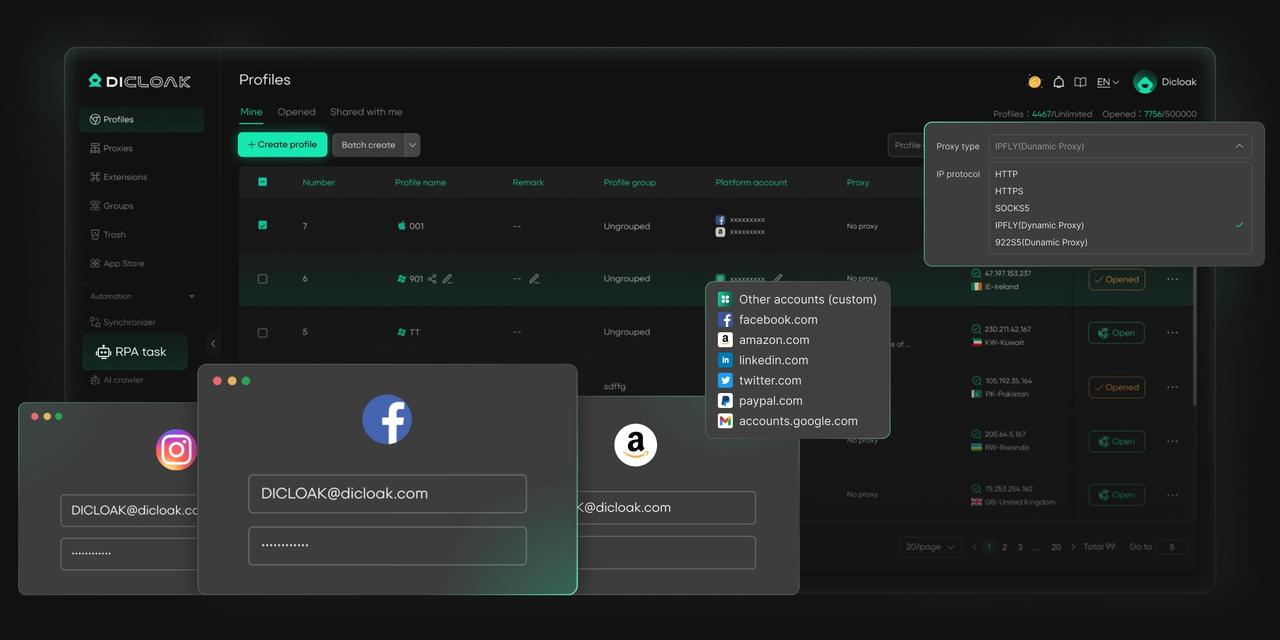
⚡The DICloak Antidetect Browser has become a global favorite for its unparalleled ability to efficiently and securely manage multiple accounts. Designed for professionals in social media management, affiliate marketing and more, DICloak offers powerful features like RPA automation, bulk operations, and a synchronizer. Additionally, it allows you to customize fingerprints and integrate proxies for each profile, ensuring top-level security and operational efficiency. It’s the ultimate tool for seamless, secure, and scalable operations.
What Makes DICloak Stand Out?
✅ Manage 1,000+ Accounts on One Device: Stop wasting money on extra hardware! DICloak allows you to manage multiple accounts on a single device, cutting costs and boosting efficiency.
✅ Guaranteed Account Safety, No Ban Risks: Every account gets its own isolated browser profile with custom fingerprints and IPs, drastically reducing the risk of bans. Your accounts, your control!
✅ Flexible Proxy Configuration for Maximum Performance: Seamlessly integrate with all major proxy protocols (HTTP/HTTPS, SOCKS5) and manage your proxy pool with bulk operations. No more struggling with IP management—DICloak has you covered.
✅ Streamlined Team Collaboration for Better Results: Easily manage your team with advanced tools like profile sharing, permission settings, data isolation, and operation logs. Your team works smarter, not harder.
✅ Automate the Grind with RPA: DICloak's built-in RPA saves you hours of manual work. Automate repetitive tasks, streamline workflows, and focus on what really matters—growing your business.
✅ Powerful Bulk Tools to Scale Your Operations: Create, import, and launch multiple browser profiles in one click. DICloak makes scaling your business as easy as it gets.
✅ Compatible with All Major Operating Systems: Based on the Chrome core, DICloak supports simulating Windows, Mac, iOS, Android, and Linux operating systems. No matter what platform you need, DICloak has you covered.
🔗 Ready to Get Started?
Visit the DICloak website to explore more details and choose the plan that’s right for you. Start for free today and experience the power of secure, efficient, and scalable multi-account management!
Conclusion
In the end, the question how many Gmail accounts can I have does not have one fixed answer for everyone. Google does not publish a strict limit on the number of Gmail accounts a person can own, and many users successfully manage multiple accounts for personal life, work, and different projects. In real use, the limits people face usually come from security checks, phone verification rules, and account linking signals, not from the number itself.
When accounts are created with clear purposes, managed with good habits, and kept properly separated, Gmail generally works smoothly. Using smart organization methods, secure login practices, and clean browser profiles helps accounts stay stable over time. The key takeaway is simple. Multiple Gmail accounts can be a powerful tool for organization and efficiency, as long as they are managed carefully, used responsibly, and protected with strong security settings.
Frequently Asked Questions (FAQs)
How many Gmail accounts can I have as one person?
Google does not set a public maximum number for personal Gmail accounts. In theory, one person can have multiple Gmail accounts. In practice, limits appear during account creation because of phone number verification, IP address checks, and security signals. This is why the real answer to how many gmail accounts can i have depends on how the accounts are created and managed, not just on the number itself.
Is it legal and allowed to have multiple Gmail accounts?
Yes, it is allowed to have multiple Gmail accounts. Google supports signing in to more than one account and switching between them. Problems usually happen only when accounts are created or used in ways that look automated, abusive, or unsafe. If accounts are used for clear purposes like work, personal email, or projects, they are generally fine.
How many Gmail accounts can I have with one phone number?
Google limits how many Gmail accounts can be verified with the same phone number. The exact number is not public and may change based on account history and risk signals. Many users report that one phone number works for only a few account verifications before Google blocks it for new signups. This is one of the most common limits people face when asking how many gmail accounts can i have.
Can having too many Gmail accounts get them suspended?
Having many Gmail accounts alone does not cause suspension. The risk comes from account linking. If multiple accounts share the same browser fingerprint, IP address, cookies, or behavior patterns, Google may group them together. When one account is flagged, others can be affected. This is why separation and proper management matter more than the total number of accounts.
What is the safest way to manage multiple Gmail accounts long term?
The safest way is to give each Gmail account a clear purpose and manage it like a real user. Use strong passwords, enable 2-Step Verification, keep recovery information updated, and avoid creating many accounts in a short time. As the number of accounts grows, using separate browser profiles or tools that help isolate accounts can reduce linking risks and improve stability. This approach helps you manage multiple accounts safely after understanding how many gmail accounts can i have.
 Web Proxy Tools
 Free Tools
 Cookie Plugin
 UA Generator
 MAC Address Generator
 IP Generator
 IP Address List
 2FA Code Generator
 World Clock
 Anonymous Check
 WebRTC Leak Test
 UUID Generator
 Free Web Proxy Site
 Proxy Checker
 FB Ad Checker
 AI Web Scraping
 Free SMM Tools
 Twitter Shadowban Checker
 Instagram Name Checker
 UTM Generator
 Username Generator
 AI Hashtag Generator
 LinkedIn Headline Generator
 Social Media Image Resizer