In the booming world of AI, a ChatGPT Plus subscription is like an all-access pass. But at $20 a month, sharing that pass with family is tempting. This leads to the central question: "Can I share a ChatGPT Plus account with family to split the cost?" While OpenAI's rules say no, a powerful privacy tool offers a clever workaround. The good news is that there's a smarter, more secure way to share that dramatically reduces the risk of getting caught: using a tool called an antidetect browser.
What's the Big Deal with a ChatGPT Plus Subscription?
ChatGPT Plus offers a significant upgrade over the free version, providing powerful features that justify its cost and make it a desirable tool for families and professionals to share. It unlocks the full potential of OpenAI's technology for heavy users.
How Do the ChatGPT Plans Differ?
OpenAI's plans are designed for different needs and budgets. Here’s a quick comparison to see why so many users want access to the Plus features.
| Feature / Plan |
Free |
ChatGPT Plus |
ChatGPT Pro |
ChatGPT Business |
| Price (approx.) |
$0 / month |
~$20 / month |
~$200 / month |
~$25–30 / user/month (business tier) |
| Intended Users |
Casual users / beginners |
Individual power users |
Heavy users / professionals / researchers |
Teams & small businesses |
| Model Access |
Base GPT models with limits |
Advanced GPT‑5 models with priority access |
Full advanced models (including pro reasoning and highest performance) |
Generous access to frontier models for teams |
| Usage Limits |
Limited messages & features |
Higher limits than Free |
Highest usage — unlimited messages & uploads |
Virtually unlimited GPT‑5 with fair‑use policies |
| Response Priority |
Standard |
Priority access & faster responses |
Highest priority & performance |
Priority across team workspace |
| Custom GPTs |
Yes (basic) |
Yes |
Yes |
Yes (team shared & workspace) |
| Deep Research / AI Agents |
Very limited |
Included but limited quotas |
Full access & larger quotas |
Included for workspace users |
| Collaboration / Team Tools |
❌ |
❌ |
❌ |
✔️ Shared workspace, admin controls, SSO, billing management |
| Security & Privacy |
Standard |
Standard |
Standard |
Higher business privacy; data not used to train models by default |
| Data Training Control |
Opt‑out possible |
Opt‑out possible |
Opt‑out possible |
Workspace data not used for training by default |
| Best For |
Exploring ChatGPT & occasional use |
Frequent personal use, creatives & students |
Developers, researchers & heavy workflows |
Small teams that need collaboration + AI power |
Who Should Get ChatGPT Plus?
While not for everyone, ChatGPT Plus is a game-changer for specific types of users who can benefit from its advanced capabilities.
- Daily Coders & Developers: Access to GPT-5 (OpenAI's anticipated next-gen model) helps debug code faster, suggest better solutions, and explain complex programming concepts.
- Content Creators: It's an invaluable tool for bloggers, writers, and social media managers to draft posts, brainstorm ideas, and edit content.
- Researchers & Students: The Deep Research Agent can sift through academic papers, summarize studies, and help structure essays, saving hours of work.
- Multimedia Users: For those who generate images or edit videos, the higher quality of the multimodal tools provides more creative flexibility.
- People Who Hate Waiting: Plus subscribers get priority access, skipping the line during peak hours when the free version might be unavailable.
So, Can I Share a ChatGPT Plus Account with Family?
Let's get straight to the point: according to OpenAI's terms of service, you are not allowed to share your ChatGPT Plus account. The rules clearly state that a subscription is for "individual use only," and sharing your login details violates this policy.
OpenAI enforces this rule to prevent misuse and to encourage individual subscriptions, which fund the service. The platform tracks login locations and devices, so if it sees multiple people logging in from different places, it may flag your account for suspicious activity.
If you get caught, the consequences can be serious:
- A formal warning from OpenAI.
- A temporary ban, locking you out of your account.
- Losing access to your account forever, with no possibility of a refund.
Despite these risks, many people still look for ways to share the benefits and the cost of a Plus subscription.
How Can I Share a ChatGPT Plus Account with Family?
While people have found ways to share an account, not all methods are safe or practical. Here are the most common approaches, their risks, and the safest option available.
Method 1: Sharing Login Details Directly
The most common method is simply giving your username and password to your family members. While free and easy, it is also the riskiest.
- Account Detection: OpenAI's systems can easily detect logins from different devices, IP addresses, and locations, flagging the account for a potential ban. This is precisely the problem that more advanced solutions are designed to solve.
- Mixed Chat History: Everyone's conversations get jumbled together, making it chaotic to find your work research among your child's homework questions.
- Misuse Risks: If one family member accidentally generates content that violates OpenAI's rules, the entire account is put at risk.
- Locked Out: Too many simultaneous logins can trigger a temporary account lock, leaving everyone without access when they need it most.
Method 2: Using Password Managers
Using a tool like LastPass or 1Password to share credentials is more secure than texting a password, but it doesn't solve the main problem. OpenAI can still detect that multiple people are using the account from different locations, leaving you just as vulnerable to a ban.
Method 3: Using a Shared Device
This method involves keeping the ChatGPT Plus account logged in on a single, shared family device like a tablet. While this avoids multi-device detection, it's highly impractical as only one person can use it at a time, and all chat histories still get mixed together.
Method 4: The Official Option - ChatGPT Business Plan
OpenAI's official solution for group access is the ChatGPT Business plan. It is designed for teams and groups who want to share access legally.
Pros:
- It is 100% safe and compliant with OpenAI's terms of service.
- Each family member gets their own separate account, with a private chat history and settings.
Cons:
- It comes at a much higher cost, priced at 25 per user per month. For a family of four, that's 100 per month.
- The per-user pricing is fixed, meaning you pay the full price for each person, even if they use it infrequently.
Method 5: A Safer Method - Use an Antidetect Browser like DICloak
A safer and more cost-effective alternative is to use an antidetect browser like DICloak. Trusted by over 6,800 teams in 135+ countries, this tool is designed to manage multiple accounts without being detected.
DICloak works by creating a unique browser fingerprint for each user. This is far more sophisticated than simply hiding your IP address. It spoofs dozens of data points that websites use for tracking, including WebGL, WebGPU, canvas, geo-location, fonts, and system settings. This makes it look to OpenAI as if each family member is logging in from a separate, unique device, dramatically reducing the risk of your account being flagged or banned.
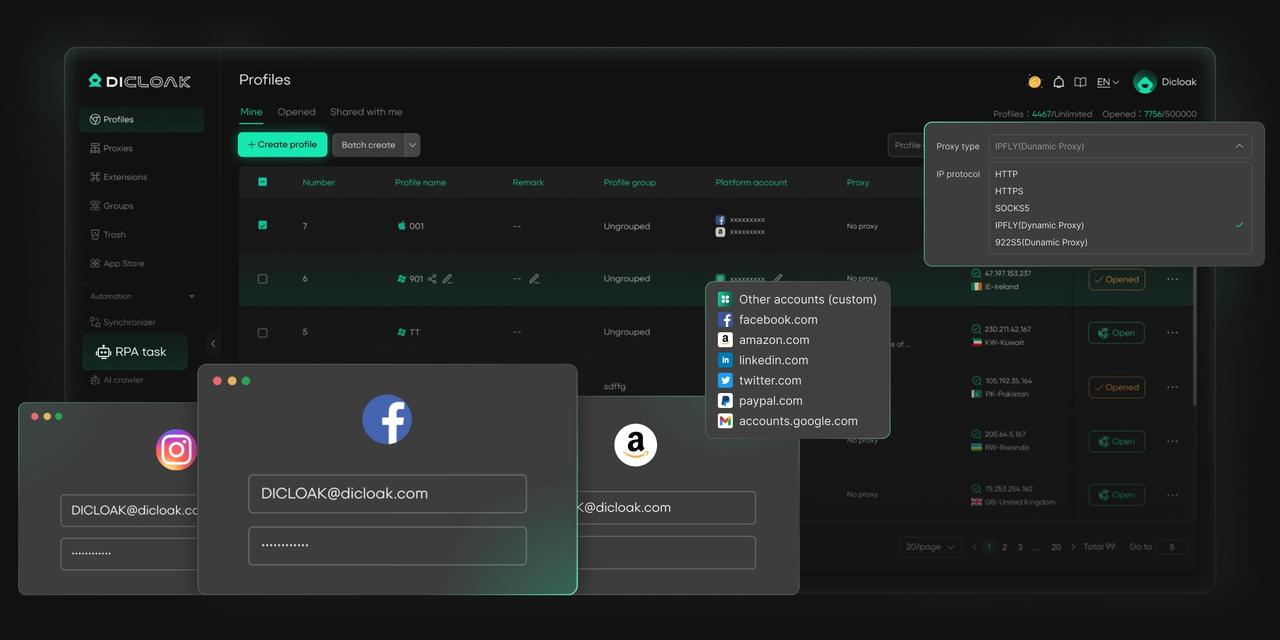
Each DICloak profile functions like a "Virtual Machine—faster and cheaper," providing an isolated environment for each user. It also offers features that are perfect for sharing:
- Effortless Team Collaboration: Securely share profiles and manage flexible user permissions.
- Advanced Data Security Protection: All data is encrypted to protect against leaks and scraping.
The cost savings are substantial. For a family of four, the choice is stark: Pay 100/month** for the official ChatGPT Business plan, or pay **49/month for a shared Plus account ($20) managed with DICloak (using a $29 plan as an example)—a savings of over 50%.
Step-by-Step Guide: Use DICloak to Share a ChatGPT Plus Account
Setting up DICloak to share your account is straightforward, even for non-technical users.
- Step 1: Download and Install DICloak Go to the official DICloak website, download the application, and follow the on-screen instructions to install it. Once installed, create your account.
- Step 2: Create Unique Browser Profiles In the DICloak app, create a new, separate browser profile for each family member. Give each profile a clear name. Fill in the ChatGPT website in the "Platform" field and then enter your shared login details. You can also configure a specific proxy for each profile if needed for added security.
- Step 3: Create a Team Group Navigate to the "Members" tab on the left menu and select "Create a group." Name it something clear like "Family ChatGPT" to keep things organized.
- Step 4: Invite Family Members and Assign Profiles In your new group, add each family member by entering their details. Then, authorize them to access the specific ChatGPT browser profiles you created in Step 2. They will receive an invitation to join your DICloak team space.
- Step 5: Manage Permissions & Share Profiles As the administrator, you can control what each member can do. The pre-configured ChatGPT profiles are now securely shared with your family members within the team space.
- Step 6: Start Using ChatGPT Plus Safely Each family member can now log into their DICloak account, open their assigned profile, and start using ChatGPT Plus. Because each profile has a unique browser fingerprint, OpenAI will see each session as a separate, legitimate user.
Conclusion
Sharing a ChatGPT Plus account is a smart way to save money, but doing so by simply handing out your password is a risk that could cost you your subscription. Directly sharing login details can lead to account bans and a confusing mess of mixed chat histories.
DICloak stands out as the most pragmatic solution, balancing cost, safety, and functionality. By creating unique browser profiles for each user, it protects your account from detection while saving you a significant amount of money compared to official business plans.
Ready to share safely? You can try DICloak for free to see how it can protect your ChatGPT account and your wallet.
Frequently Asked Questions (FAQs)
Can I share a ChatGPT Plus subscription for free?
Sharing your login details directly is free, but it comes with a high risk of getting your account banned by OpenAI. A safer alternative is DICloak, which offers a free plan that includes 2 profiles. Its paid plans are far more affordable than buying multiple ChatGPT subscriptions for your family.
ChatGPT Plus or Business Plan? Which one should I choose?
Your choice depends on your budget. For a small family, a single ChatGPT Plus account combined with DICloak is significantly cheaper. For a group of four, this combination costs around 49 per month, whereas the official ChatGPT Business plan would cost 100 per month.
Is using the DICloak anti-detect browser really helpful for sharing a ChatGPT Plus account?
Yes. DICloak's core technology creates unique browser fingerprints designed specifically to bypass detection systems like those used by OpenAI. It is a reliable tool trusted by over 6,800 teams in 135+ countries for securely managing and sharing accounts.
Can I use my ChatGPT Plus account on multiple devices?
Logging into your account directly on multiple personal devices is risky and can trigger detection. With DICloak, you can safely use the account on as many devices as you want, because each one is managed through its own unique and protected profile.
What issues might you face when directly sharing a ChatGPT Plus account?
Directly sharing your account can lead to several problems, including getting banned permanently, losing access to your entire chat history, having your account data exposed, and being held responsible for harmful content generated by others on your account.
 Web Proxy Tools
 Free Tools
 Cookie Plugin
 UA Generator
 MAC Address Generator
 IP Generator
 IP Address List
 2FA Code Generator
 World Clock
 Anonymous Check
 WebRTC Leak Test
 UUID Generator
 Free Web Proxy Site
 Proxy Checker
 FB Ad Checker
 AI Web Scraping
 Free SMM Tools
 Twitter Shadowban Checker
 Instagram Name Checker
 UTM Generator
 Username Generator
 AI Hashtag Generator
 LinkedIn Headline Generator
 Social Media Image Resizer