Contextualizing the Shift Toward Specialized Virtualization
The tools that once defined account management are undergoing a rigorous re-evaluation. For years, digital marketers and e-commerce professionals utilized gaming-focused Android emulators like LDPlayer to bridge the gap between mobile applications and desktop efficiency. However, as we move through 2026, the limitations of this approach have become apparent.
The primary drivers for this migration are rooted in technical friction and security vulnerabilities. Professional users frequently cite persistent lag, significant privacy risks, and excessive hardware resource consumption as primary pain points. While LDPlayer 9 is optimized for lower-end PCs, it still struggles with occasional crashes and niche app compatibility gaps that can disrupt commercial workflows. Consequently, the industry is shifting toward "identity isolation"—a method that prioritizes distinct digital signatures over simple device emulation.

Why Professionals Seek an ldplayer alternative for Marketing Operations
The fundamental disconnect between traditional emulators and professional requirements lies in their core design philosophy. LDPlayer and its contemporaries are engineered for high frames-per-second (FPS) and gaming performance. In contrast, marketing and social media operations demand "anti-detection" and "multi-account safety."
Modern platforms employ sophisticated algorithms designed to identify "account association," where multiple profiles are linked to a single machine ID. When multiple accounts are accessed through a standard emulator, they often share underlying hardware signals. If the platform detects a pattern of high-volume activity from a single device signature, it can result in a "bulk ban," where every associated account is terminated regardless of individual standing. A reliable alternative must focus on reducing this risk by ensuring each account appears to originate from an entirely separate, unique device.
The Mechanics of Detection: Why Traditional Emulators Trigger Flags
To understand why standard emulation often leads to account flags, one must look at the technical inconsistencies presented to platform security systems.
Hardware Fingerprinting and Instance Association
Platforms monitor hardware identifiers such as IMEI numbers, MAC addresses, and serial numbers. While standard emulators allow users to change these IDs, the implementation is often technically inconsistent. From a cybersecurity perspective, these emulators often generate "impossible" hardware profiles—for example, pairing a generic mobile IMEI with a high-end desktop GPU signature. Platform security systems recognize these statistical anomalies as clear indicators of virtualization, leading to immediate account restrictions. When a user runs multiple LDPlayer instances on one PC without advanced fingerprint masking, the shared hardware environment creates a condition where instance association is virtually guaranteed.
Network Fingerprints and Proxy Management
Network integrity is the second pillar of account security. Running upwards of 50 accounts on a single network connection is a high-risk operation. Effective account growth requires rigorous Proxy Management to ensure IP isolation. Without distinct network exit points for each profile, platforms can blacklist entire network ranges. Professionals now prioritize tools that allow for persistent session locations and the isolation of network traffic at the profile level, preventing a single account's activity from compromising the entire infrastructure.
How ldplayer alternative Technology Prevents Canvas Fingerprinting
The most effective alternatives to traditional emulators shift the focus from heavy virtual machines (VMs) to sophisticated browser-based isolation.
Browser Fingerprint Customization
A professional alternative utilizes isolated browser profiles rather than simulating a full Android kernel. This is a critical distinction: traditional emulators often leave "leaky" traces within the Android kernel that mobile apps can probe to detect virtualization. A browser-based approach, such as that used by DICloak, controls API returns at the engine level. By managing how the browser reports Canvas, WebGL, and Web Audio data, the system provides consistent, believable data to the platform's trackers. Each profile maintains its own isolated data storage, ensuring that cookies and cache remain strictly partitioned.
Simulating Diverse Operating Systems
Unlike standard emulators that are confined to a specific Android version, advanced virtualization tools can simulate a wide array of environments. Based on a robust Chrome core, these tools can mimic Windows, Mac, iOS, and Android operating systems. This versatility allows a single physical workstation to manage over 1,000 accounts, with each profile appearing to reside on a different type of hardware. This level of scaling is impossible with traditional emulators due to the massive overhead required to run hundreds of full OS instances.
Operational Scenarios: Scaling Beyond Local Hardware Limitations
Consider a growth team managing 50 TikTok profiles or Facebook Ads accounts. Using a standard emulator would require allocating specific CPU cores and RAM to each of the 50 virtual machines. This typically leads to extreme hardware strain, system instability, and the "occasional crashes" noted in gaming-centric tools.
By transitioning to an identity-focused alternative, the same team can run these 50 profiles as lightweight, process-level isolated instances. This reduces hardware consumption by an order of magnitude, allowing for a more stable and responsive environment.
Pro Tip: To minimize risk, ensure each profile is paired with a dedicated SOCKS5 or HTTP/HTTPS proxy. DICloak supports bulk proxy integration, allowing you to maintain persistent session locations across massive profile lists without manual configuration.
Implementing Isolation with a Reliable ldplayer alternative
DICloak has emerged as a specialized implementation tool for professionals who require high-level identity masking. It automates the isolation process, allowing users to move away from the manual friction of setting up individual virtual environments. The platform focuses on operational efficiency, featuring "bulk creation" and "one-click launch" capabilities that are essential for large-scale maneuvers.
Automating Workflows with RPA
A key advantage of professional-grade alternatives is the integration of Robotic Process Automation (RPA). RPA allows for the automation of repetitive, manual tasks such as account warming, e-commerce browsing, or data collection. By utilizing RPA, businesses can save hours of manual labor, ensuring that account activity remains consistent and "human-like" across hundreds of profiles simultaneously.
Standard Emulators vs. DICloak: A Technical Comparison
| Feature |
Standard Emulator (e.g., LDPlayer) |
Professional Antidetect (DICloak) |
| Hardware Resource Use |
High (Requires CPU/RAM allocation per VM) |
Low (Lightweight process-level isolation) |
| Fingerprint Customization |
Basic (Limited and often inconsistent IDs) |
Advanced (Engine-level Canvas, WebGL, Web Audio) |
| Multi-Account Scale |
Limited by physical RAM/CPU capacity |
1,000+ profiles on a single device |
| Core Framework |
Full Android OS Virtualization |
Chrome-core Browser Isolation |
| Stability |
Subject to occasional crashes and app gaps |
High stability for web and mobile-web profiles |
| Main Purpose |
High-FPS Gaming and Entertainment |
Secure Business and Marketing Operations |
Strategic Advantages of the DICloak Ecosystem
Transitioning to a dedicated antidetect ecosystem provides a structured framework for team-based growth, though it requires a shift in technical strategy.
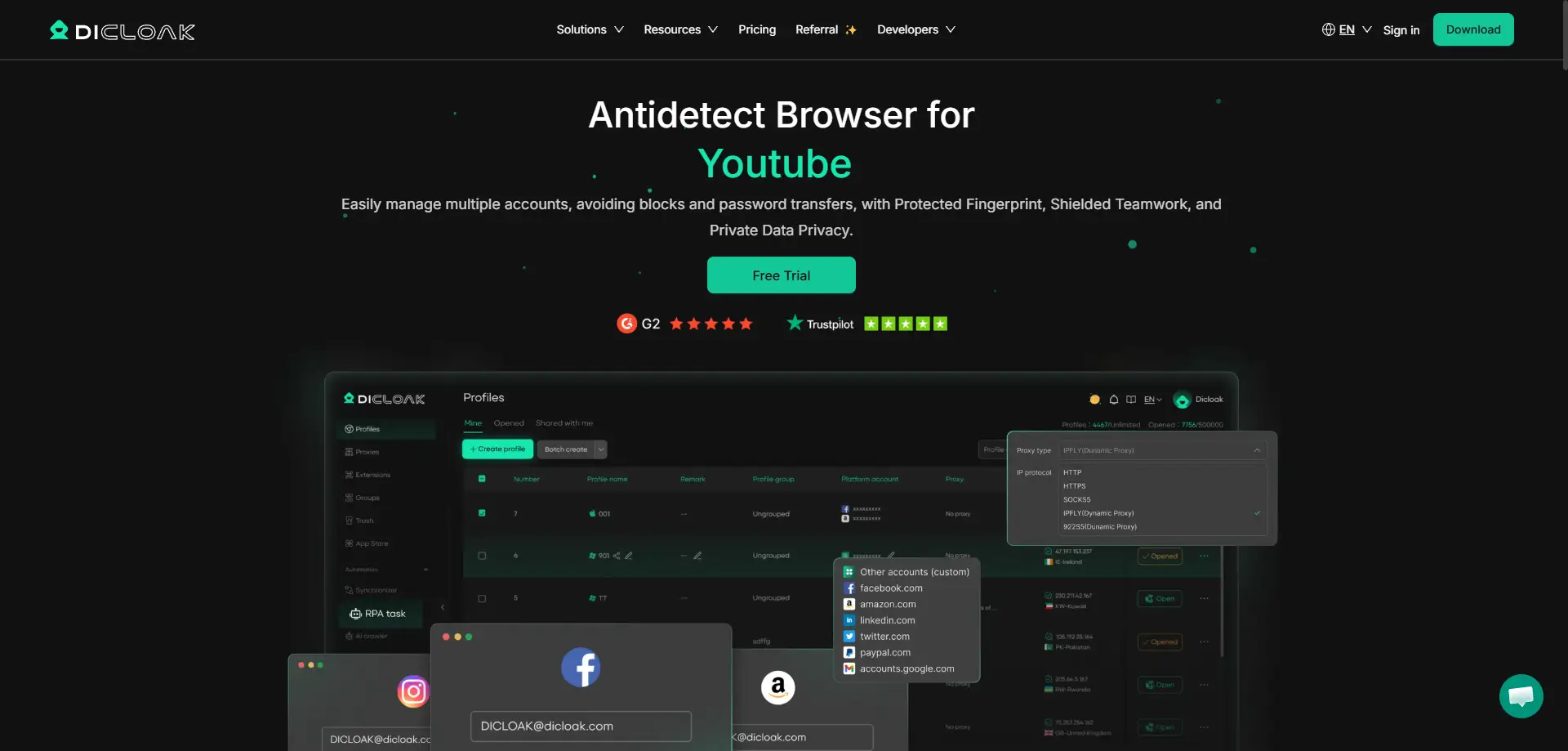
Core Benefits for Scalable Operations
- Team Collaboration: DICloak allows for seamless profile sharing with granular permission settings, ensuring data isolation remains intact even in multi-user environments.
- Audit and Operation Logs: Detailed operation logs act as a cybersecurity audit trail. If an account is flagged, managers can review the logs to identify whether specific behavioral patterns or team errors triggered the platform's security checkpoints.
- Massive Scalability: The ability to import and manage thousands of accounts from a single interface removes the hardware bottlenecks inherent in traditional emulation.
Considerations for Deployment
- Gaming Suitability: These tools are not designed for AAA gaming. Users specifically requiring 240 FPS for competitive mobile gaming should continue to use performance-tuned emulators.
- Proxy Quality: The effectiveness of identity isolation is heavily dependent on the quality of the underlying proxies. High-quality SOCKS5 or HTTP/HTTPS proxies are required to maintain the integrity of the isolated profiles.
Best Practices for Risk-Aware Account Management
When implementing an ldplayer alternative, practitioners must maintain strict operational discipline. The use of operation logs is essential for tracking the "digital hygiene" of a team. Furthermore, a strategic approach to network isolation is required: avoid mixing residential and datacenter proxies within a single campaign. Platforms often flag the sudden shift from a residential IP to a datacenter IP as a high-risk event, which can lead to account challenges even if the browser fingerprint is perfectly masked.
Frequently Asked Questions About ldplayer alternative Solutions
Can I run Android apps on Windows 10/11 without an emulator?
Yes. Professional tools like DICloak use environment simulation to mimic the User-Agent, screen resolution, and platform signatures of mobile devices. This allows you to run the mobile-web or web versions of apps in a way that platforms perceive as a legitimate mobile device, without the overhead of a full .apk emulator.
What is the best way to manage 50+ social media accounts?
The most secure method is the use of isolated profiles. Each profile should have a unique, customized browser fingerprint and a dedicated proxy. This ensures that even if one account is compromised, there is no technical link—or "footprint"—connecting it to the other 49 accounts.
Are antidetect browsers safer than standard emulators?
For business and marketing purposes, yes. Standard emulators focus on performance, often resulting in inconsistent hardware signatures that are easily detected by modern security systems. Antidetect browsers are specifically engineered to control data at the browser-engine level, providing a more reliable and scalable solution for identity isolation.
 Web Proxy Tools
 Free Tools
 Cookie Plugin
 UA Generator
 MAC Address Generator
 IP Generator
 IP Address List
 2FA Code Generator
 World Clock
 Anonymous Check
 WebRTC Leak Test
 UUID Generator
 Free Web Proxy Site
 Proxy Checker
 FB Ad Checker
 AI Web Scraping
 Free SMM Tools
 Twitter Shadowban Checker
 Instagram Name Checker
 UTM Generator
 Username Generator
 AI Hashtag Generator
 LinkedIn Headline Generator
 Social Media Image Resizer