Why Look for Hootsuite Alternatives in 2026?
Hootsuite is still one of the biggest names in social media management. It combines publishing, analytics, engagement, social listening, and team tools in one platform. But a strong market position does not mean it is the right fit for every team. In 2026, many businesses are comparing Hootsuite alternatives because they want a better balance of price, features, and ease of use.
Hootsuite’s Market Position in 2026
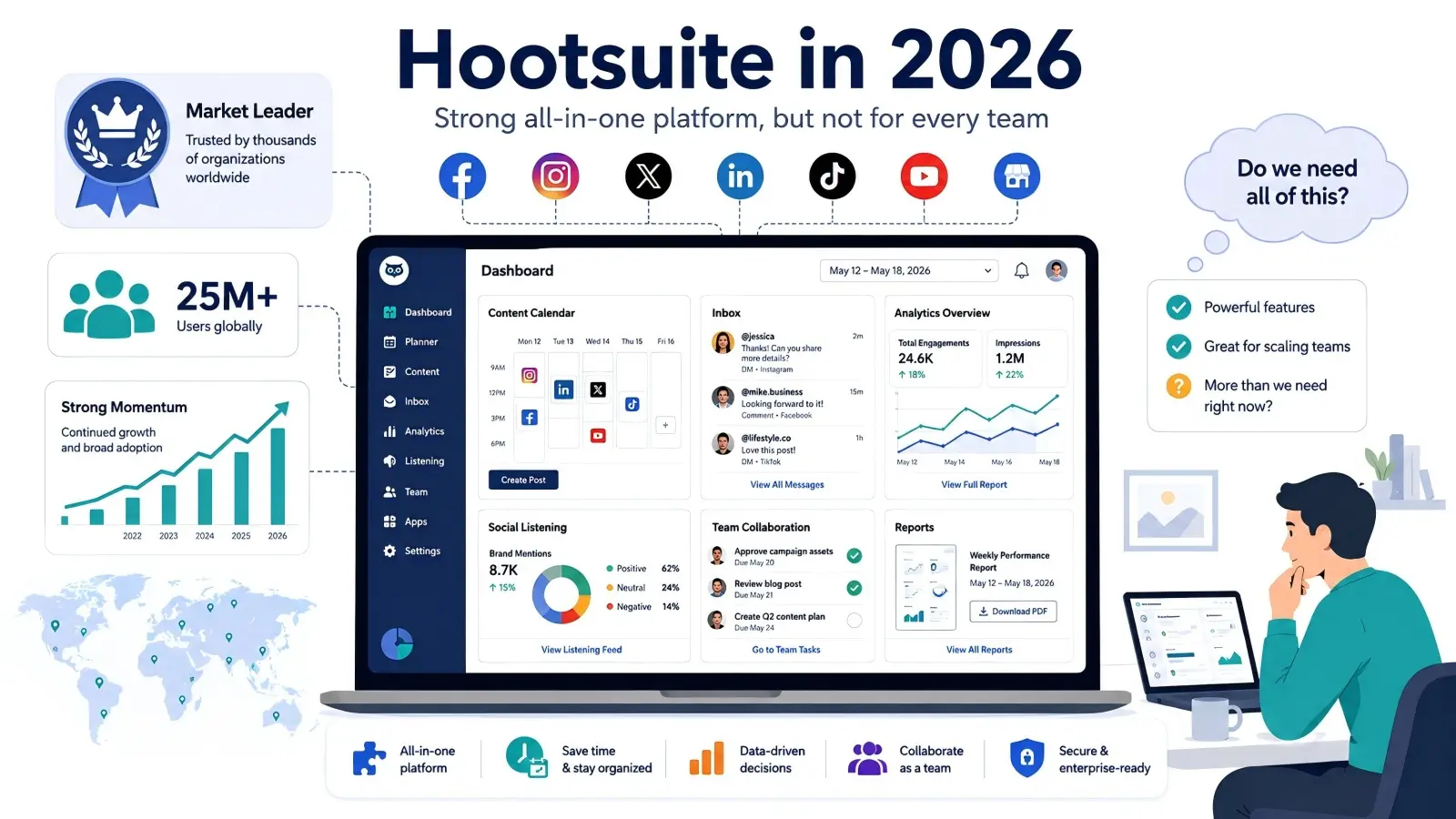
Hootsuite has been in the market since 2008, and more than 25 million people have used the platform over its lifetime. It also works with thousands of enterprise customers and was ranked the No. 1 product on G2’s 2026 Best Software Products list. These numbers show that Hootsuite remains a major platform rather than a tool that businesses are simply leaving behind.
Its strength comes from bringing many social tasks into one place. Teams can schedule content, manage messages, create reports, monitor conversations, and use social listening tools without moving between several platforms. For large organizations, that broad feature set can be valuable. Smaller teams, however, may not need everything included in the platform.
Why Users Compare Hootsuite Alternatives
Cost is one of the clearest reasons. Current Hootsuite pricing starts at about $99 per user per month for Standard, with Professional at $199 and Advanced at $399. Hootsuite no longer offers a permanent free plan, although users can test its paid plans through a 14-day free trial. Because pricing is tied to users and higher plans unlock more advanced features, total Hootsuite fees can rise as a team grows.
Some important tools also sit on higher tiers. Professional adds features such as automated inbox workflows, trend forecasting, and custom reports, while Advanced adds team approval tools. This matters to a small agency that may only need one advanced workflow but has to move to a more expensive plan to get it. Recent G2 reviews also mention high pricing, crowded workflows, and extra clicks for tasks such as bulk editing, although many users still rate Hootsuite highly for scheduling and centralized account management.
AI is another area worth judging carefully. Hootsuite made a major AI push in June 2026 with Wisdom, its social-first AI agent, and the new Social OS. Wisdom can work with social data, conversations, content, and listening signals, so it goes beyond a simple caption generator. Still, basic AI writing and image generation are now common features in social media tools. Teams should therefore ask whether they need Hootsuite’s deeper social intelligence or would get enough value from simpler Hootsuite alternatives with basic AI tools.
What This Hootsuite Alternatives Guide Covers
No Hootsuite alternative wins in every category. One platform may offer better pricing but weaker reporting. Another may work well for agencies but charge more for each user. Social listening is one of the biggest differences to watch because some tools offer only basic mention tracking, while Hootsuite can monitor conversations across 30+ social networks and more than 150 million websites through its wider listening platform.
This guide compares free and paid Hootsuite alternatives by pricing, features, pros, cons, and team size. The goal is not to find a tool with the longest feature list. It is to help you choose one that fits the way your team works and the amount you are comfortable spending.
Best Hootsuite Alternatives Compared
The best Hootsuite alternatives are not all trying to solve the same problem. Some focus on affordable publishing. Others add client approvals, social inboxes, reporting, or full social listening. This matters because current Hootsuite pricing starts at $99 per user per month for Standard, rises to $199 for Professional and $399 for Advanced, while Enterprise uses custom pricing. Hootsuite Standard also includes basic social listening, so a cheaper scheduler is not always a feature-for-feature replacement.
The comparison below groups tools by the teams they fit best. Prices are starting rates and usually reflect annual billing where the provider offers a discount.
Budget-Friendly Hootsuite Alternatives for Solo Creators & Freelancers
Budget tools work best when publishing is the main job. They can help one person plan posts, reuse content, and track basic results without paying high Hootsuite fees. The main trade-off is social listening. Most tools in this tier focus on owned social accounts rather than broad monitoring of conversations across social networks and the wider web.
| Tool |
Starting price |
Pros vs. Hootsuite |
Main limitation |
Best fit |
| Buffer |
Free for 3 channels; Essentials from $5/month per channel with annual billing |
Very simple interface, low entry cost, AI Assistant, analytics, community inbox |
Costs rise as more channels are added; not a full social listening suite |
Solo creators and small brands managing a few accounts (buffer.com) |
| Metricool |
Free; Starter from $20/month |
Strong value for scheduling, competitor tracking, analytics, PDF/PPT reports, and multiple brands |
Free plan excludes LinkedIn and X; deeper team tools require Advanced |
Freelancers, SMBs, and marketers who care about analytics |
| Publer |
Professional from $5/month for one social account; Business from $10 |
Flexible account-based pricing and low cost for small setups |
Extra accounts and members increase the final bill; less suited to advanced listening or enterprise workflows |
Individuals managing a small number of social profiles (publer.com) |
| SocialBee |
Bootstrap $29/month; Accelerate $49; Pro $99 |
Strong content recycling, categories, AI content tools, CSV uploads, and flexible scheduling |
No permanent free plan; broader agency setups require higher Pro plans |
Creators and small businesses that publish evergreen content often |
Consider a freelancer running Instagram, LinkedIn, and Facebook for one small company. Buffer's free or low-cost plan may cover most daily publishing needs without the $99-per-user starting cost of Hootsuite. A freelancer handling several brands may get more value from Metricool because its paid plans are built around brands and include report exports. However, if either user needs to track wider brand conversations, sentiment, and emerging discussions, these cheaper Hootsuite alternatives may need a separate listening tool. Hootsuite Standard already includes Lumen, which can search recent brand, competitor, topic, and hashtag mentions and analyze sentiment.
Mid-Tier Hootsuite Alternatives for Small & Mid-Sized Agencies
Agencies need more than cheap scheduling. Client approvals, bulk publishing, shared inboxes, downloadable reports, and predictable account limits become much more important when several people work across many brands. Mid-tier Hootsuite alternatives often offer these features for less than Hootsuite Advanced, although social listening may still cost extra.
| Tool |
Starting price |
Pros vs. Hootsuite |
Main limitation |
Best fit |
| SocialPilot |
Essentials $17/month; Standard $34; Premium $85 with annual billing |
Lower entry price, bulk scheduling, PDF reports, client approvals, white-label reports, and generous user limits |
Deeper brand intelligence and social listening are not its main strength |
Small and growing agencies that manage many client accounts |
| Sendible |
Core $35/month; Plus $99; Premium $199 |
Unlimited users on every plan, bulk scheduling, monitoring, reports, and client workspaces |
More workspaces and advanced agency features push users toward higher tiers |
Agencies that want to avoid per-seat charges |
| Agorapulse |
Standard $79/user/month; Professional $119; Advanced $149 with annual billing |
Strong inbox, unlimited publishing, branded reports, ROI reporting, team assignments, and advanced agency workflows |
Paid per user; advanced listening costs an extra $100 per search each month |
Agencies that need reporting and engagement in one platform |
| Vista Social |
Professional $79/month for 15 profiles and 2 users; Advanced $149 |
Good profile-to-user ratio, bulk scheduling, approvals, reporting, and modern AI tools |
Wider social/web/news listening starts at an extra $75/month; X costs extra |
Agencies and growing social teams looking for flexible bundled pricing |
The difference becomes clear with a six-person agency. SocialPilot Premium costs $85 per month when billed annually and includes six users, 20 social accounts, advanced analytics, client approval, and white-label reporting. Hootsuite uses per-user pricing, so Hootsuite fees become much more important when several employees need their own seats.
Agorapulse is more expensive, but it moves closer to Hootsuite in reporting and engagement. Standard already includes unlimited publishing, one inbox, and branded report exports. Advanced adds bulk actions, competitor benchmarking, ROI reports, and deeper reporting. Its Advanced Listening add-on can search social networks, Reddit, blogs, news, and forums, but each search currently costs $100 per month. This is a good example of why social listening should be priced separately when comparing Hootsuite alternatives.
Enterprise-Grade Hootsuite Competitors for Large Brands & Agencies
Enterprise teams usually care less about the cheapest monthly plan and more about governance. They may have dozens of employees, regional teams, legal reviews, large customer-care operations, and a need to watch brand conversations in real time. At this level, advanced listening and reporting are often the biggest differences between platforms.
| Tool |
Pricing |
Pros vs. Hootsuite |
Main limitation |
Best fit |
| Sprout Social |
Essentials $79/seat/month; Standard $199; Professional $299; Advanced $399 with annual billing |
Strong Smart Inbox, enterprise analytics, CRM/helpdesk integrations, multi-step approvals, and optional Premium Analytics and Listening |
Per-seat costs can become high for large teams; advanced listening is an add-on |
Data-driven brands, customer-care teams, and larger agencies |
| Brandwatch |
Custom pricing |
Deep social listening, consumer intelligence, benchmarking, customizable dashboards, roles, and multi-step approvals |
No simple public entry price; broader and more complex than many SMBs need |
Large brands, PR teams, research teams, and agencies where listening is central |
| Emplifi |
Custom pricing across Essential, Advanced, and Intelligent tiers |
Unlimited users and owned profiles, enterprise social listening, AI workflows, reporting, care, and team governance |
Designed mainly for enterprise operations; pricing requires sales contact |
Global brands connecting social marketing, customer care, and listening |
Sprout Social is one of the closest direct Hootsuite alternatives for organizations that want publishing, inbox management, reporting, approvals, and customer care in one system. Professional supports unlimited social profiles and custom multi-step approval workflows, while Advanced adds sentiment, automation rules, scheduled reports, API access, and helpdesk integrations. Sprout's full Listening and Premium Analytics products are separate add-ons, so teams should include them when comparing total cost.
Brandwatch and Emplifi go further into enterprise intelligence. Brandwatch can monitor conversations across more than 100 million sources and combines listening with publishing, benchmarking, approval workflows, and customizable dashboards. A 2026 Brandwatch case study shows how agency Franco used multi-step approvals, listening, reporting, and benchmarking across client accounts rather than treating social media as publishing alone. Emplifi also connects real-time listening with publishing and customer care. Its current listening product tracks sentiment, trends, and risk signals across social channels, news, and online communities. These platforms make more sense when social data affects PR, customer service, and business decisions across a large company.
Special-Use Hootsuite Alternatives for Specific Workflows
Not every team needs an all-in-one Hootsuite replacement. A creator may care more about TikTok and Reels than customer-care routing. A content team may spend most of its time getting posts approved. Another business may want AI to create images, captions, and videos before anything reaches a scheduler. In these cases, a specialized tool can offer better value than paying for a large suite.
| Tool |
Starting price |
Main strength |
Main limitation |
Best fit |
| Later |
Starter $18.75/month; Growth $37.50; Scale $82.50 with annual billing |
Strong Instagram, TikTok, Reels, Shorts, visual planning, best-time insights, and Link in Bio tools |
Starter limits posts and users; deeper monitoring and analytics require Scale |
Creators, ecommerce brands, and visual-first social teams |
| Predis.ai |
Core from $19/month with annual billing; Rise from $40 |
AI-first generation of social images, videos, captions, competitor content ideas, and publishing |
More focused on creating content than listening, customer care, or enterprise governance |
Small teams that need to create high volumes of social content quickly |
| Planable |
Basic from about $33/workspace/month with annual billing; Pro about $49 |
Excellent visual collaboration, client feedback, approvals, workspaces, and social planning |
Analytics and social inbox are paid add-ons; not designed as a social listening suite |
Agencies with approval-heavy client workflows |
| Loomly |
Starter $49/month with annual billing; Beyond $249 |
12 accounts and 3 users on Starter, custom approval workflows, bulk posting, reports, and AI features |
Social listening is limited compared with enterprise platforms |
Marketing teams that want simple collaboration without per-seat pricing |
Later is especially useful when short-form video drives the content strategy. Its Starter plan covers Instagram, Facebook, Threads, Pinterest, TikTok, LinkedIn, YouTube, and Snapchat, while Growth adds a social inbox, approvals, collaboration, and up to 180 scheduled posts per profile. Scale adds unlimited posts, custom analytics, competitive benchmarking, brand mentions, and future trend insights. A fashion brand that publishes Reels, TikToks, and Shorts every day may care more about these visual and video tools than the deeper customer-care features included in Hootsuite.
Predis.ai solves a different problem. Its main value comes before publishing: users can generate social images, videos, captions, and other creative assets with AI and then send content to connected channels. Planable is stronger when approval is the bottleneck, while Loomly combines scheduling with team workflows and includes limited social listening in its plans.
The key point is that scheduling is not the same as social media management. A scheduler may publish content perfectly but still offer little help when a brand needs to detect a sudden rise in negative sentiment, analyze wider industry conversations, route hundreds of customer messages, or manage complex regional permissions. When comparing Hootsuite alternatives, decide first whether you need a publishing tool, an agency workflow platform, or a complete social intelligence suite. That distinction is often more important than the difference between two monthly prices.
When Should You Still Stick With Hootsuite?
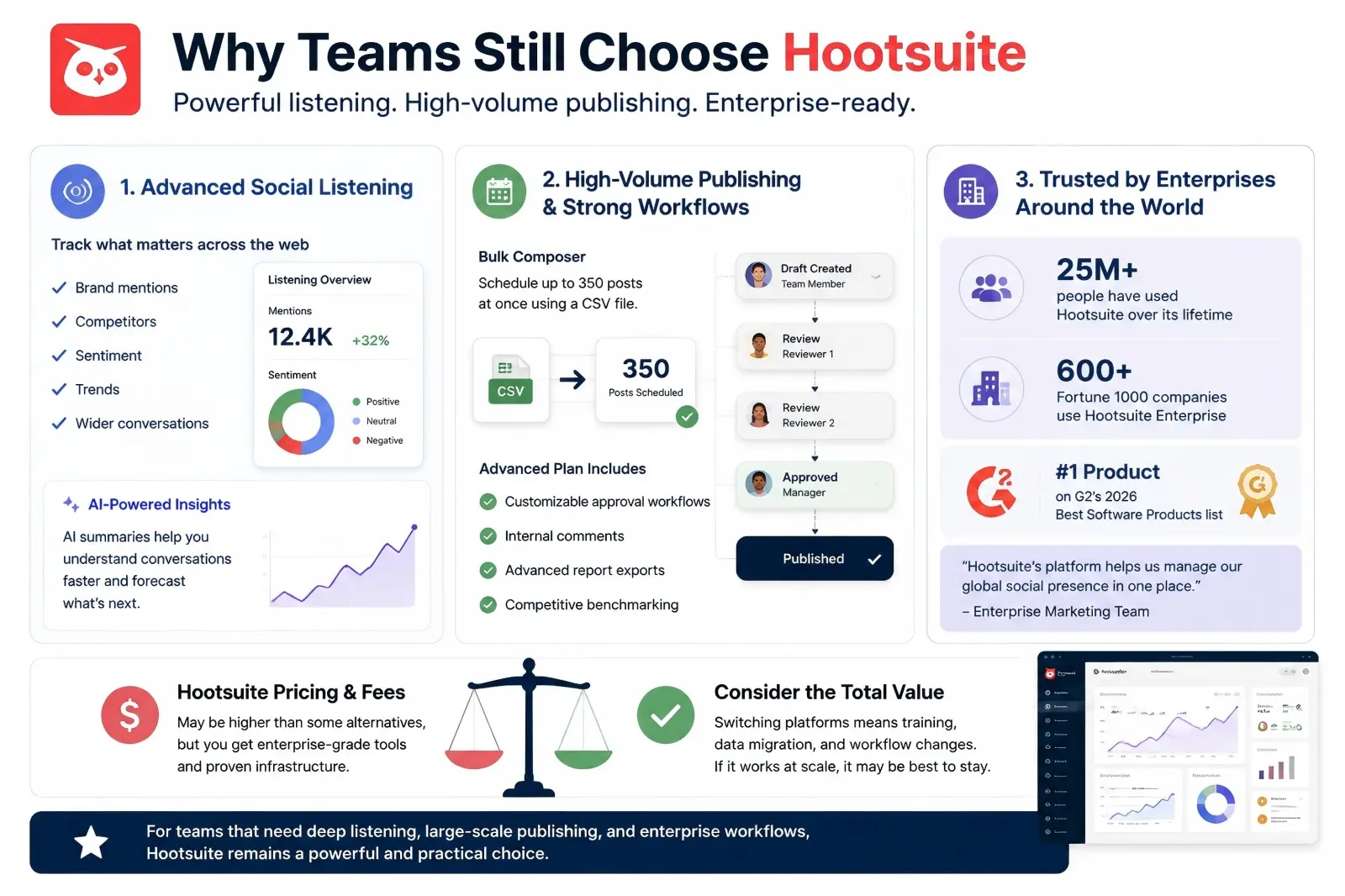
Not every team needs to switch. Some Hootsuite alternatives offer lower prices or simpler workflows, but Hootsuite still has an advantage when social media operations become large and complex. If your team already depends on its listening, bulk publishing, reporting, and approval tools, the cost and effort of moving may outweigh the savings.
When Hootsuite May Be Better Than Hootsuite Alternatives
Hootsuite remains a strong choice for teams that rely heavily on social listening. Its current listening tools can track brand mentions, competitors, sentiment, trends, and wider online conversations. Hootsuite has also expanded this area with AI-powered summaries and forecasting. If listening data feeds into your PR, customer research, or campaign planning, a cheaper scheduler may not offer the same depth.
High-volume publishing is another reason to stay. Hootsuite's Bulk Composer can schedule up to 350 posts from a CSV file at once, which is useful for large campaigns or teams managing many accounts. Its Advanced plan also includes customizable approval workflows, internal comments, advanced report exports, and competitive benchmarking. For example, a global marketing team can move content through several reviewers before publishing while keeping approval records in one system.
Finally, established enterprises may value Hootsuite's track record and existing infrastructure. Hootsuite says more than 25 million people have used the platform, and more than 600 Fortune 1000 companies use its Enterprise product. Hootsuite pricing and total Hootsuite fees may be higher than some alternatives, but switching platforms also brings training, migration, and workflow costs. If your current setup already works at scale, staying with Hootsuite can sometimes be more practical than choosing a cheaper replacement.
Agency Note: Scheduling Tools Cannot Fix Multi-Account Session Risk
When agencies compare Hootsuite alternatives, price and publishing features are only part of the picture. Tools like Hootsuite can manage scheduling, messages, analytics, approvals, and social listening, but they do not replace the browser sessions used when staff log in directly to social platforms. For teams managing many client accounts, that separate layer still needs attention.
Multi-Account Risk Beyond Hootsuite Alternatives
Direct account work often happens outside the scheduler. A team member may need to open Facebook, TikTok, LinkedIn, or another platform to change settings, handle features not supported through an API, or complete account verification. If many client accounts are handled in the same browser profile, cookies, local storage, login sessions, and other browser data can become harder to keep organized. Platforms may also use device and session signals as part of their security checks, so frequent account switching can sometimes lead to extra verification or login reviews.
This does not mean separate browser profiles can guarantee that an account will never face restrictions. Platform rules, account history, login patterns, content, and many other factors can affect account status. The practical goal is simpler: keep client sessions separate, reduce accidental account mix-ups, and make it clearer which environment belongs to each account.
Recommended Agency Workflow for Multi-Account Management
A practical agency setup can combine a scheduler with separate browser Profiles. The scheduling platform can handle calendars, publishing, reports, inbox tasks, and approvals. For direct account work, team members can use isolated browser Profiles so each client account keeps its own browser configuration and local data. DICloak, for example, lets users create separate Profiles and assign specific Profile Groups to team members.
Consider an agency managing 20 client accounts. It could use one of the Hootsuite alternatives for planned posts and reports, while staff open only the browser Profiles assigned to their clients when native platform access is needed. Managers can also control which Profiles different team members can access. This adds another factor beyond Hootsuite pricing or Hootsuite fees: the full workflow should cover both social media management and the browser-level account work that happens around it.
Most Hootsuite alternatives focus on publishing, analytics, inbox management, and content planning. However, teams that manage many social media accounts may face another challenge: keeping different account sessions organized while several people work on them. In this type of workflow, an antidetect browser can serve a different role from a traditional social media management platform. Teams can use DICloak alongside scheduling or analytics tools when they need separate browser Profiles, bulk browser operations, or more control over who can access each account.
Managing Multiple Accounts Securely and Efficiently
Social media managers often work with several brand, client, or regional accounts at the same time. Instead of logging in and out of the same browser session, operators can create separate browser Profiles in DICloak. Each Profile keeps its own browser settings, cache, account information, and other local data. Users can also configure proxies for individual Profiles when their workflow requires different network settings. This setup may help teams keep account sessions more clearly separated and reduce mistakes caused by mixing cookies or login data between accounts.
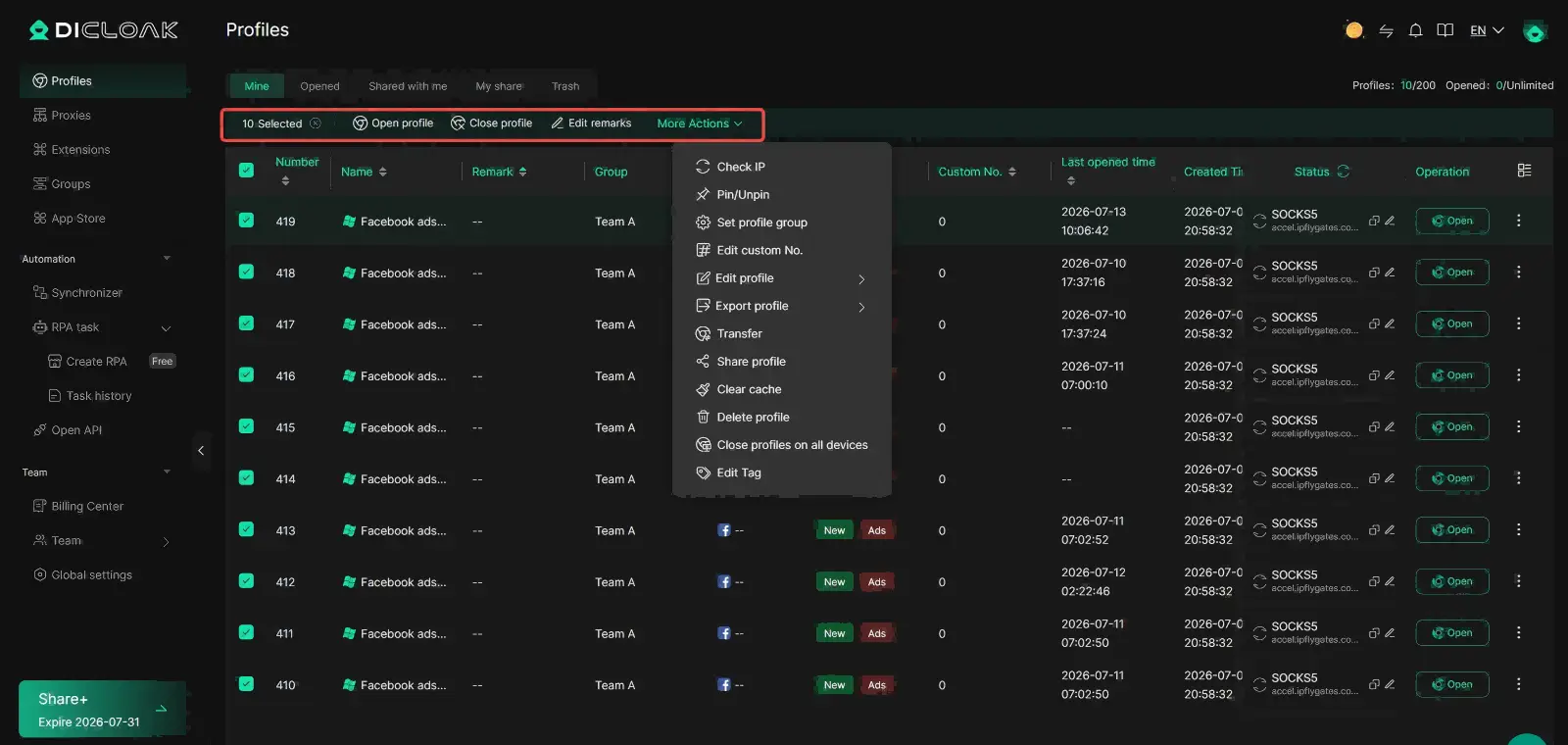
For example, an agency managing Facebook, TikTok, and X accounts for several clients could place each client's accounts in separate Profile Groups. Team members could then open only the Profiles assigned to their projects instead of searching through one large list of logins. DICloak also supports batch actions for Profiles, including opening, closing, editing, grouping, importing, and updating multiple Profiles. These tools may be useful when the number of managed accounts grows beyond what is comfortable to handle one by one. Teams should still follow the account and automation rules of each social platform they use.
Customizable Automation for Bulk Social Media Tasks
Repetitive browser work can take up a large part of a social media operator's day. Users who handle similar steps across many Profiles can use DICloak's RPA tools to build repeatable browser workflows and choose whether a task runs once, several times, or on a recurring schedule. This can be useful for routine browser-based tasks that would otherwise require the same sequence of clicks and inputs across many accounts.
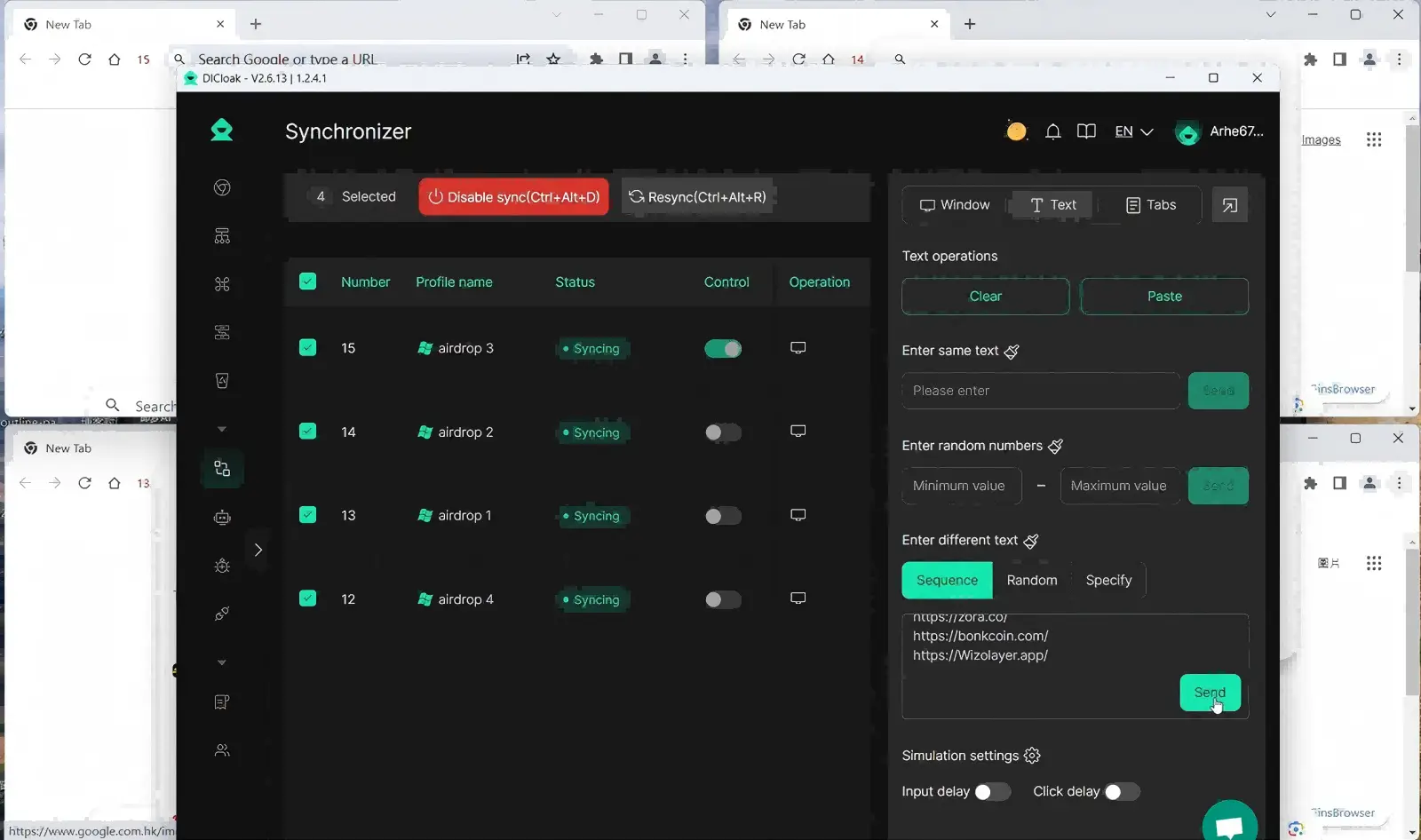
Teams can also use the window Synchronizer when they need to repeat the same manual action across selected browser Profiles. One Profile acts as the main window, while selected windows can follow actions such as clicks, text input, scrolling, tab changes, and opening URLs. For example, an operator preparing several campaign accounts could use the feature for repetitive setup steps instead of repeating every action manually. This does not replace the scheduling and analytics functions found in traditional Hootsuite alternatives, but it can reduce some of the browser-level work around multi-account operations.
Collaboration Tools for Teams Handling Social Media
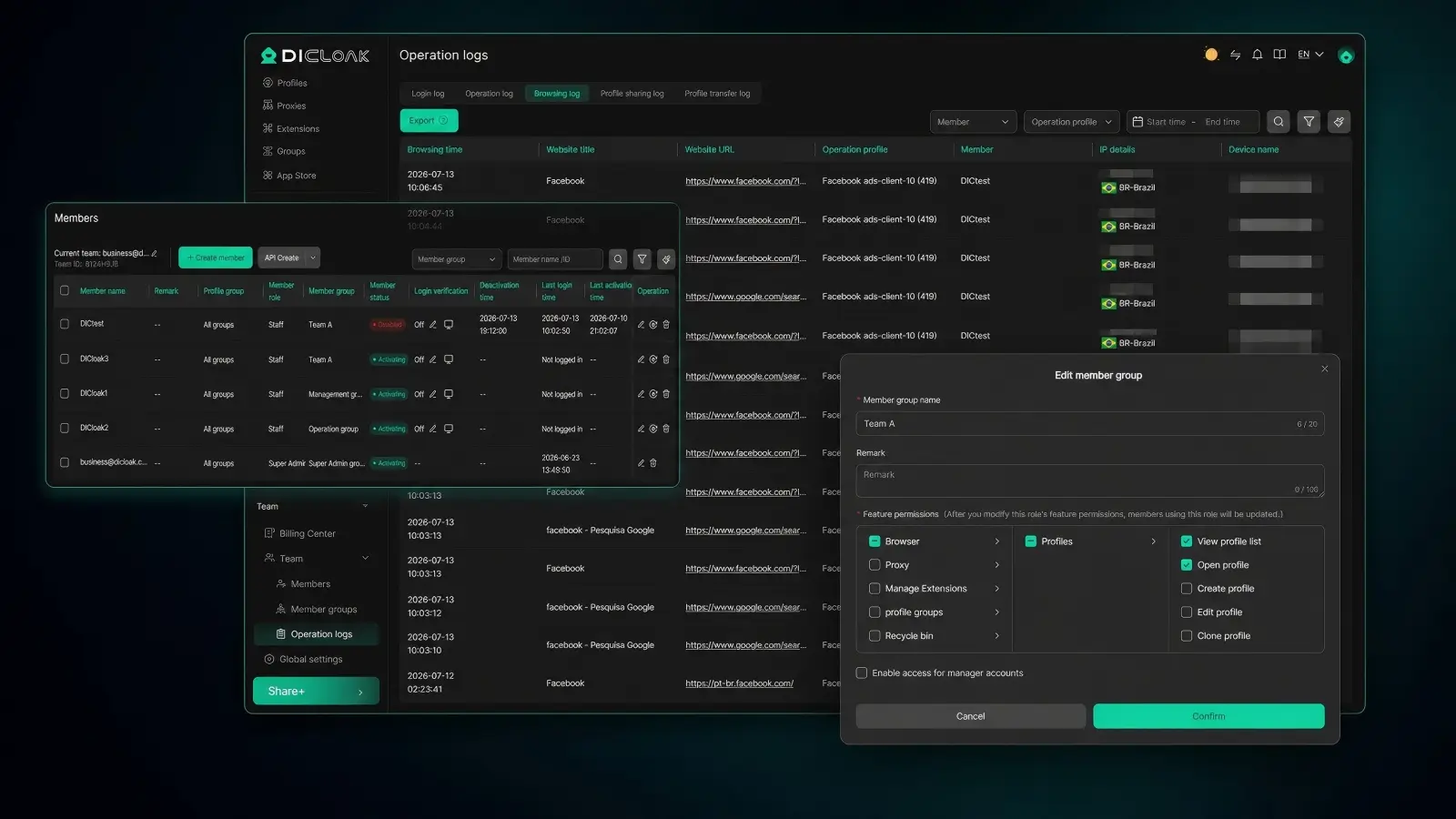
Multi-account management becomes harder when several employees need different levels of access. Rather than giving every team member the same permissions, managers can organize staff into Member Groups and decide which functions each group can use. They can also assign specific Profile Groups to individual members and set access times when needed. For example, a content operator could receive access only to the Profiles needed for daily posting, while a manager could have broader control over Profiles, proxies, and team settings.
Teams can also control which Profile fields members can see and review member activity through available management settings. This can make account handoffs easier when several people work on the same client portfolio. Instead of sharing browser credentials through spreadsheets or chat messages, teams can organize access around roles and assigned Profiles. For agencies comparing Hootsuite alternatives, this makes DICloak more useful as a supporting multi-account workspace rather than a direct replacement for a social media scheduler.
Frequently Asked Questions About Hootsuite Alternatives
What are the best Hootsuite alternatives in 2026?
The best Hootsuite alternatives depend on your needs. Buffer and Metricool suit smaller teams, while Sprout Social, Agorapulse, SocialPilot, and Sendible offer more advanced features for agencies and larger businesses.
Are there any free alternatives to Hootsuite?
Yes. Buffer, Metricool, and Publer all offer free plans. These free social media management tools usually limit social accounts, scheduled posts, users, or advanced analytics.
Why are businesses looking for a Hootsuite replacement?
Many businesses look for a Hootsuite replacement because of pricing, team size, or workflow needs. Some want lower costs, a simpler interface, stronger reporting, or more flexible collaboration tools.
Are Hootsuite alternatives cheaper than Hootsuite?
Some Hootsuite alternatives cost less, especially for solo users and small teams. However, total costs depend on users, social accounts, reports, and add-ons, so it is better to compare full Hootsuite pricing with each competitor.
Yes. Most tools like Hootsuite can manage multiple social accounts for scheduling, analytics, and engagement. Teams that also need separate browser Profiles or controlled account access may use a tool such as DICloak alongside their social media platform.
Conclusion
The best Hootsuite alternatives in 2026 are not simply the cheapest tools or the ones with the longest feature lists. The right choice depends on your team size, budget, social channels, reporting needs, and whether you need advanced social listening or approval workflows.
Solo creators may get enough value from lower-cost tools such as Buffer or Metricool. Agencies may prefer platforms like SocialPilot, Sendible, or Agorapulse for client work and team collaboration. Large brands may need deeper listening, reporting, and governance from tools such as Sprout Social, Brandwatch, or Emplifi.
Before switching, compare the full cost instead of only the starting price. Hootsuite pricing may be higher than some alternatives, but lower Hootsuite fees do not always mean better value if the replacement lacks features your team relies on. Test the tool with real workflows, including publishing, approvals, reporting, integrations, and account management.
For agencies handling many client accounts, it can also make sense to separate social scheduling from browser-level account work. A scheduling platform can manage content and reporting, while separate browser Profiles can help teams keep direct account sessions organized.
In the end, the best Hootsuite alternative is the one that fits your actual workflow today and still makes sense as your team grows.
 Web Proxy Tools
 Free Tools
 Cookie Plugin
 UA Generator
 MAC Address Generator
 IP Generator
 IP Address List
 2FA Code Generator
 World Clock
 Anonymous Check
 WebRTC Leak Test
 UUID Generator
 Free Web Proxy Site
 Proxy Checker
 FB Ad Checker
 AI Web Scraping
 Free SMM Tools
 Twitter Shadowban Checker
 Instagram Name Checker
 UTM Generator
 Username Generator
 AI Hashtag Generator
 LinkedIn Headline Generator
 Social Media Image Resizer